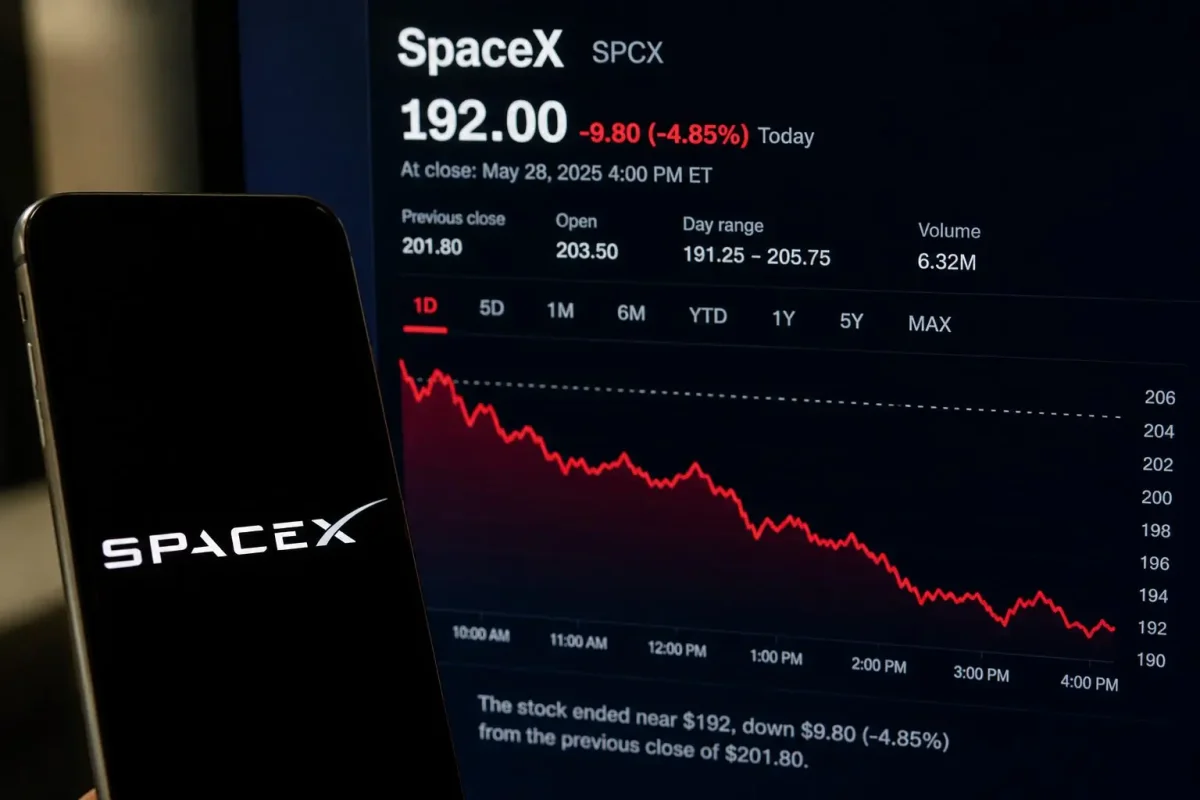
NEW YORK, June 17, 2026 – SpaceX shares tumbled approximately 5% on Wednesday, logging their first full-session decline since the company’s public debut last week. The stock closed just under $192 after touching an intraday low near $187, reversing part of the rally that had briefly pushed the company past both Amazon and Microsoft in market capitalization.
Market Context
The broader market retreated after the Federal Reserve held interest rates steady but indicated that a rate increase could come later this year. The S&P 500 fell 1.28%, the Dow dropped 1.01%, and the Nasdaq slid 1.45%. Carson Group’s Ryan Detrick noted the key question is whether investors should expect a hike or if the Fed will hold steady.
SpaceX’s Market Cap Slips Below Amazon
SpaceX’s market capitalization fell to around $2.584 trillion after the late-day drop, according to MarketWatch, while Amazon came in at $2.598 trillion. Earlier in the week, SpaceX had briefly overtaken both Amazon and Microsoft in market value. The stock had closed Tuesday at $201.80, putting its market cap at roughly $2.655 trillion.
Options Activity and Volatility
Options trading has been a key driver of SpaceX’s volatility. Reuters reported that more than 1 million SpaceX options had traded by early Tuesday afternoon. Joe Saluzzi of Themis Trading described the stock as “one of those meme stocks,” while Brent Kochuba of SpotGamma noted that traders “can’t hedge SpaceX” with any other instrument.
Valuation Concerns
Morningstar analyst Nicolas Owens reiterated a “significantly overvalued” rating on Wednesday, cutting the fair value estimate to $62 from $63. The downgrade followed SpaceX’s $60 billion equity issuance related to the Cursor AI coding platform acquisition. Owens warned that the current stock price assumes rapid Starship reusability and commercial orbital data center success, both of which remain uncertain.
Analyst and Investor Sentiment
Some market participants had expressed caution even before Wednesday’s drop. Todd Schoenberger, CIO at Crosscheck Management, questioned whether investors are “investing in SpaceX or trading SpaceX.” Jake Dollarhide, CEO of Longbow Asset Management, warned that expiring lock-up periods could lead to “selling pressure.”
Index Inclusion and Passive Support
SpaceX is set to join the Nasdaq 100, along with select MSCI and Russell large-cap benchmarks, according to Reuters. Funds tracking those indexes may be forced to buy shares on inclusion. Kevin Moss, who helped create the Private Shares Fund, noted that regardless of retail investors’ views on valuation, many may hold the stock through retirement accounts or index funds.
Outlook
The trade is not one-sided. Passive funds could provide support through forced buying, but the higher valuation, new supply from unlocked shares, and a potentially tighter rate environment could weigh on the stock if buyers hold back. The next test comes ahead of a shortened trading week: U.S. equity and options markets will be closed on Friday, June 19, for Juneteenth, giving investors just one session to adjust after SpaceX logged its first drop as a public company.