Tesla shares traded near flat Thursday afternoon, erasing an early advance as the market digested SpaceX's initial public offering filing and new details about financial ties between Elon Musk's companies. The stock, which opened at $422.35 and rose as high as $426.79, was last seen at $417.23, mirroring a broader tech pullback with the SPY ETF down 0.3% and the QQQ slipping 0.5%.
SpaceX's IPO filing sharpened the debate over whether a public listing of the rocket company would enhance or dilute what some analysts call Tesla's "Musk ecosystem" premium. Dan Ives of Wedbush Securities predicted the two companies could eventually merge in 2027, while Dennis Dick of Triple D Trading questioned whether Tesla loses some of its luster once investors have an alternative way to bet on Musk.
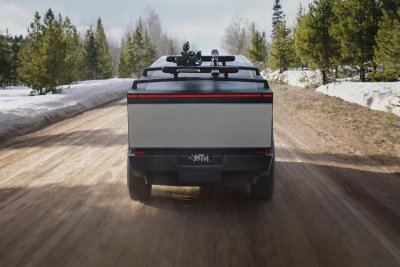
The filing also revealed that SpaceX and xAI purchased approximately $650 million in goods and services from Tesla last year, including $506 million of Megapack battery systems and $131 million of Cybertrucks. Tesla's own quarterly filing showed a $2 billion investment in SpaceX common stock in March and $87 million in first-quarter revenue from Megapack orders placed by SpaceX. These related-party transactions are expected to face increased scrutiny as SpaceX moves toward its public debut on Nasdaq.
Beyond the intercompany dynamics, Tesla's core business continues to face significant spending demands. The company reported first-quarter revenue of $22.39 billion, up 16% year over year, with net income of $477 million. It delivered 358,023 vehicles and deployed 8.8 gigawatt-hours of energy storage products. Capital expenditures reached $2.49 billion in the quarter, and Tesla expects to spend more than $25 billion in 2026 on AI, compute infrastructure, data centers, manufacturing, and charging expansion.
In a move to broaden its software reach, Tesla announced that Full Self-Driving Supervised is now available in China, according to CnEVPost. The advanced driver-assistance system still requires active driver supervision and does not make the vehicle autonomous. The expansion comes as Chinese rival Xpeng began mass production of its first robotaxi in Guangzhou, targeting fully driverless operations by early 2027, Reuters reported.
Musk reiterated his bold timeline this week, predicting that cars without human safety monitors will become more widespread in the U.S. later this year and that AI will handle "probably 90% of all distance driven" within five to 10 years. However, Reuters noted that Tesla's robotaxi operations in Austin, Dallas, and Houston still suffer from long waits and limited availability.
The risk for Tesla is that the narrative outpaces execution. A public SpaceX could divert some Musk-focused capital, while related-party transactions may raise governance concerns. Delays in robotaxi deployment, slower-than-expected software adoption in China, or weak returns on AI infrastructure spending could make the company's heavy capital outlays harder for investors to justify. For now, the stock's subdued action suggests the market is taking a wait-and-see approach.