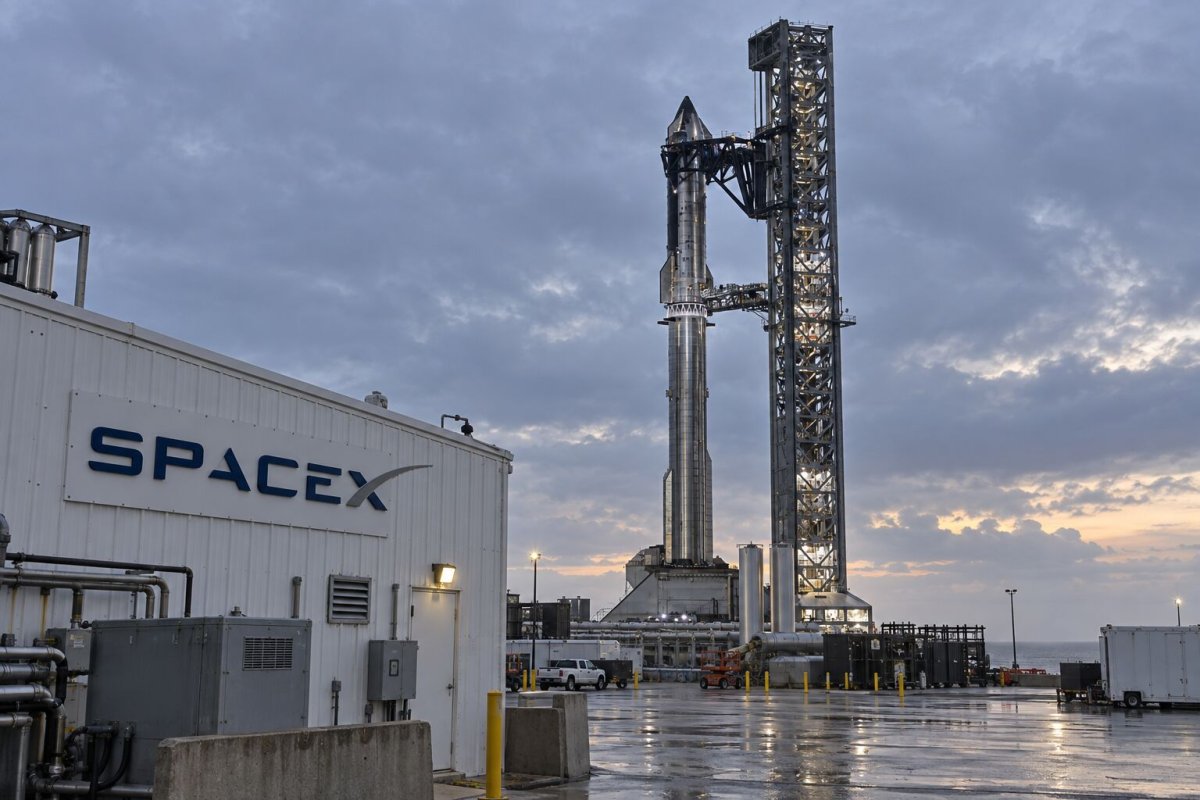
SpaceX's stock closed at $153.47 on Tuesday, a 3.7% gain that lifted the newly public rocket, satellite, and artificial intelligence company's market capitalization to approximately $2.02 trillion. The rally intensifies the spotlight on Chief Financial Officer Bret Johnsen, who is scheduled to speak at the Goldman Sachs Communacopia and Technology Conference on Thursday at 12:25 p.m. Pacific time. Investors are eager to hear how the company plans to bridge the gap between its impressive adjusted earnings and the substantial cash outflows required to fund its ambitious expansion across Starship, Starlink, and AI compute infrastructure.
Valuation at a Glance
The $2 trillion valuation translates to roughly 65 times the company's annualized revenue run-rate, based on its second-quarter revenue of $7.814 billion. With about 13.18 billion Class A and Class B shares outstanding as of July 28, the market cap aligns with the current quote data. Even after subtracting net cash of approximately $61.6 billion, the enterprise value-to-sales ratio stands at a steep 62.8 times. Adjusted EBITDA for the quarter was $3.538 billion, up from $1.214 billion a year earlier, but the equity is valued at about 143 times that annualized figure.
Cash Position and Capital Allocation
SpaceX ended June with a robust cash position: $93.522 billion in cash and equivalents plus $6.487 billion in marketable securities. The company's June initial public offering raised approximately $85.7 billion in net proceeds after selling 638.9 million shares, including the underwriters' option. The stock now trades 13.7% above its $135 IPO price. Additionally, SpaceX issued $25 billion in senior notes with coupons ranging from 5.35% to 6.65%, and no material principal due before July 2031, removing near-term refinancing risks. However, the company's cash flow from operations for the first half of 2026 was $3.466 billion, while capital expenditures reached $28.476 billion, resulting in a negative free cash flow of $25.010 billion. AI investments alone consumed $23.551 billion, or 82.7% of total capex.
Key Questions for the CFO
Investors will be listening for three critical answers from Johnsen. First, how quickly will AI contracts convert into cash? SpaceX has disclosed $14.1 billion in contracted sales from cloud-services agreements, but the timing of receipts and customer concentration remain unclear. The AI segment posted $2.561 billion in Q2 revenue and $1.146 billion in adjusted EBITDA, yet it lost $1.257 billion from operations and consumed $15.828 billion in capex during the quarter. Second, can Starlink's subscriber growth offset declining ARPU? Connectivity revenue rose 66% year over year to $4.291 billion, and operating income climbed 79% to $1.656 billion, but average monthly revenue per user fell 22.4% to $66 as the service expanded internationally. Third, where is the capex ceiling? The space segment lost $542 million from operations and spent $1.174 billion on capex, while Starship Flight 13 achieved its objectives in July.
Bull vs. Bear Case
Bulls point to substantial operational leverage: total Q2 revenue surged 92% year over year, the operating loss narrowed by $827 million, and connectivity is already solidly profitable. The company's $100 billion cash cushion provides time that most capital-intensive businesses lack. However, bears argue that the valuation leaves no room for error. At over 60 times sales, any slowdown in AI deployment, weaker Starlink economics, or further capex increases could trigger a sharp re-rating. The cash balance represents only about 5% of the market cap, so liquidity alone cannot defend the stock price.
Thursday's Test
Thursday's presentation is a pivotal moment. If Johnsen can provide concrete guidance on AI capex efficiency, Starlink ARPU stabilization, and the path to positive free cash flow, the stock could justify its premium. Conversely, vague commentary or further cost escalation could undermine investor confidence. The market will be watching closely for any signals that the extraordinary spending is translating into sustainable cash generation.
