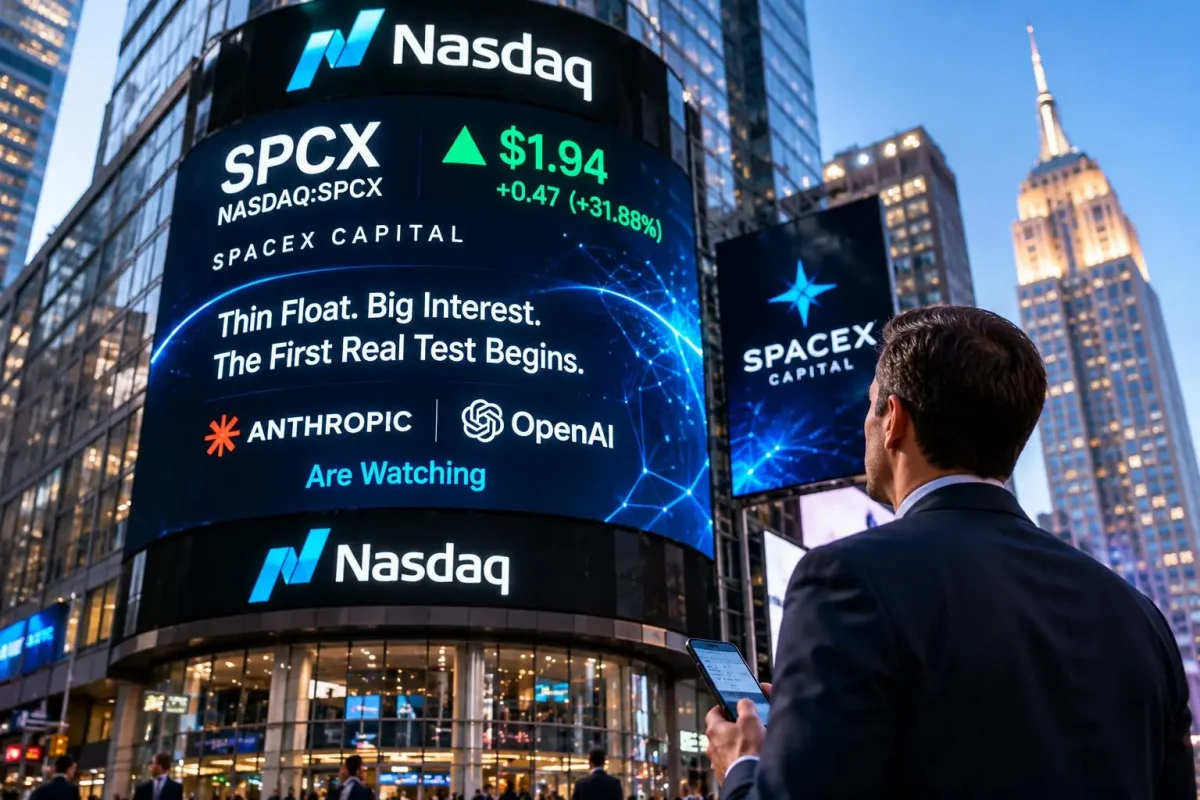
SpaceX (NASDAQ: SPCX) experienced a significant downturn, falling 21% from its recent peak to $178.35 in premarket trading. This decline underscores the volatility inherent in stocks with a limited public float, as only about 4.9% of the company's equity is available for trading. The $47 drop from the $225.64 high erased approximately $620 billion in headline market value, illustrating how a small number of traded shares can drive outsized price movements.
The Scarcity Premium Repricing
The recent sell-off is attributed to investors reassessing the scarcity premium embedded in SpaceX's record-breaking IPO. With the stock still 32.1% above its $135 offer price, the market is experiencing its first live test of whether a mega-cap issuer can float less than 5% of its implied equity while maintaining orderly price discovery. This scenario is particularly relevant for Anthropic and OpenAI, which are considering similar IPO structures.
Supply Dynamics and Market Impact
The math behind the volatility is straightforward. The final prospectus offered 555.56 million shares, with an additional 83.3 million through the greenshoe, totaling 638.9 million shares. At the $135 offer price, the company was valued at approximately $1.77 trillion, implying about 13.11 billion shares. This means the IPO block represents just 4.87% of implied equity, creating a 20.5-times float multiplier. Each $1 move in SPCX changes the headline market value by about $13.11 billion, while the distributed shares see a change of only $638.9 million.
This structure amplifies the impact of index demand and price swings. The initial trading day saw over 510 million shares change hands, with retail investors receiving roughly 20% of the allocation. "Demand significantly outstripped the initial supply," noted Brian Jacobsen, chief economic strategist at Annex Wealth Management.
Index Inclusion and Passive Money
Passive money will play a role, but the effect is smaller than the $2 trillion headline suggests. Nasdaq's rules allow fast entry for large new listings, but for low-float securities, the shares used for index weighting are capped at three times free float. This would initially recognize about 14.6% of SpaceX's equity, giving an effective indexed market capitalization near $342 billion at current prices, rather than $2.34 trillion.
Implications for Anthropic and OpenAI
Anthropic's bankers now have a real market experiment to study. The company filed a confidential draft S-1 on June 1, with its latest funding round valuing it at $965 billion. "Filing shortly after SpaceX allows Anthropic to capitalize on strong investor interest," said IPOX vice president Kat Liu. The key lesson is that tight supply can support the opening valuation but makes every subsequent trade carry more informational weight.
OpenAI announced its own confidential S-1 submission on June 8, potentially seeking a valuation of up to $1 trillion. CEO Sam Altman told staff he expected an IPO within the next year. Public investors will also have to consider the company's capital intensity, with reports of $3.7 billion burned in the first quarter on $5.7 billion of revenue.
Stress Testing the Supply Scenario
Applying SpaceX's 4.87% initial distribution ratio to Anthropic's $965 billion valuation and a hypothetical $1 trillion OpenAI IPO would create approximately $95.8 billion of publicly tradable equity against $1.965 trillion of combined headline value. This is only about 12% more stock than SpaceX's $85.7 billion offering. Wall Street would not need to absorb $2 trillion; it would need to clear less than $100 billion while using that small block to establish the valuation of everything else.
Bear Case and Risks
The bear case is concentrated and asymmetric. With so little implied equity tradable, even moderate selling can overwhelm the available bid. A sustained break below Thursday's $172.11 intraday low could bring the $160.95 debut close, followed by the $150 opening price and $135 offer price. Supply will eventually expand as SpaceX's lockup permits up to 20% of specified shares to be sold.
