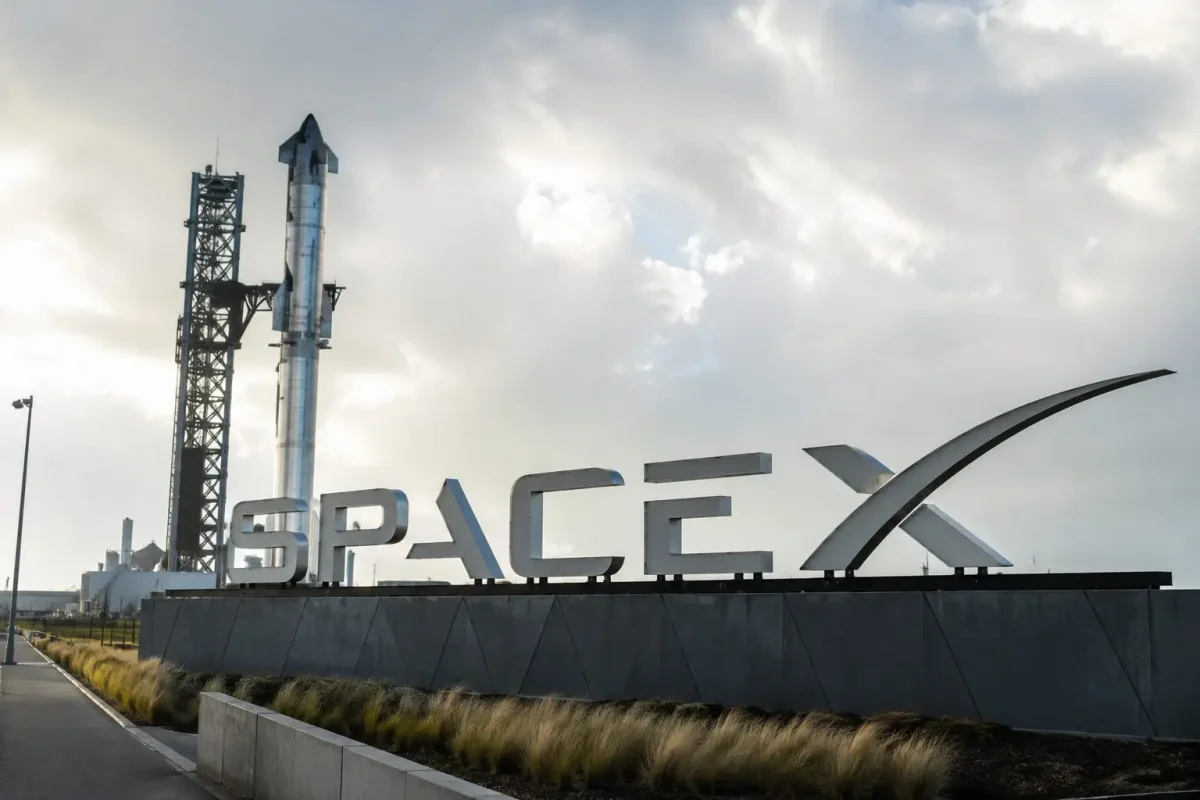
SpaceX (NASDAQ:SPCX) is gearing up for the 13th flight test of its Starship vehicle, scheduled for Thursday, July 16, following a successful full-duration static fire of all 33 Super Heavy engines. The launch window opens at 5:45 p.m. CDT and lasts 90 minutes, with operations based out of Starbase, Texas. This mission carries heightened significance for investors, as the stock has faced a challenging week, closing at $145.30 on Friday—a 4.5% daily decline and a 10.3% drop since July 2. In contrast, the Nasdaq Composite rose 1.7% over the same period, widening the gap between SpaceX and the index to about 12 points.
Commercial Payload and Capacity Milestones
Flight 13 marks a shift toward commercial objectives, with the upper stage tasked to deploy 20 Starlink V3 satellites. Each satellite is designed for downlink speeds of one terabit per second, giving the mission a total capacity of 20 Tbps. This represents roughly 6.7 times the capacity of a typical Falcon 9 batch, based on SpaceX's stated benchmark of 60 V3 satellites achieving 20 times Falcon 9 capability. The company has not provided official forecasts for these figures, but CFO Bret Johnsen has emphasized that each Starship launch carrying satellites holds "20 times the capability" of a Falcon launch. A successful deployment would validate some of these capacity claims, though it falls short of the full 60-satellite load or demonstrating rapid reuse.
Industry Context and Competitive Edge
SpaceX's vertical integration provides a distinct advantage over competitors like Amazon (NASDAQ:AMZN), whose Project Kuiper broadband network had 394 satellites in orbit as of July 2. Amazon relies on external launchers such as United Launch Alliance, Arianespace, and SpaceX itself, with around 100 launch contracts valued at least $82 billion. The gap in payload capacity is mirrored by a wider gap in launch cadence. Flight 12 occurred 55 days ago, putting the annualized rate at about 6.6 launches. Broker forecasts from Reuters project a wide range—from 1,500 to nearly 5,000 Starship launches per year by 2031—depending on reuse success. Mark Hackett, chief market strategist at Nationwide, noted "nervousness about expectations being too high," while CFRA's Keith Snyder, with a sell rating and $115 price target, awaits "growth actually to begin to materialize."
Operational and Regulatory Challenges
The static fire test on Friday generated noise that rattled South Padre Island and nearby communities, prompting local authorities to establish a safety perimeter and close Highway 4 and Boca Chica Beach for Thursday's launch. The previous flight, Flight 12 on May 22, saw the upper stage successfully deploy dummy satellites and splash down in the Indian Ocean, but the Super Heavy booster lost control and crashed into the Gulf of Mexico. The FAA opened a mishap investigation, confirming no injuries or property damage. Any further issues—hardware failures, regulatory delays, or weather—could postpone V3 satellite deployment and keep Starlink reliant on the smaller Falcon 9, as noted in SpaceX's prospectus.
Investor Focus and Key Metrics
This week, investors are zeroing in on four critical numbers: the planned deployment of 20 satellites, one engine relight in space, two controlled ocean splashdowns, and the countdown to Flight 14. The first three will determine if Flight 13 meets its objectives, while the last will test Wall Street's timing bets on SpaceX's ambitious growth trajectory. A flawless mission would not prove the system can handle 60 satellites, rapid booster turnaround, or thousands of launches annually, but it would mark a step toward validating the company's long-term vision.