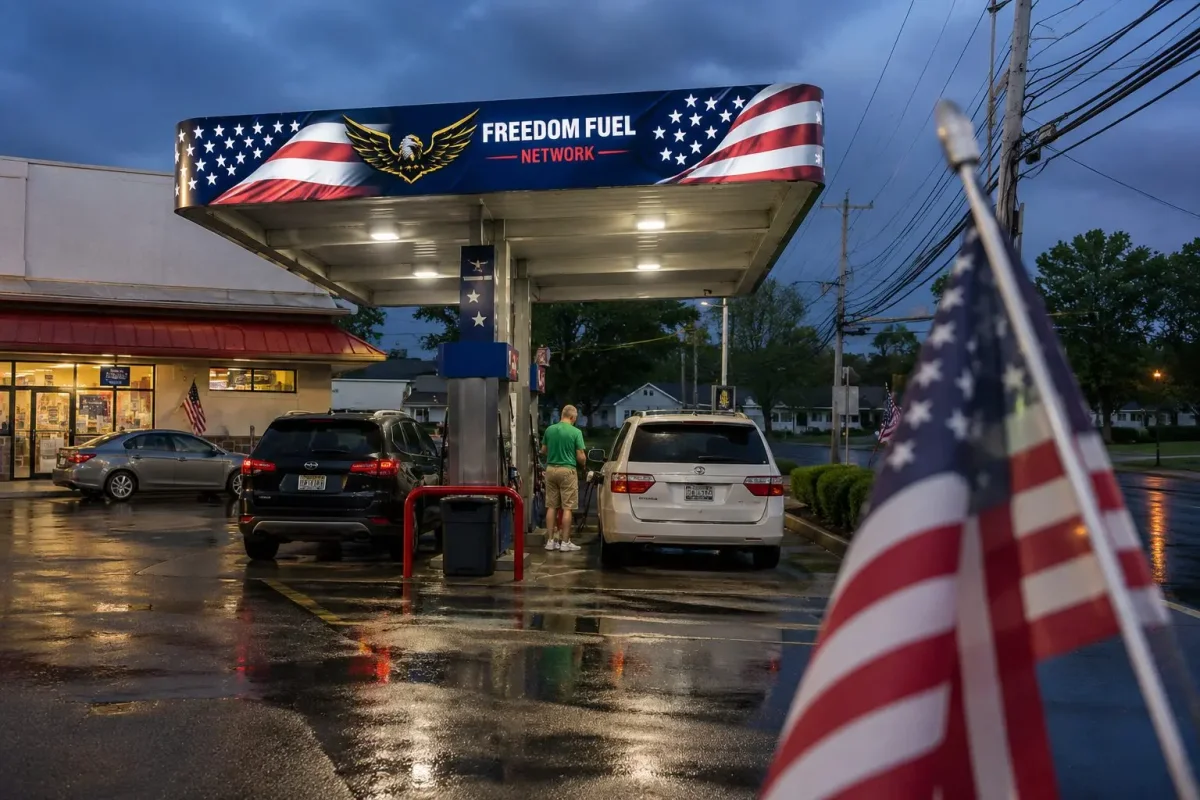
PHILADELPHIA – Freedom Fuel Network, the gasoline retailer promoted by former President Donald Trump, has announced a more than 50% increase in gasoline volumes since its launch. However, the surge in sales may be undermining the company's financial health, as the promised $3.47 per gallon price now appears unsustainable given current wholesale costs.
Using Pennsylvania's July 9 wholesale price and the original rack-to-break-even spread, the $3.47 pump price implies a fuel-only loss of approximately 31 cents per gallon. For a typical station selling 102,000 gallons per month—based on industry analyst Tom Kloza's earlier estimate and the reported volume growth—the modeled shortfall reaches about $31,600 monthly, excluding fees, payroll, utilities, and rent. The White House has stated that no government or third-party subsidies support the price.
The loss-leader strategy, selling fuel below cost, typically relies on in-store purchases to offset losses. Yet, the broader market context is challenging. U.S. gasoline inventories began July at their lowest since 2021, while the 3-2-1 crack spread—a measure of refining profitability—hit a record $64.58 per barrel on July 8. This tightening supply backdrop has pushed wholesale prices higher, squeezing Freedom Fuel's margins.
According to AAA, the average price for regular gasoline in Pennsylvania was $3.972 on Sunday, while New Jersey's average stood at $3.930. GasBuddy data from Friday showed most Freedom Fuel stations had raised prices to $3.57 or higher, narrowing but not eliminating the discount. The gap between the $3.47 price and break-even, estimated at $3.64 or higher on July 3, widened to 31 cents by July 9 as the Pennsylvania rack price rose from $2.89 to $3.03.
Publicly traded convenience store chains offer a stark contrast. Murphy USA Inc. (NYSE: MUSA) reported a first-quarter retail fuel margin of 25.4 cents per gallon, with total gallons up 2.1% but same-store volumes slipping 0.8%. Casey's General Stores Inc. (NASDAQ: CASY) posted a fiscal fourth-quarter fuel margin of 46.9 cents per gallon (excluding card fees), with comparable-store gallons rising 1.5% and an inside margin of 42.4%. CEO Darren Rebelez emphasized "balancing gallons sold with fuel margin."
The financial challenge for Freedom Fuel operators is stark. To offset a $31,620 monthly fuel loss at $3.47, a station would need roughly $74,600 in additional in-store sales per month—about $2,500 per day—using Casey's 42.4% inside margin as a benchmark. That figure rises if the station sells more fuel, as each additional gallon adds to the loss. At 102,000 gallons, a 10-cent swing in wholesale costs changes monthly gross by $10,200.
The Philadelphia Inquirer reported that one visited store in the program was not operational, and others appeared small, run-down, or offered limited merchandise. "It's difficult to see how these stations are making money," said Jeff Lenard of the National Association of Convenience Stores, noting that such locations typically rely heavily on fuel margins. The spot-price model does not account for cheaper inventory, supply contracts, rebates, or varying delivery costs and taxes.
U.S. markets were closed Sunday, but the national average gasoline price climbed 6 cents to $3.88 over the past week—the biggest jump since mid-May. Gasoline inventories fell to 212.1 million barrels, about 10 million below the five-year average. Brent crude ended Friday at $76.01 a barrel, up 5.5% on the week, while West Texas Intermediate settled at $71.41, up nearly 4%. WTI futures resume trading Sunday at 6 p.m. EDT, ahead of the equities open Monday, when markets will react to President Trump's claim that the Strait of Hormuz is open amid ongoing U.S.-Iran hostilities. OPEC's monthly market report is due Monday, followed by the EIA inventory report on Wednesday.
Freedom Fuel's 50% volume claim underscores strong demand for cheap gasoline, but without transparency on procurement terms and store-level profitability, it does not prove long-term viability. The network's ability to sustain its price promise hinges on whether in-store sales can offset mounting fuel losses—a tall order given the current inventory and margin environment.