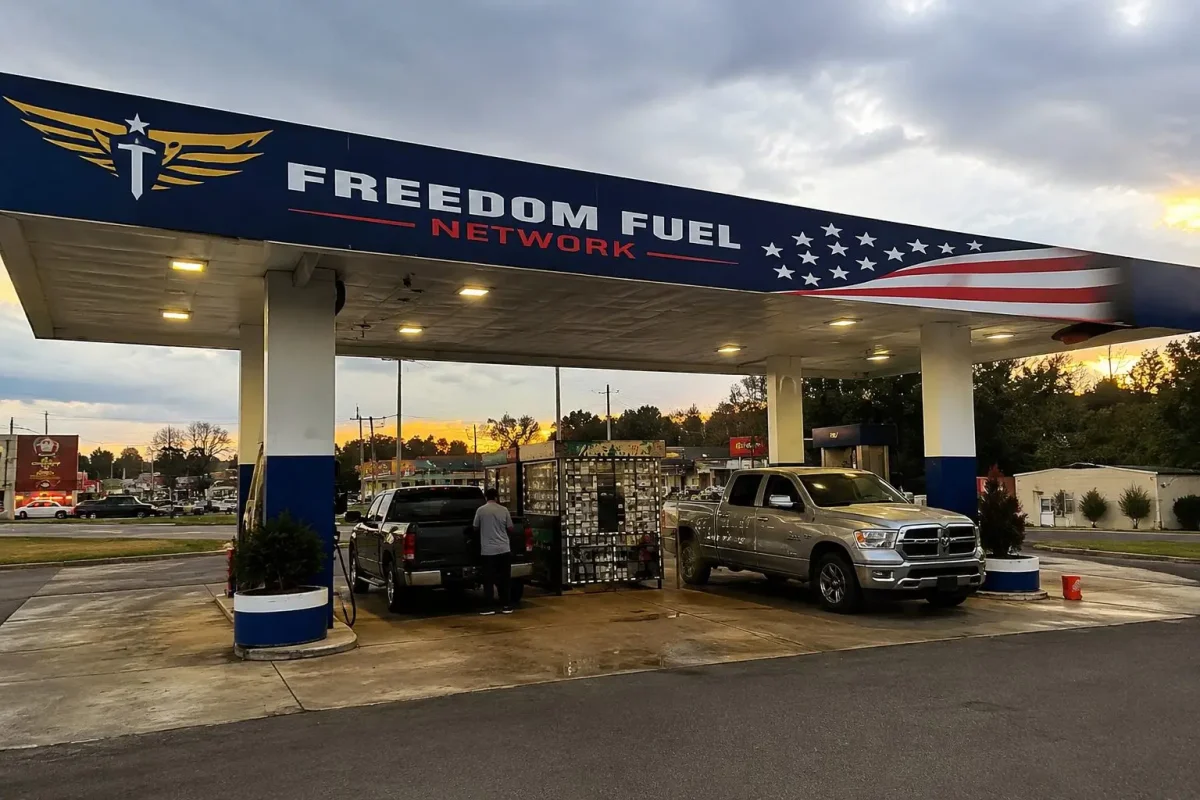
Philadelphia, July 11, 2026 – Freedom Fuel Network's retail price increases in its inaugural week have failed to keep pace with the surge in wholesale gasoline costs, raising red flags about the long-term viability of the initiative championed by President Donald Trump. At a station in Bristol, Pennsylvania, regular gasoline was priced at $3.57 per gallon on Friday, just 10 cents above the $3.47 launch price touted by the president last week. In contrast, the wholesale benchmark price has climbed 14 cents.
Widening Margin Gap
The Pennsylvania OPIS rack price, which represents the terminal rate before taxes and delivery, rose to $3.03 per gallon on July 9 from $2.89 at launch. After incorporating state and federal gasoline taxes—approximately 57 cents for Pennsylvania and 18 cents federally—the benchmark reaches about $3.78 before factoring in freight and card processing fees. This leaves a 21-cent difference at the pump, widening from the 17-cent gap observed on July 3. Tom Kloza, chief energy adviser at Gulf Oil, described the business model as "jumping off a cliff."
Unit Economics Under Pressure
The financial strain is evident in the unit economics. For a station selling 68,000 gallons per month, the modeled monthly gap increased from $11,560 at launch to $14,280 by July 9-10. This estimate does not include delivery, payment processing, wages, or overhead costs. Freedom Fuel has not disclosed its contracted supply cost, leaving analysts to speculate on the true profitability.
Without a baseline for previous sales volumes, the reported revenue boost is ambiguous. Freedom Fuel noted a 50% increase in average sales at its 25 stations, with some outlets more than doubling, but did not specify starting volumes. If each of its 20 Pennsylvania locations was selling the national station average of 68,000 gallons per month, the current margin would result in a total fuel shortfall of approximately $285,600. With a 50% volume increase, that deficit would climb to around $428,400. Each additional 10,000 gallons sold at the same gap adds $2,100 in losses.
Broader Market Context
U.S. markets were closed for the weekend, but replacement cost pressures intensified. West Texas Intermediate crude rose 4% for the week, closing at $71.41 per barrel on Friday, while Brent finished at $76.01, up 5.4%. AAA reported regular gas at $3.963 in Philadelphia’s Pennsylvania side and $3.882 nationally on Saturday, placing the Bristol price roughly 39 cents and 31 cents lower, respectively.
U.S. gasoline stocks dropped by 1.9 million barrels last week to 212.1 million, nearly 10 million barrels below the five-year average. Petroleum-product exports hit a weekly record of 8.7 million barrels per day. "Gasoline prices have rallied alongside the massive move higher in crude oil," said Alex Hodes, energy analyst at StoneX Group (NASDAQ: SNEX).
Comparative Margins
Fuel sellers with public market listings provide context for margin expectations. Casey's General Stores (NASDAQ: CASY) posted a fuel gross margin of about 42.6 cents per gallon for its last fiscal year. Murphy USA (NYSE: MUSA) reported 25.4 cents in the first quarter, with CEO Mindy West describing the model as a "low-cost high volume operating model." Freedom Fuel's estimated negative margin of 21.0 cents per gallon as of July 9-10 stands in stark contrast.
Definitions vary, as Freedom Fuel uses a spot cost estimate while peers report company-derived margins that do not represent final operating profit.
In-Store Sales as a Lifeline
To offset the $14,280 fuel margin gap, Freedom Fuel would need to generate an additional $34,000 to $71,000 per month in store sales, without accounting for extra labor and card fees. This could prove challenging at some locations. The Philadelphia Inquirer found several sites with small or bare-bones stores and noted that the Brookhaven location was closed. "It's difficult to see how these stations are making money," said Jeff Lenard of the National Association of Convenience Stores.
Uncertain Future
Details on ownership and funding remain scarce. A Delaware company filed for the Freedom Fuel trademark on July 1, but the company website has not disclosed its backers or financials. The White House has stated that Freedom Fuel is private and not receiving federal funds. "Stations selling at this price, it's not sustainable," said Patrick De Haan, head of petroleum analysis at GasBuddy.
The estimate does not cover a full profit and loss statement. A supplier rebate, lower contract price, cheaper freight, or a boost in store sales could help bridge the gap. Lower wholesale prices would also provide relief. Conversely, if crude or terminal prices rise further while pump prices remain capped, losses on advertised volume will worsen.
Key data points to watch include the U.S. Energy Information Administration's retail fuel price update on July 14 and its weekly petroleum supply data on July 15. For Freedom Fuel, the critical question is whether its posted prices will change again—and whether the company will release enough details for analysts to assess if in-store sales or fuel discounts can cover the growing wholesale gap.