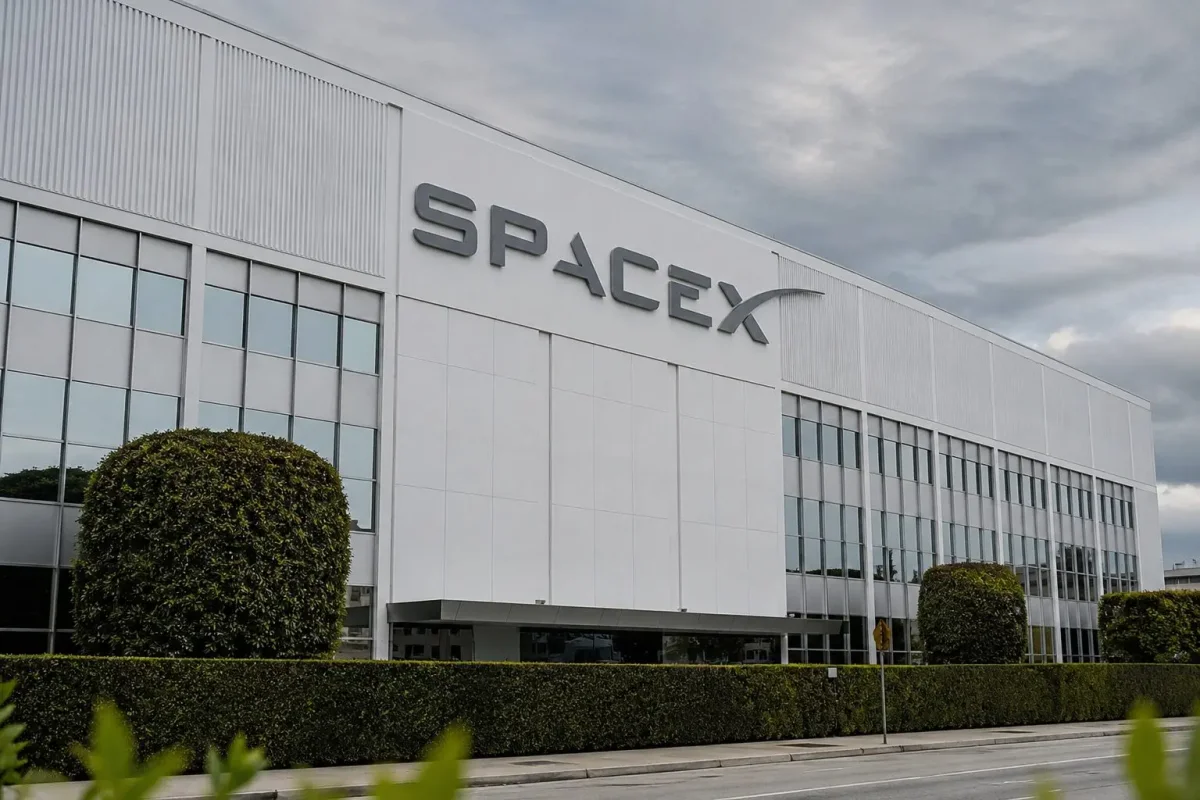
SpaceX (NASDAQ:SPCX) shares staged a remarkable recovery last week, climbing 23% to close at $133.11 on Friday, just 1.4% below its IPO price of $135. The rebound came after a volatile lockup period that saw the entry of hundreds of millions of new shares into the market, testing investor resolve and the long-term thesis of prominent bull Jim Cramer.
Lockup Expansion and Market Reaction
The initial lockup expiry on Thursday released an additional 911.5 million insider shares, swelling the total eligible float from 638.9 million to approximately 1.55 billion shares—a 143% increase. Despite this potential supply glut, SpaceX shares gained 6.1% on Thursday and added another 15.8% on Friday, demonstrating robust demand. Friday's trading volume of 242.1 million shares represented 15.6% of the expanded pool, though not all eligible shares were sold.
The weekly gain of 23% outpaced the broader market by 17.8 percentage points. For context, the Nasdaq Composite rose 5.2% and the S&P 500 gained 3.6% over the same period.
Financial Performance: Strong Growth, Heavy Spending
The company's second-quarter results, released earlier, provided a fundamental boost. Revenue surged 91.9% year-over-year to $7.814 billion, driven by strong growth across all segments. Adjusted EBITDA more than doubled to $3.538 billion, while the net loss narrowed to $541 million from $1.008 billion a year ago.
However, capital expenditures have become a focal point for investors. Total capex reached $18.369 billion in the quarter, a staggering 550% increase from the prior year, and now represents 235.1% of revenue. The bulk of this spending is directed toward AI infrastructure, which alone accounted for $15.828 billion—6.18 times the segment's revenue.
Segment Breakdown
- Connectivity: Revenue of $4.291 billion, operating income of $1.656 billion, capex of $1.367 billion (0.32x revenue).
- AI: Revenue of $2.561 billion, operating loss of $1.257 billion, capex of $15.828 billion (6.18x revenue).
- Space: Revenue of $962 million, operating loss of $542 million, capex of $1.174 billion (1.22x revenue).
Chief Financial Officer Bret Johnsen defended the spending, noting that the payback period for new compute installations is "less than one-year." The company also secured an additional $6.7 billion in cloud agreements after the quarter ended, which could support future cash flows.
Analyst Sentiment and Price Targets
Wall Street remains largely optimistic, though targets vary widely. The consensus from 28 analysts is a Buy rating with a price target of $228, implying about 71% upside from Friday's close. Notable calls include:
- Argus Research (Steve Silver): Raised to Buy, $160 target (20.2% upside).
- Piper Sandler (Alexander Potter): Neutral, lowered target to $140 (5.2% upside).
- Wells Fargo (Ken Gawrelski): Overweight, trimmed target to $215 (61.5% upside).
- Cantor Fitzgerald (Colin Canfield): Overweight, $246 target (84.8% upside).
- Needham (Ryan Koontz): Buy, $250 target (87.8% upside).
Upcoming Catalysts and Risks
Investors will watch several key events this week, including July CPI data on Wednesday, PPI on Thursday, and retail sales on Friday. These figures could influence interest rate expectations and, consequently, valuations for growth stocks like SpaceX.
Further lockup expirations are scheduled for August 20 (7% of shares) and additional tranches through December 8, though larger insider stakes are subject to extended restrictions. The company continues to burn cash, and capex levels are unlikely to moderate soon.
Jim Cramer's "100-year piece of paper" comment, made on CNBC, cited lunar business, Starship, and orbital data centers as long-term drivers. While Friday's surge shows investors can absorb supply shocks, the path to sustained profitability remains uncertain. The next validation will be whether SpaceX can convert its massive investments into free cash flow.