SUNation Energy (NASDAQ: SUNE) saw its shares jump 33% in early premarket trading on Wednesday after Suniva, its merger partner, disclosed an $835 million financing package for a second U.S. solar-cell factory. The funding significantly reduces the project's financing risk, but it does not mean today's SUNE shareholders have an $835 million asset; they are expected to own only about 1.8% of the combined company once the reverse merger closes.
SUNE was indicated at $3.16 around 6:22 a.m. ET, up 33.3% from Tuesday's close of $2.37, according to delayed Yahoo Finance data. The move came on a thin premarket tape, so the regular-session opening price and volume will be closely watched.
What Suniva's 5 Million Actually Finances
Suniva said in an SEC-filed release that it completed a mix of debt and equity financing. The package includes senior secured facilities from funds managed by Goldman Sachs Alternatives and I Squared Capital, a second-lien facility from JBA Asset Management, and equity from several investors. The company did not disclose the dollar split between debt and equity, interest rates, maturities, or the ownership issued to the new investors.
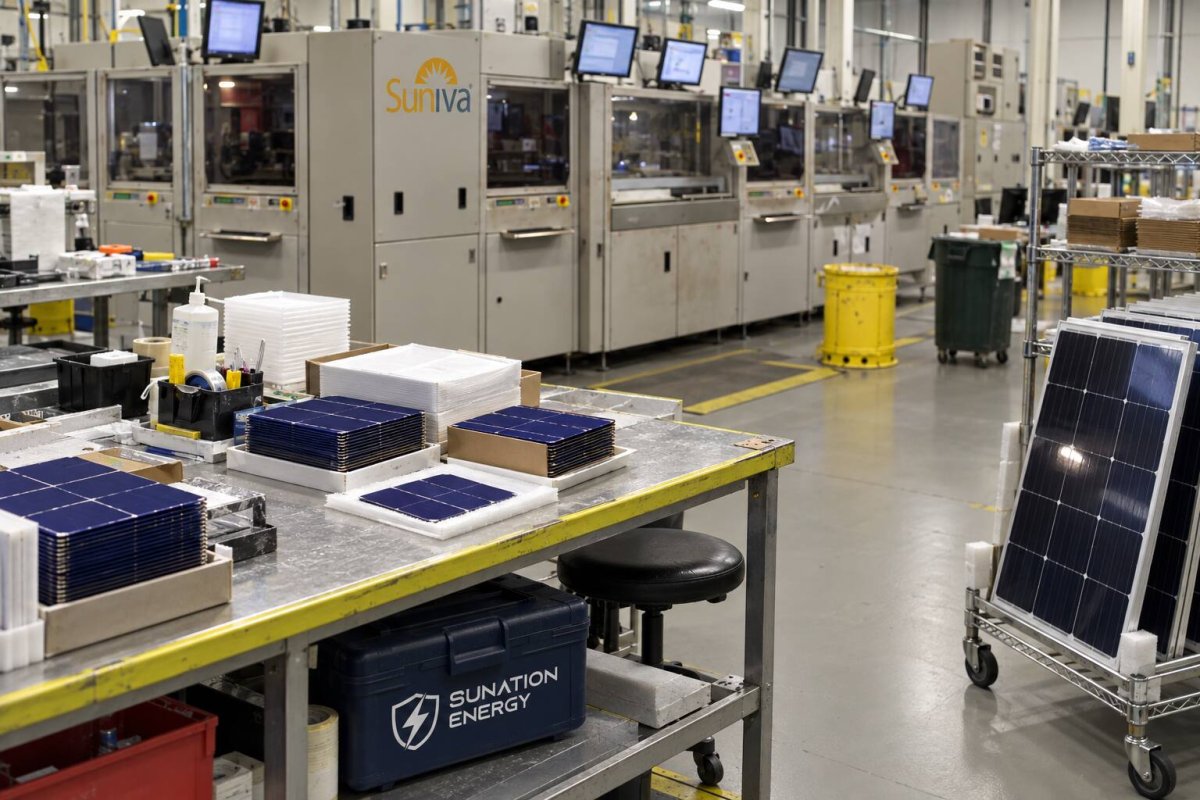
The capital is intended to fund a 4.5-gigawatt solar-cell plant in Laurens County, South Carolina, alongside Suniva's operating 1-GW Norcross, Georgia, facility. Suniva now describes the South Carolina project as an approximately $600 million investment, with completion expected in late 2027 and a full ramp in 2028. It also says long-term offtake agreements cover most planned future production.
That is more funding certainty, but also a more demanding project description. When the South Carolina Department of Commerce announced the facility in April, the stated investment was $350 million, with operations expected online in 2027. Investors need management to explain whether the higher $600 million figure reflects broader scope, equipment and working capital, inflation, or a genuine cost increase. The new late-2027 completion and 2028 ramp language is also less aggressive than the original second-quarter 2027 opening target.
The 1.8% Ownership Number Is the Valuation Anchor
SUNation is the public shell and operating installer; Suniva is the much larger economic party in the proposed combination. Under the June merger terms, pre-merger Suniva holders are expected to own roughly 98.2% of the combined company and pre-merger SUNation holders about 1.8%, subject to adjustment for SUNation's net cash at closing. All five expected directors of the combined company would be designated by Suniva.
That structure changes how the financing headline should be read. SUNE shareholders gain a small interest in a far larger, better-funded manufacturing platform, rather than direct ownership of the capital raised. A 33% rally in the legacy stock can still be rational if the financing sharply increases the probability and expected value of closing. It is not evidence that the entire $835 million belongs to the present SUNE equity base.
The September amendment adds more dilution and closing mechanics to watch. SUNation's latest Form 8-K makes an increase in authorized shares from 1.0 billion to 1.5 billion a condition of the merger and requires approval for SUNation securities issued in exchange for certain Suniva lender securities. It also relaxes SUNation's closing net-cash requirement from negative $1.5 million to negative $2.5 million, subject to capital-raise adjustments.
Why the Merger Matters to a Stressed Legacy Business
The stand-alone SUNation operation is small and under pressure. Second-quarter revenue fell 38% year over year to $8.2 million after the U.S. residential solar tax-credit reset, while the company posted a $3.34 million net loss. It had $3.1 million in cash, $13.8 million of current liabilities and a $3.2 million working-capital deficit at June 30.
Those numbers explain both the attraction and the imbalance of the transaction. SUNation contributes a Nasdaq listing and downstream installation, storage and service channels; Suniva contributes the manufacturing platform and will control nearly all the post-deal equity. The financing removes one obstacle for Suniva, but the merger still requires SUNation shareholder approvals, SEC effectiveness of the registration statement, Nasdaq clearance and satisfaction of the revised closing conditions.
What Would Confirm the Rally
The next decisive document is the proxy statement/prospectus. It should show the fully diluted share count, the debt-versus-equity financing mix, lender securities, pro forma balance sheet and any update to the 1.8% stake. Without that bridge, investors cannot reliably translate Suniva's factory plan into value per SUNE share.
For the bullish case, the $835 million package must survive into the merged company on workable terms, the transaction must close, and the South Carolina plant must progress toward commercial output without another material schedule or cost reset. The counterargument is straightforward: a fully funded factory is valuable, but current holders own a very small slice and still bear deal, leverage and construction risk. Wednesday's jump rewards de-risking; the filings still have to reveal the price.