Teradyne (TER) shares fell sharply on Wednesday, losing roughly 16% of their value to trade at $319.10, after the chip-testing equipment maker issued a cautious outlook for the second quarter that overshadowed a record-setting first quarter powered by artificial intelligence demand.
The stock slid $61.03 from Tuesday's close, hitting a session low of $307.31, erasing a significant portion of its 2026 gains and reigniting debate among investors about the sustainability of the AI testing boom. The sell-off accelerated after hours on Tuesday when the company released its guidance, according to Reuters.
Record Q1, but a Softer Q2 Ahead
Teradyne posted first-quarter revenue of $1.282 billion, an 87% increase year-over-year, with semiconductor test revenue accounting for $1.111 billion. Robotics contributed $91 million, and product test added $80 million. GAAP net income reached $398.9 million, or $2.53 per diluted share, while non-GAAP earnings came in at $2.56 per share.
However, management projected second-quarter revenue in the range of $1.15 billion to $1.25 billion, with adjusted earnings between $1.86 and $2.15 per share—well below the $2.56 reported in Q1. The midpoint of the revenue guidance still represents roughly 84% growth from a year earlier, but the sequential decline spooked investors.
AI Demand Drives 70% of Revenue
Chief Executive Greg Smith noted that approximately 70% of first-quarter revenue was tied to AI demand, calling it a record quarter and crediting the company's "wafer to AI data center strategy." He highlighted "durable AI demand drivers" but cautioned that large customer programs could result in "lumpy growth."
CFO Michelle Turner described Q1 as "an exceptional quarter" on the earnings call, but noted that gross margins are expected to decline to 58%-59% in Q2, down from 60.9% in Q1, as peak volumes and one-off gains normalize.
Competitive Landscape and Risks
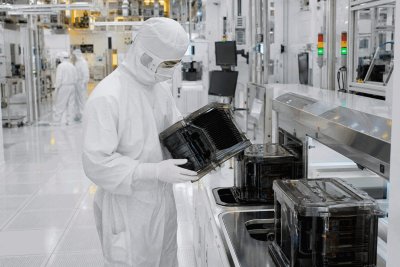
Teradyne competes with Advantest and Cohu for a slice of the AI-fueled semiconductor test market, a niche but critical segment within the chip supply chain. The company's automated test equipment (ATE) verifies chips before they leave the factory, and as AI processors, memory, and networking chips grow in complexity, demand for testing has surged.
However, the heavy reliance on AI data-center expansion and a handful of large chip projects introduces risk. Should hyperscalers reduce spending, or if supply chain disruptions delay customer timelines, revenue could become choppy. A shift back to softer mobile and industrial segments would also weigh on results.
Strategic Acquisition and Analyst Views
Earlier in April, Teradyne acquired TestInsight, a developer of semiconductor test development, validation, and conversion software. Management said the deal aims to accelerate time-to-market for AI and data-center chips, though it did not move the stock on Wednesday.
Despite the guidance disappointment, some analysts remain bullish. UBS maintained a Buy rating with a $440 price target, suggesting the long-term outlook remains intact even as near-term sentiment sours. The market's focus now shifts to whether AI spending will lift the entire test-equipment sector or if Teradyne's record quarter was a temporary peak.
For now, the stock's sharp pullback underscores the tension between strong AI-driven execution and the reality of uneven growth in a capital-intensive industry.