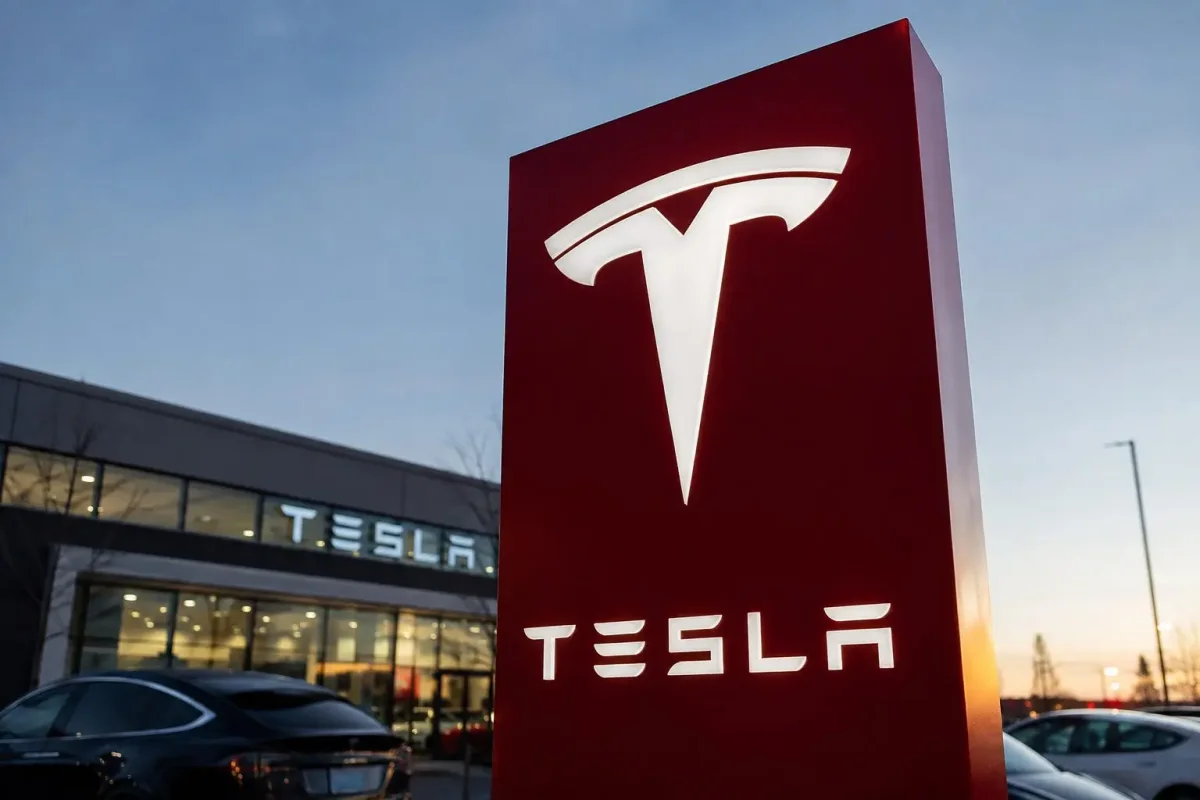
Tesla Inc. (NASDAQ:TSLA) shares advanced 3.5% in early trading on Friday, reaching $330.63 by 11:02 a.m. EDT, as investors digested the company's ambitious $16.8 billion Terafab joint venture with SpaceX. The tech-heavy Invesco QQQ Trust (NASDAQ:QQQ) rose 0.8%, reflecting broader market optimism.
The Terafab project, announced Thursday, represents a significant financial commitment for the electric vehicle maker. The initial budget of $16.8 billion accounts for 38.6% of Tesla's cash and investments as of the end of the second quarter, and is 3.6 times its quarterly operating cash flow. This substantial outlay has put the spotlight on Tesla's capital allocation strategy, especially as the company also plans to spend over $25 billion in capital expenditures for 2026, with AI infrastructure cited as a key driver.
Market Reaction and Valuation
Tesla's market capitalization now stands at approximately $1.17 trillion, nearly 15 times that of General Motors (NYSE:GM), 21 times Ford's (NYSE:F) value, and 56 times Rivian's (NASDAQ:RIVN). This premium valuation underscores the market's high expectations for Tesla's AI-related ventures, including the Terafab semiconductor facility.
The Terafab, located in Grimes County, Texas, will span 100 million square feet and focus on manufacturing, assembling, and testing advanced logic and memory semiconductors. Intel Corporation (NASDAQ:INTC) has previously joined the initiative, and Elon Musk described the facility as bringing "cutting-edge manufacturing to America."
Financial Implications and Analyst Views
Analysts remain cautiously optimistic, with a median price target of $403 per FactSet, implying a 22% upside from current levels. However, the range is wide, from $24.86 to $600, reflecting uncertainty about Tesla's AI ambitions and capital needs. There are 22 Buy or Overweight ratings, 20 Holds, and six negative ratings, keeping the consensus at Overweight.
Comparing the Terafab budget to Tesla's Q2 results provides perspective: the $16.8 billion investment is 42.2 times Tesla's operating income of $398 million and 2.9 times its fixed asset investments of $5.789 billion. While Tesla did not disclose how the funding will be split with SpaceX, the ratios assume Tesla may not finance the entire project.
Q2 Earnings Disappoint, Disclosures Raise Questions
Tesla's second-quarter results were mixed, with revenue beating estimates by 2.4% but operating income missing by 73.5%. Adjusted earnings came in 40% below forecasts. The quarter saw record deliveries, boosting revenue, but expenses offset operational leverage. Capital spending was $5.789 billion, below the consensus of $6.698 billion, while free cash flow improved by $2.162 billion to -$1.092 billion.
The financial relationship between Tesla and SpaceX is deepening. In Q2, Tesla reported $318 million in revenue from Megapack sales to SpaceX, and it purchased $2 billion worth of SpaceX stock in the first half of the year. These related-party transactions raise governance questions, especially as the Terafab joint venture adds another layer of interdependence.
Regulatory and Market Catalysts
European developments could provide a catalyst. Dutch authorities have authorized Tesla's supervised Full Self-Driving system, though comprehensive safety data has not been released. An EU-wide vote may occur in October, which could impact Tesla's autonomous driving prospects.
Despite Friday's gains, Tesla shares remain about 12% below their pre-earnings close on July 22, reflecting investor concerns about margin pressure and capital spending. The stock is still up 6.2% from its July 31 close.
Risks Ahead
Key risks include potential Terafab delays, higher costs, or low manufacturing yields, which could further strain cash flow. Regulatory obstacles for FSD and governance issues involving related parties could also weigh on Tesla's valuation premium. As Tesla embarks on this capital-intensive venture, investors will closely watch how the company balances growth ambitions with financial discipline.