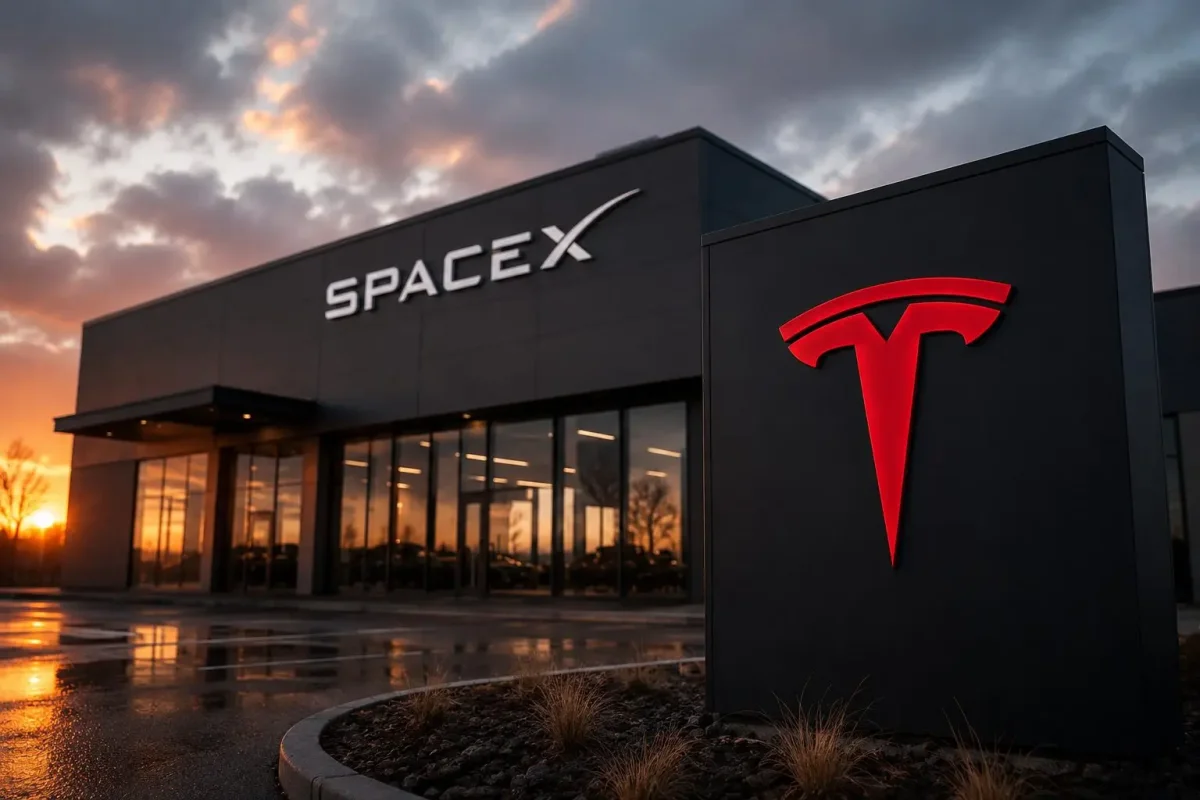
NEW YORK, July 8, 2026, 09:07 EDT. The potential merger between Tesla (NASDAQ:TSLA) and SpaceX (NASDAQ:SPCX) has introduced a substantial exchange-ratio risk, with the premium now estimated at up to $428 billion. This figure has emerged as traders evaluate how shares would convert between the two companies, adding a layer of complexity to the deal's valuation.
RBC's Revised Price Target
Royal Bank of Canada's (TSE:RY) RBC Capital Markets has raised its price target for Tesla to $500, incorporating a 25%-30% deal premium for a potential SpaceX acquisition. Analyst Tom Narayan noted that the new target is based on unconfirmed chatter about a possible merger, with the premium reflecting the strategic value of combining the two entities. The revised target implies a significant upside from Tesla's current trading levels.
Market Reactions and Premium Calculations
With Tesla's market capitalization hovering around $1.43 trillion, a 20%-30% premium translates to $285 billion to $428 billion. This far exceeds J.P. Morgan's (NYSE:JPM) estimate of $4.3 billion in passive inflows from SpaceX's inclusion in the Nasdaq-100. The disparity highlights the magnitude of the merger premium relative to index-related demand.
J.P. Morgan analyst Rajat Gupta described the merger as "strategically coherent on paper" but pointed to potential hurdles, including regulatory approvals in China and governance concerns. Elon Musk's significant voting control in SpaceX—85% compared to 20% in Tesla—could lead to dilution risks for Tesla minority shareholders, Gupta warned.
Trading Dynamics
As of Tuesday, Tesla shares were trading at $402.90, while SpaceX shares fell 6.8% to $149.47. The gap between the two stocks underscores the market's focus on the exchange ratio. If Tesla offers a 20%-30% premium, Tesla shareholders could see a substantial boost, while SpaceX investors would likely pay using stock under a simple all-stock structure.
RBC's Narayan emphasized that Tesla holders will probably demand a premium, partly because Musk would control over 50% of the combined entity, up from his current 20% stake in Tesla. This concentration of control adds another layer of risk for minority investors.
Investor Sentiment and Analyst Views
Longtime shareholders of both companies, including Ross Gerber of Gerber Kawasaki Wealth and Investment Management, view a merger as inevitable. "We know this is going to happen at some point," Gerber told Bloomberg, calling it a "foregone conclusion." This sentiment has helped buoy Tesla's stock, as some holders may hold on in anticipation of a deal.
However, J.P. Morgan's Gupta remains cautious, citing issues like China's approval, SpaceX's defense ties and government contracts, and Tesla's operations in China. The differing valuations among analysts also highlight the uncertainty: Raymond James has set a target of $800 for SpaceX, while CFRA is at $115, the lowest on the Street.
Index Inclusion and Market Pressure
SpaceX joined the Nasdaq-100 with a 1.34% weight shortly after its IPO on June 15, which raised $85.7 billion from 638.9 million Class A shares. Despite this, the stock has faced selling pressure from index rebalancing and concerns about high expectations. "There's nervousness about expectations being too high," said Mark Hackett, chief market strategist at Nationwide.
More than a dozen brokerages have initiated coverage with top-tier ratings, but the merger premium adds to the pressure on SpaceX's valuation. Goldman Sachs (NYSE:GS) analysts highlighted SpaceX's potential in space, connectivity, and AI, while Deutsche Bank (ETR:DBK) called the company a top "haloscaler."
Outlook
Neither Tesla nor SpaceX has officially commented on merger talks. SpaceX President Gwynne Shotwell has not announced any deal, though J.P. Morgan quoted her saying a merger "might make Elon's life a little easier." As the market digests the implications of a $428 billion premium, investors are closely watching for any official announcements or regulatory developments.