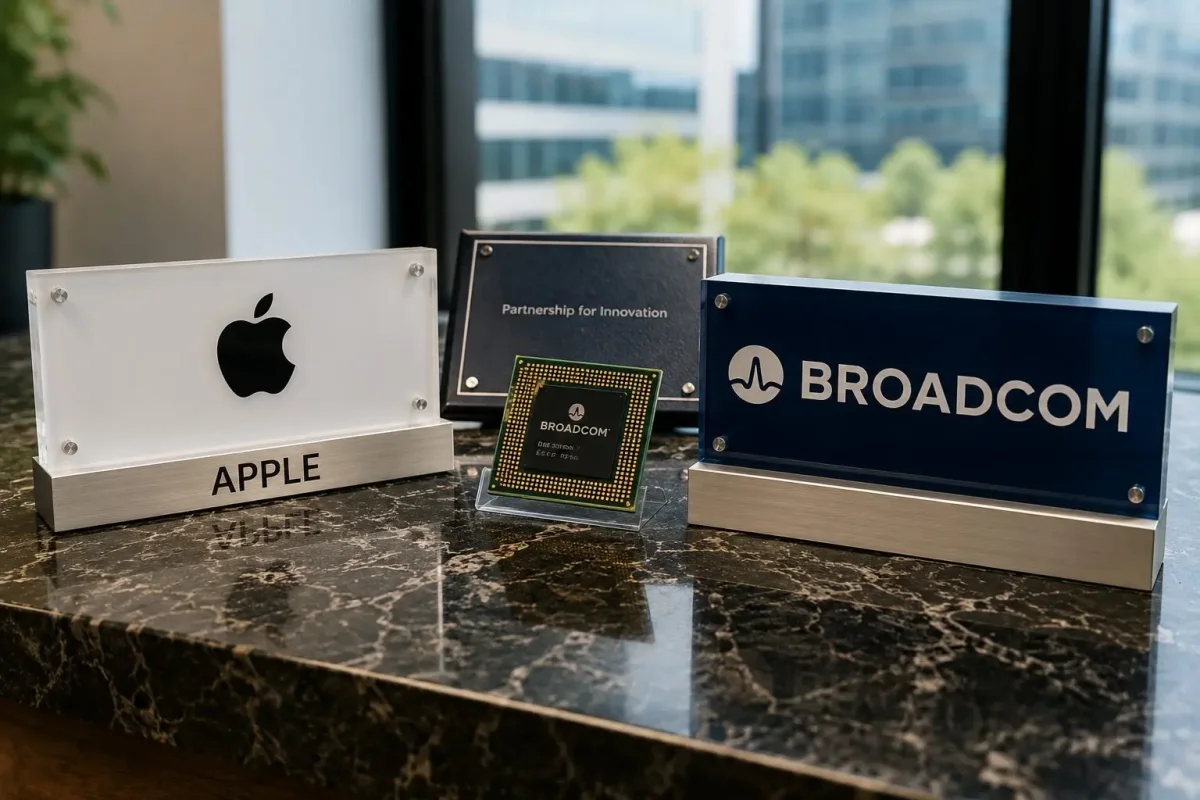
In a significant move for U.S. semiconductor manufacturing, Apple (NASDAQ:AAPL) has announced a landmark supply agreement with Broadcom (NASDAQ:AVGO) valued at over $30 billion. The multi-year deal, which runs through 2031, is set to produce more than 15 billion chips on American soil and will support a $1.5 billion expansion of Broadcom's facility in Fort Collins, Colorado. This announcement provides investors with a clearer financial picture of a partnership that had previously been difficult to quantify.
Breaking Down the Numbers
The headline figures offer a straightforward calculation: Apple's commitment equates to roughly $2 per chip. Meanwhile, Broadcom's capital expenditure on the Fort Collins expansion represents approximately 5% of the total Apple spend. This ratio is particularly noteworthy for investors, as it indicates strong revenue visibility for Broadcom without a proportional burden of factory spending. The deal also accounts for about 5% of Apple's four-year $600 billion U.S. investment pledge and represents roughly 47% of Broadcom's fiscal 2025 total net revenue of $63.887 billion.
Strategic Implications for Apple
For Apple, this agreement is less about relocating iPhone assembly to the United States and more about securing a high-volume domestic source for critical radio-frequency and wireless components. This move comes as Apple faces mounting pressure from tariffs and rising component costs. In its 2025 filing, Apple disclosed that a significant majority of its manufacturing is handled by outsourcing partners primarily in mainland China, India, Japan, South Korea, Taiwan, and Vietnam, and warned that tariffs could impact costs, pricing, and gross margins. By locking in Broadcom through 2031, Apple gains supply-chain certainty for essential components.
Broadcom's Perspective
For Broadcom, the deal provides a direct answer to a long-standing investor concern: the risk that Apple might design more of its own chips in-house. As Reuters reported, this agreement eases fears that Apple would replace Broadcom parts in the near term. However, the risk of customer concentration remains. Broadcom's annual report notes that its top five end customers accounted for about 40% of fiscal 2025 revenue, and analysts estimate that Apple represents roughly 20% of Broadcom's annual revenue. The loss of a major customer or a sharp reduction in demand could materially affect Broadcom's financial results.
Market Context and Background
This new contract extends a previous 2023 Broadcom-Apple arrangement for 5G radio-frequency parts, including FBAR filters, which Apple said would be designed and built in several U.S. manufacturing and technology hubs, including Fort Collins. Apple CEO Tim Cook emphasized that the Fort Collins components are essential to Apple device performance and connectivity, while Broadcom CEO Hock Tan expressed pleasure in expanding the company's manufacturing footprint there.
At the time of the announcement, Apple shares were quoted at $310.66 and Broadcom at $370.78 before the market open. The deal underscores a broader trend of reshoring critical semiconductor production, though Apple's overall hardware supply chain remains heavily dependent on Asian production hubs.
Investor Takeaways
The deal measure highlights include: Apple's purchase commitment per planned chip at approximately $2, Broadcom's capex versus Apple spend at about 5%, and the deal size relative to Broadcom's FY2025 revenue at roughly 47%. For Apple, the deal adds a measurable U.S. supply-chain number at a time its filings point to tariff risk. For Broadcom, it keeps a major Apple line of business in place through 2031, even as Apple continues to pull more silicon design in-house.
EMarketer analyst Jacob Bourne noted that locking in Broadcom through 2031 buys supply-chain certainty for Apple, while the risk of Apple's vertical integration remains a long-term overhang for Broadcom investors.