On Tuesday, July 7, 2026, Tesla Inc. (NASDAQ: TSLA) shares experienced a significant premarket surge, climbing by approximately 6.65% to $419.77. This rally added roughly $92.6 billion to Tesla's market capitalization, driven by intensifying chatter about a potential merger between Elon Musk's two flagship companies: Tesla and Space Exploration Technologies Corp (NASDAQ: SPCX), better known as SpaceX.
RBC Analysis Points to Premium Deal Structure
RBC Capital Markets has modeled the financial implications of an all-stock SpaceX offer for Tesla. Under the scenario, SpaceX would issue between 11.1 billion and 12.0 billion new shares to acquire Tesla at a 20%-30% premium to its current price. RBC analyst Tom Narayan raised his Tesla price target to $500 from $475, citing a 25-30% premium baked into the deal scenario. The analysis suggests that a no-premium deal would require issuing 9.26 billion new shares, representing about 70.8% of current SpaceX Class A and B shares, resulting in a pro forma equity value of $3.58 trillion. At a 20% premium, the new shares needed rise to 11.11 billion (85.0% of current shares), with a pro forma value of $3.88 trillion. A 30% premium would require 12.04 billion shares (92.0% of current shares), pushing the pro forma value to $4.03 trillion.
Market Focus on Exchange Ratio and Governance
Investors are primarily concerned with the exchange ratio, potential dilution, and the possibility that Tesla could trade as a SpaceX AI proxy even before any deal is finalized. The $4 trillion figure frequently cited in merger discussions aligns closely with these calculations, but it requires either a premium on Tesla's stock or further gains in SpaceX's valuation. Governance issues also loom large: RBC notes that a tie-up would give Musk control of over 50% of the combined entity's voting power, compared to his current ~20% stake in Tesla. SpaceX's prospectus indicates Musk would hold 82.4% of voting power post-deal, with the ability to decide matters needing shareholder approval. The filing also notes SpaceX could issue a significant amount of equity in future deals.
Financial Ties Between Tesla and SpaceX
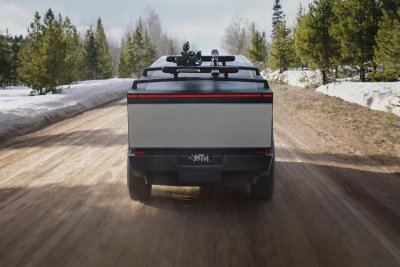
Filings reveal that SpaceX and xAI have purchased $940 million worth of goods from Tesla through April 2026. This includes $506 million in Tesla Megapack orders for 2025, $131 million in Cybertruck deliveries, $34 million in Megapack spend in Q1 2026, and $269 million committed for April. This amount represents only about 1% of the $92.6 billion in value Tesla gained on Tuesday. The ratio of value gain to total disclosed cash flows stands at approximately 98.5 times, underscoring that investor enthusiasm is not primarily driven by existing financial ties.
AI Synergies Fuel Speculation
Artificial intelligence is a key driver of the merger narrative. TradingView's GuruFocus, citing Bloomberg Intelligence modeling, suggests AI could become SpaceX's largest revenue source starting this year. Tesla is heavily focused on autonomous driving and its Optimus humanoid robot. The SpaceX prospectus details overlapping projects, including the Terafab initiative aimed at supplying chips for both Tesla's Optimus robots and vehicles, as well as for SpaceX orbital compute. However, exact projects remain contingent on separate agreements. SpaceX President Gwynne Shotwell acknowledged synergies between the two companies in a CNBC interview, emphasizing operational focus on launches and Starlink broadband.
Wall Street Momentum and Index Inclusion
SpaceX's recent public listing has generated significant Wall Street interest. Reuters reported that J.P. Morgan estimates SpaceX's potential inclusion in the Nasdaq-100 index could attract $4.3 billion in passive investment. Morgan Stanley has dubbed SpaceX 'AI's final frontier,' while RBC analysts highlight that 'the Starship is the flywheel' for the company's growth. Despite the speculation, Elon Musk has not publicly confirmed a merger plan.
Market Context and Implications
The premarket surge occurred ahead of the official U.S. market open at 9:30 a.m. Eastern, with trading active from 4 a.m. to 9:30 a.m. Eastern. The broader market appeared to shrug off concerns about cash flows between Musk's companies, focusing instead on the strategic and financial logic of a combination. If consummated, the merger would create a vertically integrated powerhouse spanning electric vehicles, autonomous driving, space launch, satellite communications, and AI compute—potentially reshaping both the automotive and aerospace industries.