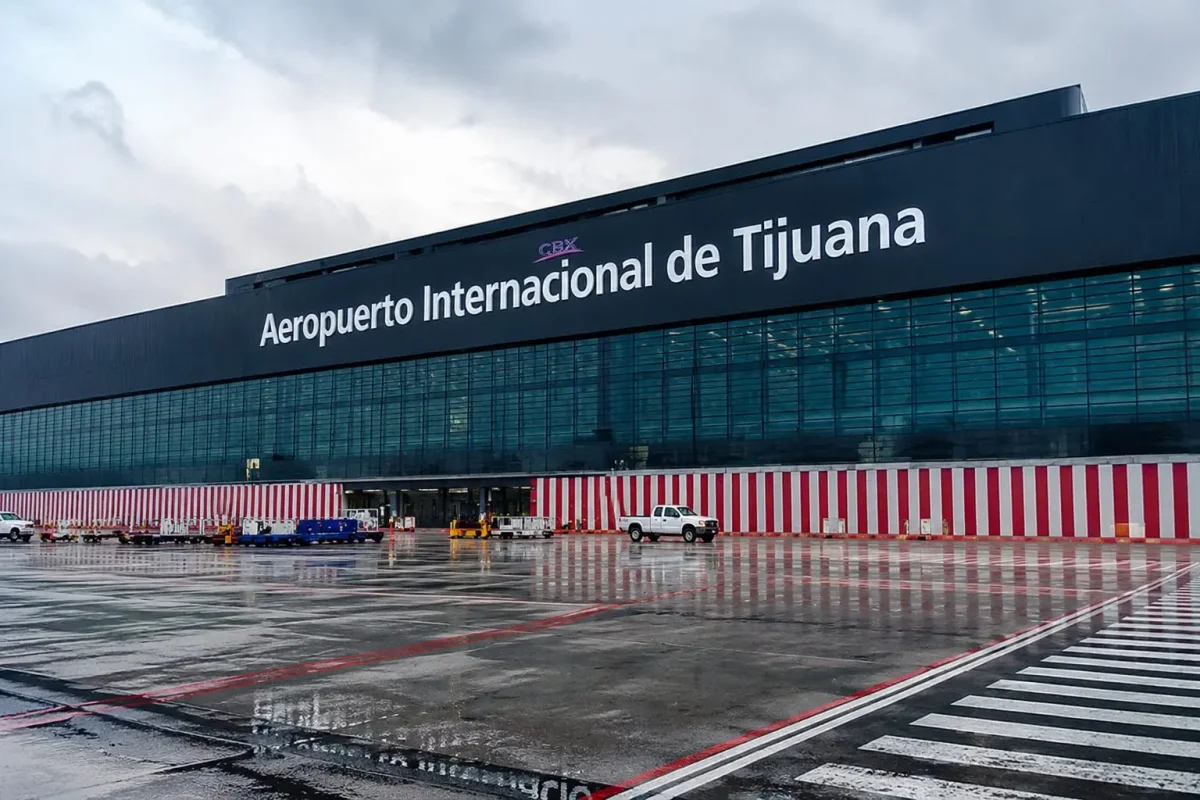
Tijuana Airport has recorded a notable reduction in flight cancellations following a review of code-share practices, yet investors are keeping a close watch on passenger traffic trends as a more reliable indicator of the airport's underlying performance. The recent audit clarified that what initially appeared as three cancellations actually involved only two aircraft movements, due to a duplicate code-share listing.
According to the latest updates, the August 2 flight logs showed three cancelled flight numbers, but one of them, Avianca's AV6830, was listed as a code-share for Viva's cancelled VB7401 on the Monterrey–Tijuana route. This duplication reduces the effective number of cancellations to two, both operated by Viva. The other cancellation was VB4087 on the Tijuana–Monterrey route. Volaris was not among the cancelled flights, though its Y4186 arrived with a 27-minute delay on July 27.
The operational impact of the one-day disruption appears minimal, but the longer-term trend in passenger numbers is what matters for investors. In June, Grupo Aeroportuario del Pacífico (GAP) handled 976,800 passengers through Tijuana, a 4.6% year-over-year decrease. This represented 19.9% of GAP's total network traffic, which stood at 4,916,500 passengers, down 5.1% from the prior year.
Breaking down Tijuana's traffic, domestic passengers fell 3.4% to 637,500, while international passengers dropped 6.8% to 339,400. Cross Border Xpress (CBX) users totaled 333,000, down 6.6%, accounting for 34.1% of Tijuana's total. CBX, which GAP fully acquired in May, generated 468.1 million pesos (approximately $26.8 million) in revenue from May to June, translating to about $42.80 per passenger. This revenue stream, covering tickets, parking, and ancillary services, is a significant contributor to GAP's earnings.
GAP's second-quarter financials showed resilience, with non-aeronautical revenue climbing 23.9% while aeronautical revenue declined 3.2%. EBITDA rose 8.4%, resulting in a 69.3% margin excluding construction accounting. The company's focus on non-aeronautical revenue and CBX is helping to offset softness in core passenger numbers.
Volaris, on the other hand, reported a strong June with passenger numbers up 11.2% to 2.68 million. However, its load factor dipped 30 basis points to 83.6%. The airline's second-quarter revenue increased 24%, but average fuel expenses jumped 70%, leading to a net loss of $127 million. CEO Enrique Beltranena emphasized that every flight operated in the quarter generated positive cash contribution, highlighting the carrier's operational discipline despite cost pressures.
In the stock market, PAC closed last week with a 0.5% gain, while Volaris advanced 2.8%. Both ADRs saw slight declines on Friday, with PAC down 1.0% and VLRS down 1.5%. Investors are now looking ahead to the release of July traffic figures, which are expected to provide a clearer picture of whether the declines in Tijuana and CBX are moderating.
For GAP, the key question is whether the downward trend in Tijuana and CBX traffic will ease. For Volaris, the challenge remains balancing capacity expansion with soaring fuel costs. The upcoming monthly data will be crucial in assessing these dynamics.
Risks remain, as flight-status updates are provisional and subject to rapid revision. Ongoing disruptions, whether from weather, operational issues, or broader economic factors, could continue to impact airport spending, CBX traffic, and airline profitability.
