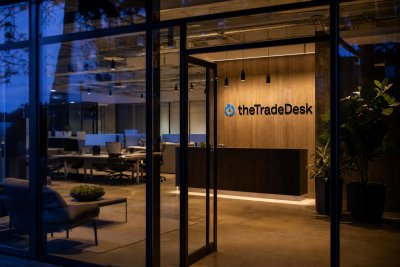
The Trade Desk experienced a sharp decline in after-hours trading on Thursday, with shares falling approximately 16% to around $19.66, after the company issued a second-quarter revenue outlook that fell short of Wall Street's expectations. This development overshadowed the company's better-than-anticipated first-quarter sales performance, intensifying investor concerns about the pace of growth in the programmatic advertising sector.
The ad-tech firm reported a 12% increase in revenue for the quarter ended March 31, reaching $688.9 million compared to $616.0 million in the same period last year. However, net income declined to $40.0 million from $50.7 million, and adjusted earnings per share came in at 28 cents, missing the consensus estimate of 32 cents. Chief Executive Jeff Green described the quarter as "another strong quarter," citing strategic upgrades that helped the company outperform during the period.
Despite the positive first-quarter results, the market's focus quickly shifted to the company's guidance for the current quarter. The Trade Desk projected second-quarter revenue of at least $750 million, below the analyst consensus of $772.4 million. The adjusted EBITDA guidance of approximately $260 million also disappointed investors. This outlook implies revenue growth of roughly 8%, a deceleration from the 12% growth achieved in the first quarter and a significant slowdown from the 25% growth recorded a year earlier.
The disappointing forecast has amplified doubts about the company's ability to sustain growth amid cautious marketing budgets and intensifying competition, particularly in the connected TV (CTV) space. Amazon remains a formidable competitor, leveraging its content, commerce data, and advertising tools. Google also continues to exert influence over the broader digital advertising market, challenging Trade Desk's position as an independent platform for the open internet.
Adding to the company's challenges, a dispute with Publicis in March, which involved allegations of fee and opt-in breaches, has lingered in the background. While the immediate trigger for Thursday's sell-off was the earnings report, the Publicis issue remains a concern for investors.
Analysts had already been cautious ahead of the earnings release. Recent target cuts included UBS analyst Stephen Ju lowering his price target to $31 while maintaining a Buy rating, Wells Fargo analyst Alec Brondolo trimming his target to $24 with an Equal-Weight rating, and Rosenblatt analyst Barton Crockett downgrading the stock to Neutral with a $25 target. These adjustments reflect the growing uncertainty surrounding the company's growth trajectory.
On a more positive note, Wedbush analyst Alicia Reese upgraded Trade Desk to Neutral ahead of the earnings, suggesting that headwinds could be "largely offset" by advertising spending related to the World Cup and political campaigns later in 2026. However, she also cautioned that competitive pressures and audit-related issues could limit long-term growth if clients continue to reallocate budgets.
The Trade Desk highlighted its operational strengths, including customer retention rates above 95%, share repurchases of approximately $164 million in the first quarter, and advancements in AI, connected TV, and identity tools. However, the market's reaction underscores that investors are currently more focused on the decelerating revenue growth than on the company's strategic initiatives.
With the stock already down 38% year-to-date before the after-hours decline, the pressure is on The Trade Desk to demonstrate that its growth trajectory can support its valuation. The next test will be whether the company can convince investors that ad buyers are still willing to increase spending through its platform at a pace that justifies its current market position.