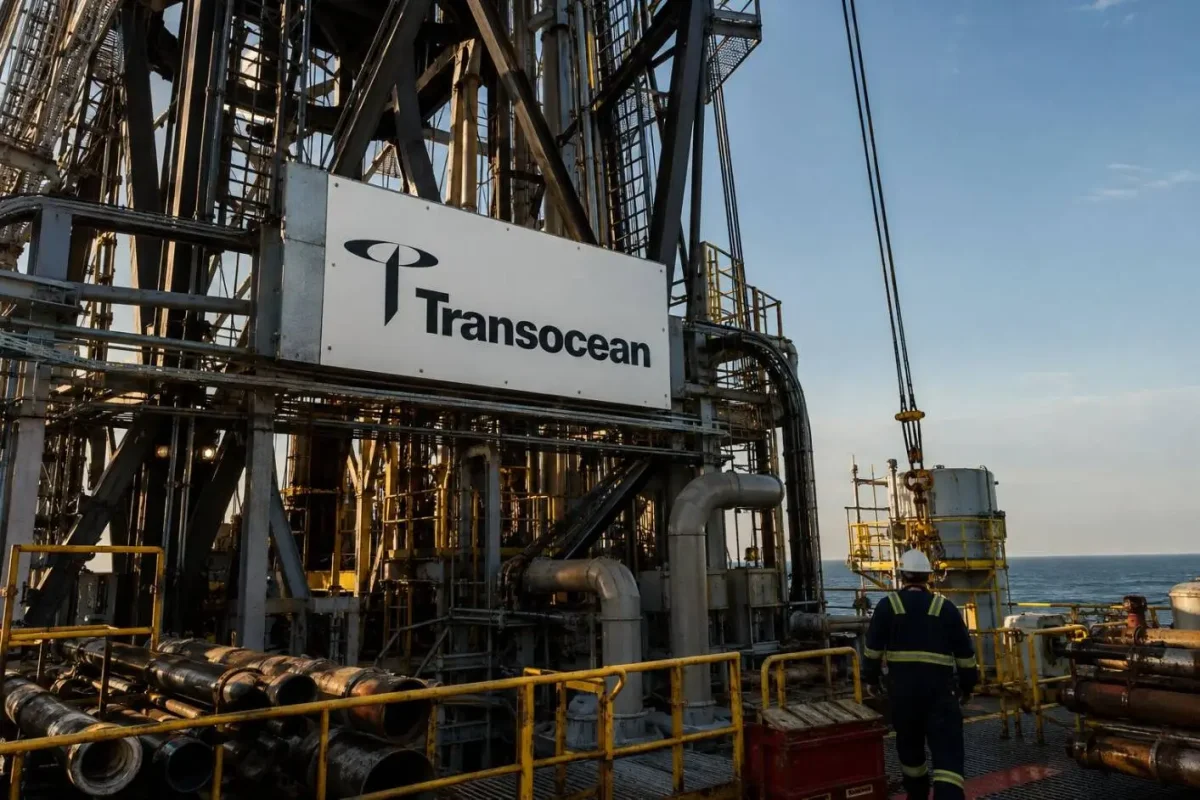
Transocean Ltd. (NYSE: RIG) saw its shares decline 3.2% on Thursday, closing at $6.02, as the offshore drilling contractor's substantial debt load continued to weigh on investor sentiment. The stock's slide came even as crude oil prices moved higher, underscoring a growing focus on balance sheet strength rather than commodity price movements.
The company faces $4.3 billion in net debt, a figure that looms large relative to its $6.7 billion contract backlog. Notably, the backlog is nearly identical to Transocean's current equity value of approximately $6.72 billion, meaning the debt burden effectively doubles the capital at risk for shareholders. Trading volume reached 40.7 million shares, about 5% above the three-month average, indicating heightened investor activity.
Broader Offshore Drilling Weakness
The decline was not isolated to Transocean. Valaris Limited (NYSE: VAL) slipped 3.0%, Noble Corporation plc (NYSE: NE) fell 3.1%, and Borr Drilling Limited (NYSE: BORR) dropped 4.2%. In contrast, the SPDR S&P 500 ETF Trust (NYSEARCA: SPY) gained 1.0%, highlighting the sector's underperformance relative to the broader market.
Oil prices offered little support. West Texas Intermediate crude rose 0.8% to $91.77 per barrel, while Brent advanced 0.2% to $95.82. The muted reaction suggests investors are prioritizing cash conversion and debt reduction at individual drillers over the macro oil outlook.
Balance Sheet Pressures
Transocean's second-quarter results, released in August, showed free cash flow of $212 million, with operating cash flow of $236 million and capital expenditures of just $24 million. Chief Executive Keelan Adamson highlighted the company's "excellent cash flow and improved liquidity" in the earnings release. However, the company still carries $5.11 billion in total debt principal, with net debt at $4.31 billion—equivalent to 2.8 times trailing adjusted EBITDA. Interest expense for the quarter totaled $114 million, according to SEC filings.
The company's backlog, reported at $6.7 billion as of August 5, is approximately 1.7 times the midpoint of its 2026 revenue guidance of $3.90 billion to $3.98 billion. But converting this backlog into cash is not guaranteed; it depends on contract timing, mobilization, and potential downtime.
New Contracts and Strategic Moves
Transocean recently secured a two-year contract with Oil and Natural Gas Corporation Limited (NSE: ONGC) for the Dhirubhai Deepwater KG2 rig, valued at approximately $300 million, with the program set to begin in early 2027 and priced extension options through 2031. Additionally, a potential deal with Equinor ASA (NYSE: EQNR) could add over $1 billion, though it remains excluded from the reported backlog pending approval from license partners. Including both agreements, reported work could approach $8.0 billion.
The company is also pursuing an all-share acquisition of Valaris, which is expected to close in the fourth quarter pending approvals. Transocean aims to achieve over $200 million in cost synergies from the merger. However, investors are skeptical about the company's ability to sustain high dayrates amid fleet expansion and integration challenges. While Transocean recently secured five contracts averaging approximately $461,000 per day, its third-quarter revenue guidance of $920 million to $960 million is lower than the second quarter's actual performance.
Analyst Perspective
Thursday's decline occurred without any company-specific news, suggesting the move was driven by sector positioning and balance sheet concerns rather than a fresh development. The company's most recent update was an India award published August 20.
Looking ahead, Transocean must demonstrate that its strong cash generation can continue to service its debt while funding future growth. The backlog provides visibility, but the immediate challenge remains managing the $5.11 billion debt principal. A decline in oil prices could further postpone offshore investments, while contract approval delays or operational issues could hinder backlog conversion. Additionally, merger-related expenses and share dilution from the Valaris acquisition may consume cash flow before delivering returns to equity holders.
Investors will be watching closely to see if Transocean can navigate these headwinds and deliver on its promise of improved liquidity and shareholder value.