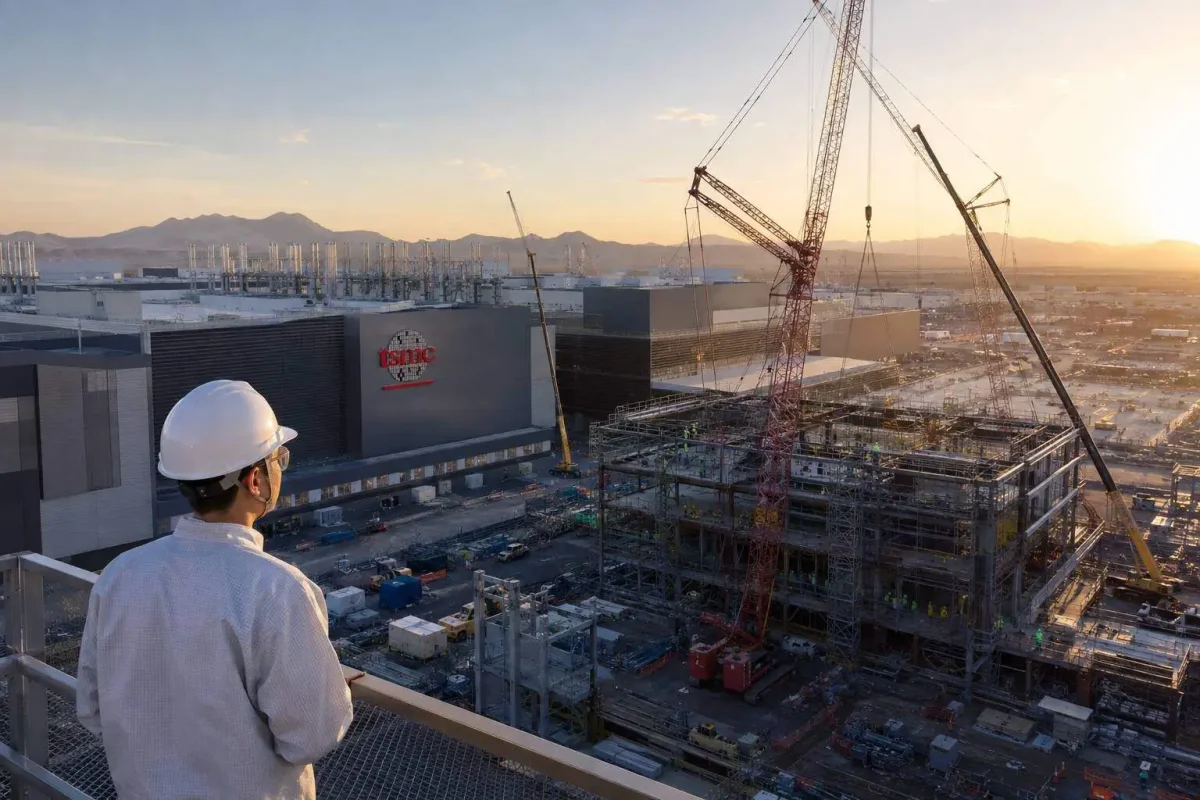
Taiwan Semiconductor Manufacturing Company (TSMC) saw its American depositary receipts (ADRs) climb 2.9% on Friday, closing at $428.91, as investors digested the chipmaker's candid assessment that its ambitious fab expansion—nearly 20 facilities worldwide—still cannot keep pace with the explosive growth in artificial intelligence demand.
The remarks came from Deputy Co-Chief Operating Officer Cliff Hou during SEMICON Taiwan on Wednesday. Hou revealed that TSMC's internal equipment-requirement index has been revised upward twice in six months, jumping from 1.0 at the end of 2025 to 1.25 in the first quarter of 2026, and then surging to 1.9 by July. This index, which measures planned equipment needs, underscores the company's struggle to scale up fast enough to meet AI-driven orders.
Hou also detailed the geographic breakdown of TSMC's construction projects: 13 fabs are underway in Taiwan, with an additional five to six overseas. The total, approaching 20, represents a construction pace roughly four to five times faster than earlier levels. However, as the executive noted, the sheer number of fabs does not translate directly into wafer output or earnings, as completion percentages and node mixes vary significantly.
Investors responded positively to the news, with TSMC's ADRs outperforming the broader semiconductor sector. Over the period from August 24 to September 4, TSMC ADRs gained 4.6%, while the iShares Semiconductor ETF (SOXX) rose 2.7%. On Friday alone, SOXX jumped 3.5%, suggesting a broader chip rally rather than a TSMC-specific move.
The operating fundamentals remain robust. TSMC reported unaudited revenue of NT$2.872 trillion for the first seven months of 2026, a 37% year-over-year increase, with July alone surging 44.7%. Second-quarter revenue reached $40.2 billion, with gross margin at 67.7% and operating margin at 60.3%, providing a strong cash engine to fund the massive capital outlay.
TSMC's 2026 capital expenditure guidance stands at $52 billion to $56 billion, a midpoint increase of about 32% from 2025, covering not only new fabs but also advanced packaging and research. CEO Wei stated in July that "AI-related demand continues to be extremely robust," leading management to raise its 2026 U.S.-dollar revenue growth forecast to slightly above 40%.
Yet the construction timeline tells a more cautious story. The Tainan N3 addition is scheduled for volume production in the first half of 2027, followed by Arizona's second fab in the second half of 2027, and Japan's second fab in 2028. These delays mean that while TSMC's order book is strong, the revenue from these new facilities will not materialize until later, creating a gap between cash outflows and inflows.
The near-term outlook remains constructive, as supply trailing demand can support high utilization rates and protect pricing power. However, the longer-term calculation is more complex. Overseas fabs are more expensive to build and ramp, and execution risks—including worker shortages and equipment delivery delays—could strand capital before revenue arrives. Conversely, a sudden AI slowdown would leave expensive capacity underutilized.
Investors will get a more immediate test on Thursday when TSMC releases August revenue figures. A strong month would bolster the demand narrative, though it won't measure the construction bottleneck directly. As the industry watches, the key takeaway is that time, not money, is TSMC's scarcest resource in the AI arms race.