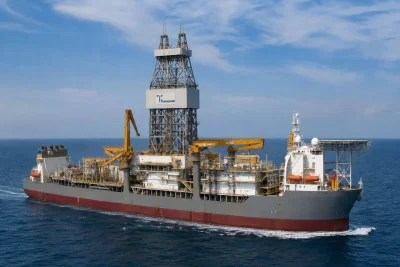
Shares of offshore drilling contractor Valaris Limited retreated in premarket activity on Tuesday, giving back a portion of the substantial gains achieved in the prior session. The stock's decline follows the announcement that rival Transocean Ltd. has agreed to acquire Valaris in an all-stock transaction, a deal that initially propelled Valaris shares upward by over 34% on Monday.
Deal Terms and Market Mechanics
Under the terms of the agreement, Transocean will issue 15.235 of its shares for each outstanding share of Valaris. Based on Transocean's closing price on Monday, this exchange ratio implies a value of $82.12 for each Valaris share, representing a premium of approximately 31.6% over Valaris's closing price before the deal was announced. In Tuesday's premarket, Valaris shares were trading around $82.18, a dip of roughly 2% from Monday's close of $83.82.
The structure of the acquisition as a stock-for-stock merger introduces a direct linkage between the two companies' share prices. With the exchange ratio fixed, the implied value of Valaris will now move in tandem with Transocean's stock price. This dynamic was evident as Transocean shares, which closed Monday up 5.9% at $5.71, experienced some weakness in after-hours trading, subsequently applying downward pressure on Valaris in the premarket session.
Strategic Rationale and Synergies
Executives from both companies framed the merger as a strategic combination designed to capitalize on the current upcycle in offshore drilling demand. Transocean Chief Executive Keelan Adamson characterized the timing as "well-timed" and highlighted identified annual cost synergies exceeding $200 million. Valaris President and CEO Anton Dibowitz emphasized the complementary nature of the two fleets, noting that the combined entity would unite Transocean's deepwater and harsh-environment assets with Valaris's premium jackup rigs. "The combined group will be capable of operating any rig at any water depth," Dibowitz stated, positioning the new company as a full-service offshore driller.
The transaction is structured as a court-approved scheme of arrangement under Bermuda law, where both companies are incorporated. The firms intend to file joint proxy materials with the U.S. Securities and Exchange Commission ahead of seeking approval from their respective shareholders. All necessary regulatory clearances are also required. The companies have targeted the second half of 2026 for the deal's completion.
Investor Focus and Inherent Risks
Following the initial surge, investor attention is now shifting to the execution risks and the timeline leading to the deal's close. A key metric being watched by traders is the "spread," or the difference between Valaris's market price and its implied value based on Transocean's share price and the fixed exchange ratio. A widening spread typically signals that the market is pricing in greater risk associated with the deal's completion, including the potential for prolonged regulatory reviews, a decline in Transocean's share price, or objections from customers or other stakeholders.
This risk is asymmetrical; if any setbacks occur, Valaris shareholders are likely to bear the brunt of the negative impact, as the value of their consideration is directly tied to Transocean's stock performance. The extended closing timeline, stretching into late 2026, inherently introduces a period of uncertainty and volatility risk that the market will continue to assess.
Upcoming Financial Disclosure
Amid the merger news, Valaris remains on schedule to report its financial results for the fourth quarter of 2025. The company has confirmed it will release its earnings before the New York Stock Exchange opening bell on February 19, followed by a conference call with analysts and investors at 10:00 a.m. Eastern Time. This report will provide stakeholders with a crucial update on the company's standalone operational and financial performance as it enters the merger process.
The proposed combination of Transocean and Valaris would create one of the world's largest offshore drilling contractors by fleet size, with a diversified portfolio across ultra-deepwater, deepwater, and harsh-environment jackup segments. The deal arrives during a period of renewed investment in offshore oil and gas projects, driven by sustained energy demand and supportive commodity prices. The market's reaction in the coming days and weeks will hinge on further details regarding integration plans, the stability of Transocean's stock, and the broader outlook for offshore drilling day rates and utilization.