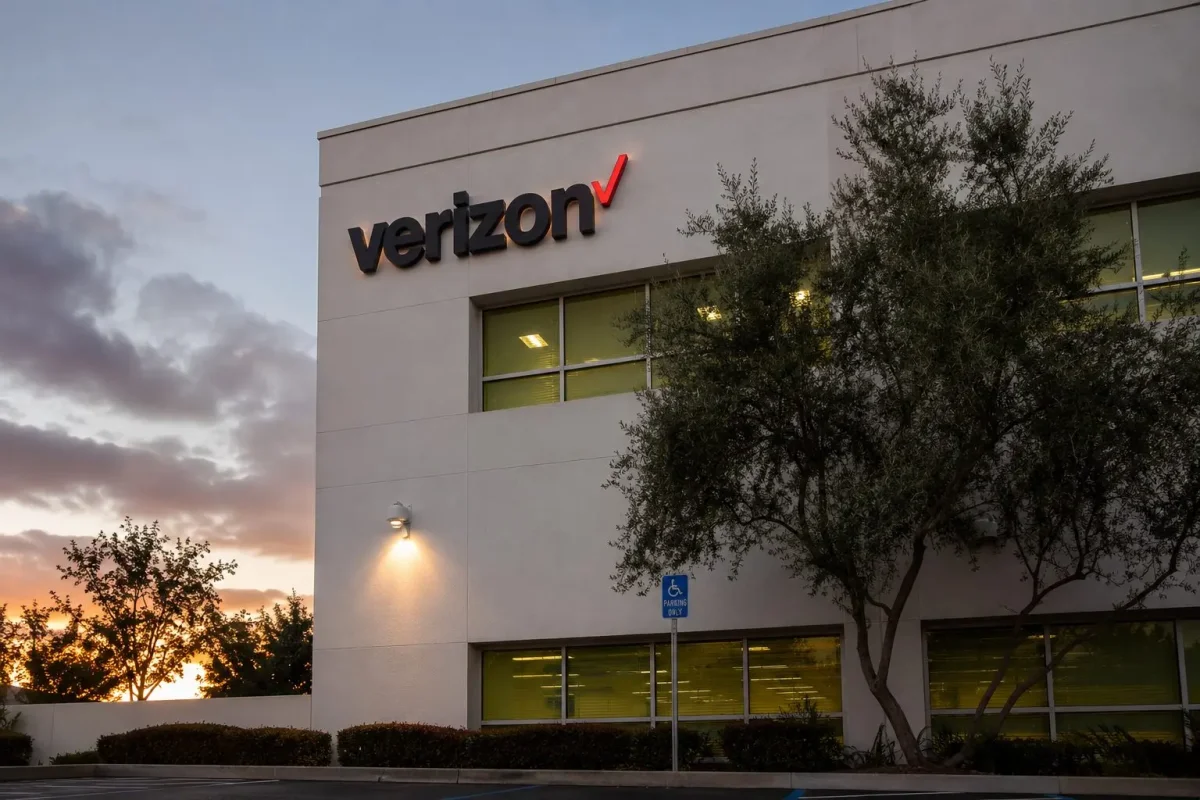
Verizon Communications Inc. (VZ) closed the holiday-shortened week on a down note, with shares finishing at $47.81 on Friday, a drop of 0.42% for the session and 1.1% lower than the prior week's close. The decline marked the third consecutive losing session for the telecommunications giant, which failed to participate in the broader market rally that saw the S&P 500, Nasdaq Composite, and Dow Jones Industrial Average all close at record highs.
The S&P 500 rose 0.22% on Friday, the Nasdaq gained 0.21%, and the Dow climbed 0.72%, with the S&P 500 notching its ninth consecutive weekly advance, according to Reuters. In contrast, the Communication Services Select Sector SPDR ETF (XLC) slipped 0.84% on Friday, underscoring the sector's underperformance relative to the technology-driven rally.
Wireless Peers Also Falter
Verizon's struggles were not isolated. AT&T (T) ended the week down approximately 1.8%, while T-Mobile US (TMUS) fell about 2.1%, with all three telecom stocks trailing the broader market. The moves did not appear to stem from any Verizon-specific negative catalyst, but rather from a broader rotation out of defensive sectors into high-growth technology and artificial intelligence names.
Key Events and Data Ahead
Investors are now turning their attention to next week's economic calendar, particularly the release of U.S. payrolls data on June 5. A Reuters poll forecasts 85,000 new jobs in May and an unemployment rate of 4.3%. Liz Ann Sonders, chief investment strategist at Schwab Center for Financial Research, noted that a strong jobs report combined with elevated inflation could influence the Federal Reserve's policy trajectory. Higher bond yields tend to pressure dividend-paying stocks like Verizon, as fixed-income alternatives become more attractive and raise concerns about debt servicing costs for heavily leveraged companies.
Verizon's Turnaround Narrative
Verizon is increasingly viewed as a turnaround story rather than a pure defensive holding. CEO Dan Schulman, who took the helm earlier this year, has emphasized a strategy to reposition the company beyond its legacy network business. At a MoffettNathanson investor conference earlier this month, Schulman stated that Verizon must "play to win" and execute on "hundreds of things" correctly, as reported by Fierce Network. The company reported its first positive Q1 postpaid phone net adds since 2013 in April, a milestone Schulman described as a "turnaround" that is "gaining momentum." Verizon also raised its full-year 2026 adjusted earnings per share guidance to a range of $4.95 to $4.99.
Competitive Landscape and Debt Management
Competition remains intense. AT&T continues to bundle fiber and wireless services, while T-Mobile focuses on perks and network superiority. Verizon is countering with its own fixed wireless access broadband offering, which delivers internet to homes over its mobile network. Schulman has described satellite connectivity as a "really good complementary service" but not a full replacement for terrestrial networks in urban and suburban areas, as reported by Broadband Breakfast.
On the balance sheet front, Verizon carries $142.5 billion in total unsecured debt as of the end of Q1. The company has announced plans to redeem $1.295 billion in debt ahead of schedule on June 20 and aims to repay nearly all of the debt associated with its Frontier acquisition by year-end.
Outlook and Risks
Verizon's upside potential hinges on steady subscriber growth, improved customer churn, debt reduction, and disciplined promotional spending, which could bolster free cash flow. However, downside risks include a strong jobs report that might push yields higher, persistent inflation, intensified price competition from AT&T or T-Mobile, or integration challenges with Frontier. These factors could keep the stock trading near the $48 level as investors favor faster-growing sectors.