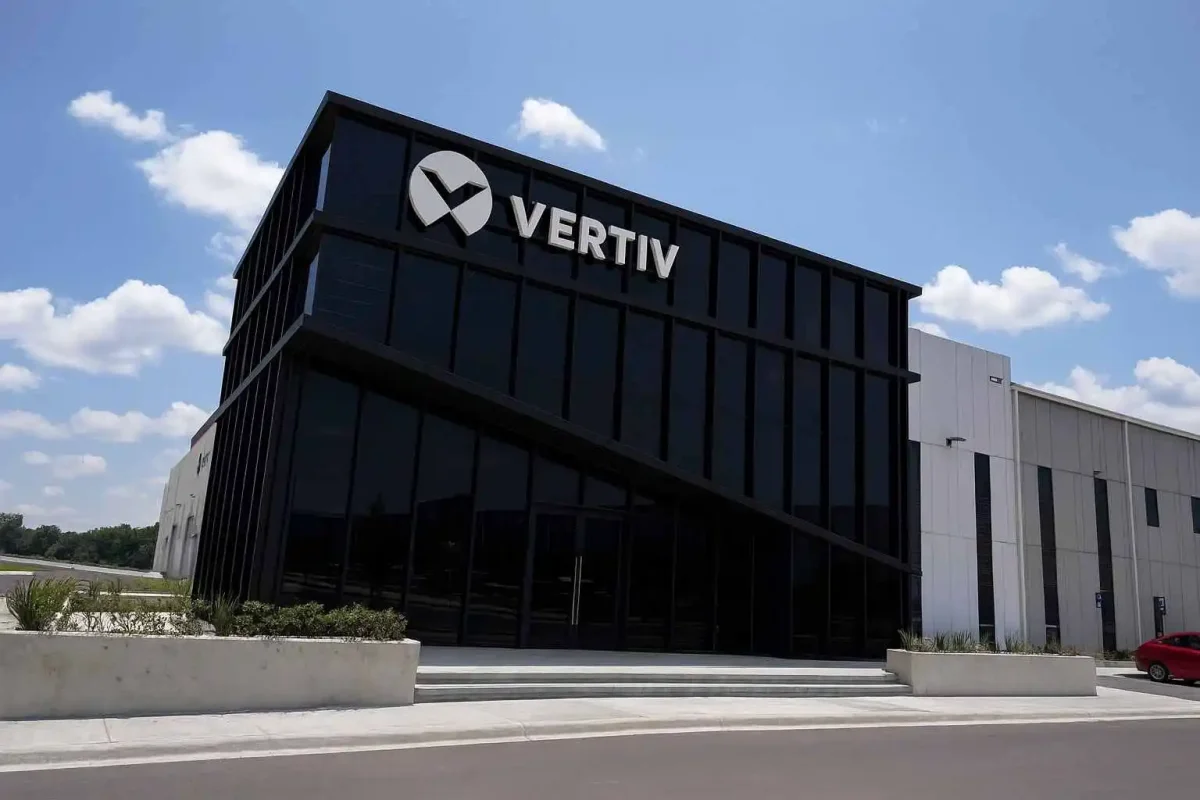
Shares of Vertiv Holdings Co retreated sharply in Friday's trading session, closing down nearly 5% at $255.88. This decline occurred despite the company's scheduled entry into the S&P 500 index, a milestone typically viewed as a positive catalyst that attracts buying from index-tracking funds and ETFs. The selloff highlights how overarching macroeconomic anxieties can overshadow company-specific positive developments.
Market-Wide Pressure Overshadows Index Catalyst
The negative sentiment was not isolated to Vertiv. The broader market faced significant headwinds, with the SPDR S&P 500 ETF (SPY) shedding approximately 1.8%. Investors grappled with renewed inflation fears, exacerbated by rising oil prices and escalating tensions in the Middle East. This environment triggered a risk-off mood, leading to losses across several related sectors. Notable decliners included Nvidia (NVDA), which slid about 3.1%, nVent Electric (NVT), down nearly 5.0%, and Eaton (ETN), which eased back by 0.9%.
Vertiv's Strong Fundamentals and AI Ambitions
Beneath the day's price action, Vertiv's underlying business metrics remain robust. The company, a provider of power and cooling infrastructure for data centers, communications networks, and industrial applications, recently provided updated financial guidance. For the full year 2026, Vertiv projected net sales in a range of $13.25 billion to $13.75 billion. Adjusted diluted earnings per share are forecast between $5.97 and $6.07.
Perhaps more striking is the company's order backlog, which ballooned to $15 billion—a staggering 109% increase from the prior year. This backlog represents committed orders that have yet to be recognized as revenue, providing what CEO Giordano Albertazzi described as "clear visibility" for sustained strong growth into the next year. For context, the company reported $10.23 billion in revenue and $1.33 billion in net income for 2025.
Strategic Push into AI Infrastructure
Vertiv is aggressively positioning itself at the center of the artificial intelligence infrastructure boom. On March 16, the company announced it is supplying critical power and cooling systems for Nvidia's Vera Rubin DSX AI factory reference design. This partnership essentially provides a blueprint for constructing large-scale AI data centers. Scott Armul, Vertiv's Chief Product and Technology Officer, framed the collaboration as enabling customers to move "faster from design to deployment," highlighting a key competitive advantage.
Potential Risks on the Horizon
Despite the strong outlook, analysts point to potential risks. The company's fortunes are closely tied to capital expenditure cycles in technology and data centers. A significant slowdown in AI or general infrastructure spending could impact growth. Furthermore, the technological landscape for data center cooling is evolving rapidly.
In a notable comment earlier this year, Nvidia CEO Jensen Huang suggested the company's next-generation data centers might not require traditional water chillers. While Barclays analysts, led by Julian Mitchell, cautioned investors not to dismiss this shift, they also noted Vertiv's potential upside in the growing liquid cooling market. This technology uses fluid instead of air to dissipate heat from densely packed server racks, an area where Vertiv is actively developing solutions.
The Week Ahead: S&P 500 Inclusion Goes Live
All eyes are now on Monday, when S&P Dow Jones Indices will formally add Vertiv to the S&P 500 as part of its scheduled quarterly rebalance. This event will force index funds and ETFs that track the benchmark to purchase the stock, which could provide a stabilizing or upward influence on the share price. The key question for investors is whether this structural buying pressure will be sufficient to counter the broader market's risk-off sentiment that dominated trading on Friday.
The coming sessions will reveal if Vertiv's fundamental strengths—its massive backlog, strategic AI partnerships, and now its status as a benchmark component—can reassert themselves once the index inclusion is complete, or if macroeconomic concerns will continue to dictate the near-term trajectory for the stock and its peers.