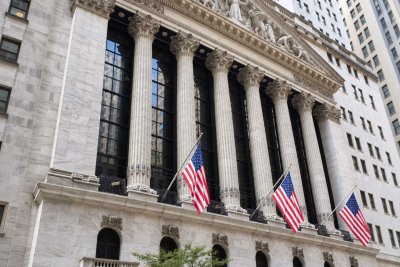
U.S. equities presented a divided picture on Friday as investors digested a surprisingly weak July jobs report that lowered expectations for further interest rate hikes. While the technology-heavy Nasdaq Composite rallied sharply, the Dow Jones Industrial Average managed only a modest gain, hampered by losses in a few heavyweight components.
By 11:36 a.m. EDT, the Dow had added 91.87 points, or 0.17%, to trade at 53,976.97. In contrast, the Nasdaq Composite surged 1.30%, or 343.47 points, to 26,691.82. The S&P 500 also advanced, climbing 0.62% to 7,757.98. This divergence highlighted a market favoring growth sectors over traditional blue chips amid shifting monetary policy expectations.
Jobs Report Shifts Rate Outlook
The catalyst for Friday's trading was the Labor Department's July employment report, which showed payrolls declined by 23,000, a stark reversal from the expected gain of 80,000. The unemployment rate ticked down to 4.1%, while revisions to May and June figures shaved a combined 103,000 jobs from previously reported levels.
The unexpected softness in hiring immediately altered market expectations for the Federal Reserve's next move. According to CME Group data, the probability of a rate increase in September plummeted to roughly 20% from 55% prior to the release. Treasury yields responded accordingly, with the 10-year note falling 4.3 basis points to 4.627%.
"The report takes some urgency off the table for a rate hike," said Brian Therien, senior analyst at Edward Jones. "Incoming inflation and jobs data will determine the timing, but this gives the Fed more room to wait."
Dow's Price-Weighted Quirk
The Dow's modest advance masked significant underlying moves, largely due to its price-weighted methodology. A $1 change in any component's share price moves the index by roughly 5.94 points, meaning higher-priced stocks have outsized influence.
Goldman Sachs (NYSE: GS) contributed 58.9 points to the Dow after rising $9.92, or 0.96%. Sherwin-Williams (NYSE: SHW) added 37.2 points with a 1.72% gain, while Salesforce (NYSE: CRM) boosted the index by 33.1 points as it climbed 2.99%. Nvidia (NASDAQ: NVDA) also lent support, contributing 29.5 points after a 2.26% rise.
However, these gains were nearly offset by steep declines in two components. Caterpillar (NYSE: CAT) dropped $12.94, or 1.51%, shaving 76.9 points off the Dow—more than the combined contribution of Nvidia and Salesforce. Visa (NYSE: V) fell $5.68, or 1.53%, subtracting another 33.7 points.
As a result, the Dow's overall gain of just 0.17% understated the strength seen in technology stocks, which rallied on the prospect of lower borrowing costs.
Earnings Season Remains Strong
Corporate earnings continued to provide a supportive backdrop. More than 85% of the over 400 S&P 500 companies that have reported so far have beaten analyst expectations, well above the historical average of 68%. This resilience allowed investors to interpret the weak jobs data as a potential catalyst for rate cuts rather than a sign of imminent economic distress.
Analyst actions on Dow components were mixed on Friday. Argus Research downgraded Procter & Gamble (NYSE: PG) to Hold from Buy, while maintaining a Buy on Walt Disney (NYSE: DIS) with a $134 price target. D.A. Davidson reiterated its Hold on Caterpillar with an $882 target, and Bernstein kept a Hold stance on Amgen (NASDAQ: AMGN) with a $345 price objective.
Looking Ahead
Investors will closely monitor upcoming inflation data, with the July consumer price index due on August 12 and producer prices following on August 13. A stronger-than-expected reading could revive rate hike speculation. Additionally, any supply disruptions in oil markets could add to inflationary pressures.
Friday's trading session will likely hinge on market breadth. If the Nasdaq's outperformance persists while the Dow lags, it would confirm that gains are being driven by rate-sensitive growth stocks rather than broad-based economic optimism.