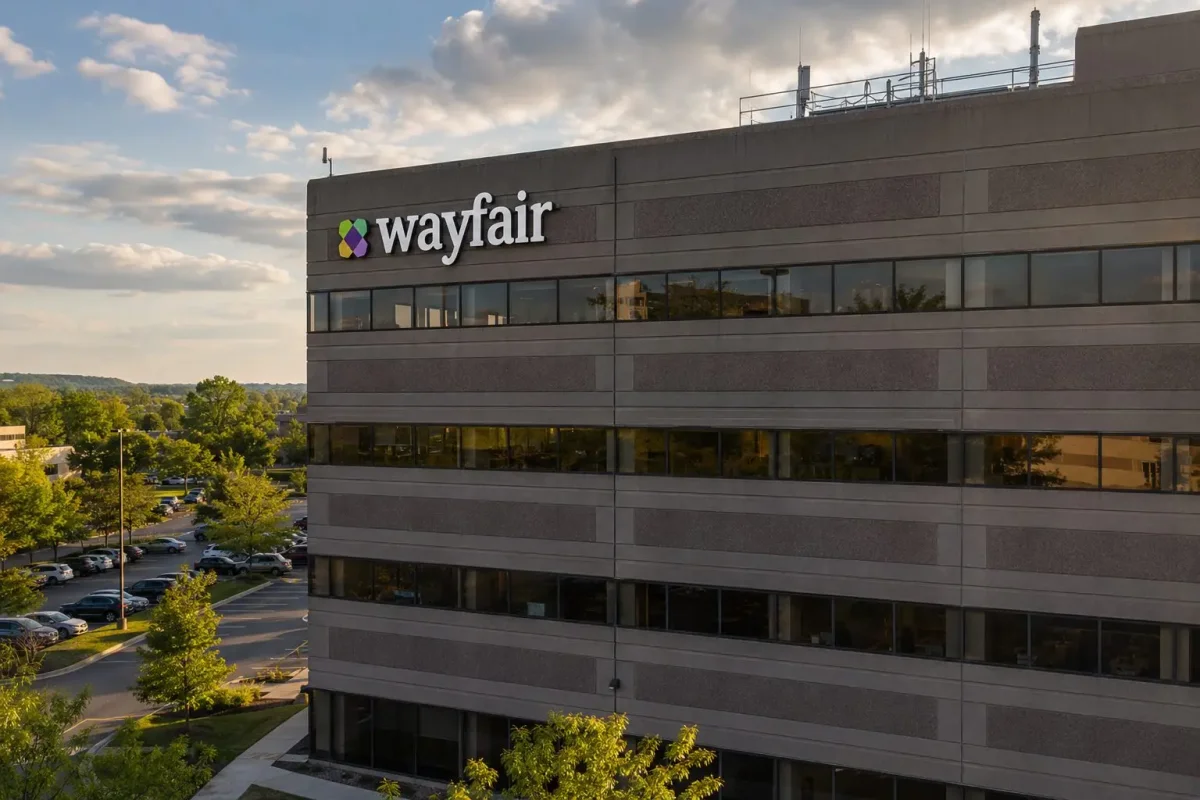
Wayfair Inc. (NYSE:W) shares closed Friday at $106.60, marking a 25.6% weekly surge after the online home furnishings retailer reported second-quarter results that beat expectations and signaled a potential turnaround. The stock's rally outpaced major indices, with the Nasdaq Composite rising 5.19%, the S&P 500 gaining 3.58%, and the Dow Jones Industrial Average up 2.96% during the same period.
The company's Q2 net revenue reached $3.519 billion, a 7.5% year-over-year increase, driven primarily by a 6.0% rise in delivered orders to 10.6 million. Average order value edged up 1.2% to $332, while active customers grew 3.3% to 21.7 million. Order frequency rose approximately 1.6%, contributing to a 4.2% increase in revenue per active customer to $596. A straightforward growth-rate breakdown suggests orders accounted for roughly 80% of the revenue increase, indicating that volume, not pricing, was the main growth driver.
The recovery appears to be fueled by market share gains rather than a broad industry rebound. U.S. revenue climbed 8.7%, while international revenue declined 1.3% (down 2.0% on a constant-currency basis). Management noted that category growth was nearly flat, underscoring that Wayfair's performance likely came at the expense of competitors. This interpretation is supported by strong gains at Perigold, Wayfair's luxury brand, which saw sales surge over 35%, and a 12.5% uptick in written sales at rival Arhaus (NASDAQ:ARHS).
Chief Executive Niraj Shah described the quarter as "another strong quarter of share capture and top line momentum." Cash generation also improved, with non-GAAP free cash flow rising to $301 million from $230 million in the prior year period. For the first half, free cash flow more than doubled to $195 million. Adjusted EBITDA margin expanded to 6.9% from 6.3%, the highest since 2021. However, GAAP results were mixed: operating income surged to $104 million from $17 million, but a $59 million debt extinguishment cost resulted in a net loss of $1 million.
Analysts responded positively to the quarter, though price targets varied widely. Benzinga reports an average price target of $109 from 29 analysts, just 2.3% above Friday's close. Targets ranged from $92 to $156, reflecting divergent views on the sustainability of growth. Ten firms raised their price targets on August 5. William Blair analyst Phillip Blee commented that Wayfair is showing increased consistency and predictability.
The stock closed Friday 8.2% below its post-earnings high of $116.08 on Tuesday and remains 11.2% off its 52-week peak of $119.98. The broader market context suggests investor optimism, but risks remain. International revenue declined, gross margin stood at 30.0%, and interest expense rose 34.5% to $39 million, with total debt principal at $2.9 billion. Additionally, investments in the loyalty program may pressure third-quarter gross margin, which is forecast at the lower end of the 29.5%–30.5% range.
Looking ahead, Wayfair projects third-quarter revenue growth in the high single digits, with adjusted EBITDA margin between 6% and 7%. Management expects advertising savings to roughly offset loyalty investment expenses. The market will be watching whether order growth can continue to drive performance, especially as economic data releases loom. July's consumer price index (CPI) is due Wednesday, producer prices Thursday, and retail sales Friday, all at 8:30 a.m. EDT. Economists surveyed by Reuters expect annual headline inflation at 3.4% and core CPI at 2.5%. A rise in yields could weigh on discretionary and housing-related stocks.
Wayfair's recent surge highlights the market's appetite for signs of recovery in the home goods sector, which has faced inconsistent demand. The company's ability to capture market share while maintaining margins will be key to sustaining investor confidence. With a mix of bullish and cautious analyst views, the stock's trajectory remains uncertain, but the Q2 results provide a compelling narrative of a potential turnaround.