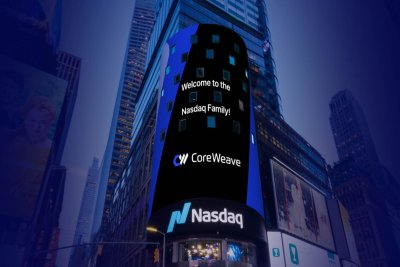
New York, June 22, 2026 – CoreWeave and Nebius Group experienced a rocky start to their Nasdaq-100 membership on Monday, with shares declining as a newly implemented index rule dampened the expected wave of passive buying. The two cloud computing firms were part of a five-company reshuffle that also added Astera Labs, Rocket Lab, and Teradyne to the benchmark index.
By early afternoon trading, CoreWeave had fallen approximately 8.5% to around $107.90, while Nebius dropped 2.2% to near $280.41. The broader tech-focused Invesco QQQ Trust slipped 0.5% amid the selloff. The declines came after both stocks had surged significantly following the June 11 announcement of their inclusion—CoreWeave gained 24% and Nebius climbed 34%—setting the stage for a classic 'sell the news' event once the rebalance took effect.
New Float-Sensitive Rule Alters Index Dynamics
A less-discussed but critical factor in Monday's trading was Nasdaq's adoption of a float-sensitive index weighting rule. This methodology ties a stock's index weight more closely to its freely tradable shares rather than its total market capitalization. Emily Spurling of Nasdaq Global Indexes explained that the new approach scales weights with available supply when a company's free float falls below 33-1/3% of its market cap. The first quarterly rebalance under these rules occurred on June 22.
This change means that index inclusion no longer guarantees a proportional influx of passive capital. While the Nasdaq-100 is tracked by over 200 products worldwide holding more than $800 billion, the float-adjusted weighting can result in less new demand than the market might anticipate, especially for stocks where a significant portion of shares are closely held or restricted.
Market Context and Implications
The reshuffle reflects the Nasdaq-100's deepening exposure to AI infrastructure companies. Astera Labs, which produces connectivity technology for AI data centers, and Teradyne, a chip-test equipment maker, each gained roughly 2% in early trading. Rocket Lab, however, dropped over 7%. The index removals included Charter Communications, Cognizant, Insmed, Verisk Analytics, and Zscaler.
For CoreWeave and Nebius, the challenge now shifts from index inclusion to converting their substantial backlogs into operational cash flow. CoreWeave reported first-quarter revenue of $2.08 billion, a net loss of $740 million, and net interest expense of $536 million. Its revenue backlog stood at $99.4 billion, and CEO Michael Intrator described it as the 'strongest bookings quarter.' A June 20 Seeking Alpha analysis highlighted CoreWeave's premium GPU-as-a-service model and noted that 36% of its remaining performance obligations are expected to convert within 24 months.
Nebius, meanwhile, is pursuing aggressive expansion. The company plans to invest approximately 1.7 billion pounds in UK data center sites, targeting 65 megawatts of capacity by 2027. It also signed a deal with Meta worth up to $27 billion, including $12 billion in reserved capacity from early 2027. First-quarter group revenue jumped 684% year-over-year to $399 million, with AI cloud contributing $389.7 million. Capital spending reached about $2.5 billion, primarily on GPUs and data centers, and the company indicated it may raise mid-single-digit billions in debt soon.
Analyst Views and Risks
Cantor Fitzgerald's Brett Knoblauch maintained an Overweight rating on CoreWeave with a $167 price target, arguing that investors are 'woefully undervaluing' the company, as reported by Barron's. However, the market's reaction on Monday suggests caution. The risk for these AI cloud names is that they are converting chip access, power deals, and customer commitments into public valuations ahead of full capacity coming online. Delays in power delivery, rising financing costs, or reduced hyperscaler spending could reverse the operating leverage that has drawn investors.
As the Nasdaq-100 reshuffle settles, the focus for CoreWeave and Nebius will be on executing their growth plans and demonstrating that their massive signed demand can translate into real capacity and sustainable cash generation. The index inclusion has raised their profile, but the market is now watching for tangible results.