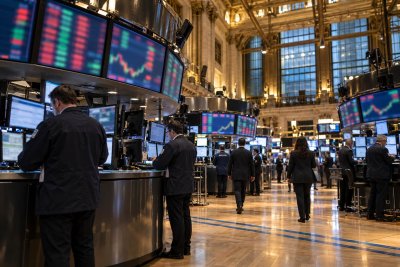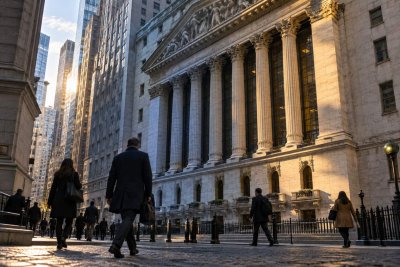
NEW YORK, July 22, 2026 – U.S. equities ended lower on Wednesday, but the headline indexes masked a sharp divergence within the artificial intelligence sector. The S&P 500 slipped 0.14% to 7,499.05, the Nasdaq Composite dropped 0.57% to 25,690.90, and the Dow Jones Industrial Average edged down 0.01% to 52,219.35. The Russell 2000 fell 1.03% to 2,956.77.
The key story of the session was the widening gap between AI hardware and software stocks. An equal-weighted basket of two hardware names rose an average of 14.6%, while two software stocks fell an average of 6.3%, creating a 21.0 percentage point spread.
Super Micro Computer (NASDAQ:SMCI) surged 19.84% to $30.56 after releasing initial fourth-quarter guidance. The server manufacturer projected gross margins between 15% and 17%, a significant improvement from its prior estimate of 8.2% to 8.4%. The company also disclosed over $60 billion in new orders, though revenue remained near the lower end of its $11 billion to $12.5 billion range. Investors clearly prioritized the margin clarity over the softer revenue outlook.
Dell Technologies (NYSE:DELL) gained 9.38% to $442.04, as the market applied the same positive lens to this hardware peer.
On the software side, ServiceNow (NYSE:NOW) slid 6.48% to $95.45, and Workday (NASDAQ:WDAY) fell 6.20% to $132.42, as investors sold shares of companies with less tangible AI benefits.
The sector divergence was also visible in broader indices. The Philadelphia Semiconductor Index gained roughly 1% at one point during the session, while software services declined 2.9%.
“Investors are a lot more discerning and specific in their approach to the AI trade,” said Kevin Gordon, a strategist at Charles Schwab (NYSE:SCHW).
Safe-haven assets moved higher amid the uncertainty. The Dow utilities index advanced 1.94%, while crude oil prices rose, with Brent crude hovering near $94 per barrel. The yield on 10-year Treasuries neared 4.66%, stirring fresh worries about inflation.
After the closing bell, attention shifted to Alphabet (NASDAQ:GOOGL) and Tesla (NASDAQ:TSLA), both of which were set to announce second-quarter results. Tesla’s consensus estimate anticipated a free-cash outflow of $3.25 billion, with capital expenditures of approximately $6.70 billion for the quarter. The cash-flow hurdle mirrors the equity split seen during Wednesday’s session: investors require evidence, not just funding proposals.
Looking ahead, primary risks include a potential oil shock, rising yields, and the Federal Reserve maintaining a hawkish stance. “Oil is the biggest near-term macro risk,” said Sameer Samana, a strategist at Wells Fargo (NYSE:WFC).
The message from Wednesday’s trading was clear: AI investments need to deliver on orders, margins, or cash flow. Narrative alone no longer suffices.