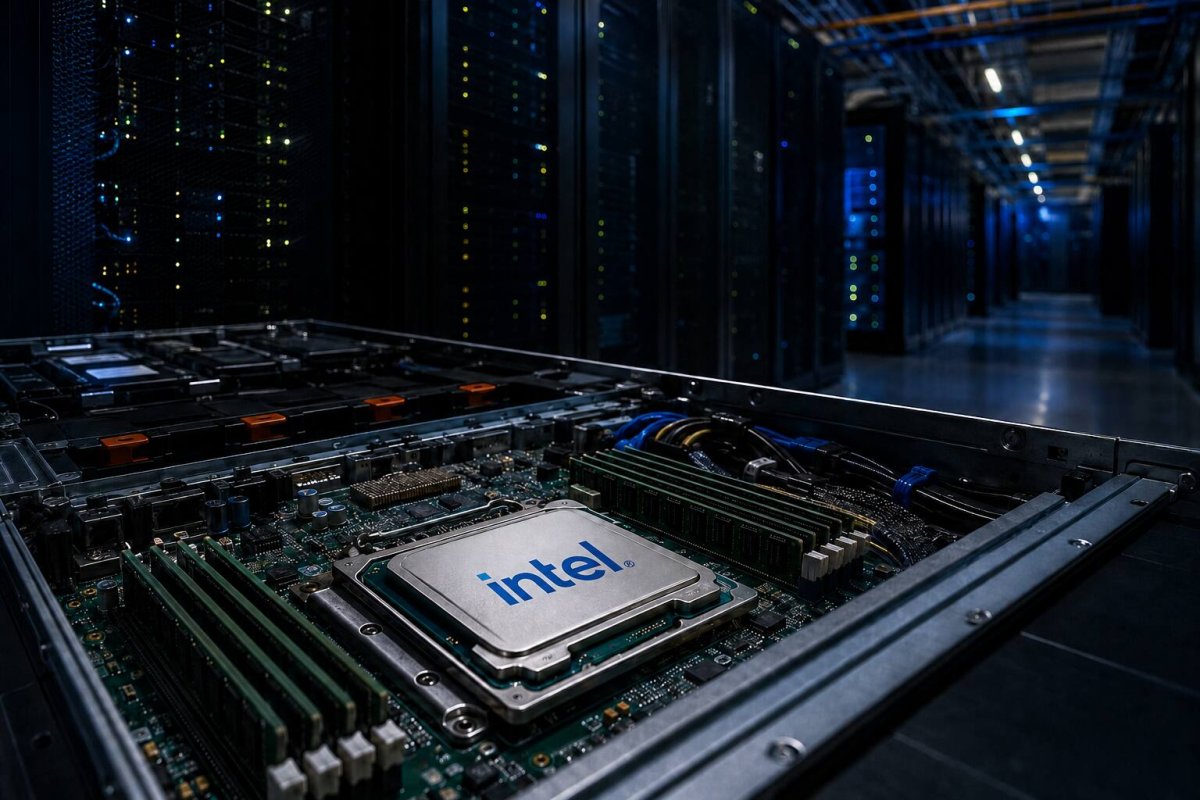
Intel Corporation (NASDAQ: INTC) experienced a notable surge on Friday, September 5, 2026, with shares climbing 4.5% to $95.80, adding approximately $20.8 billion to its market capitalization. This rally, which occurred on trading volume of 97.5 million shares, places the chipmaker in an unusual position where Wall Street analysts are sharply divided on its future value.
The bullish momentum comes amidst a rare and significant disagreement among financial experts. Mizuho Securities has set a price target of $92 per share, while Global Equities Research analyst Trip Chowdhry is far more optimistic, projecting a target of $200. This discrepancy is not merely academic; it translates into a staggering difference in implied equity value. Based on Intel's 5.044 billion outstanding shares, Mizuho's target implies a market valuation of approximately $464 billion, whereas Chowdhry's $200 target suggests a potential valuation of $1.009 trillion. Friday's closing price values the company near $483 billion, placing it closer to Mizuho's more conservative estimate.
The wide gap between these two targets highlights the uncertainty surrounding Intel's growth trajectory. Mizuho analyst Vijay Rakesh recently reduced his price target from $109 to $92, retaining a Neutral rating on the stock. This adjustment comes even as Intel trades 4.1% above that target, suggesting the stock may have run ahead of near-term fundamentals. In contrast, Chowdhry's bullish case is built on long-term earnings projections. He estimates that Intel's earnings per share (EPS) could reach $20 by 2031, which, at a 10-times multiple, supports his $200 price target.
However, such an earnings estimate implies significant growth. At today's share count, $20 of EPS would require annual profits of roughly $100.9 billion. To put this in perspective, Intel's second-quarter revenue annualizes to only $64.5 billion, and its non-GAAP EPS for the quarter was $0.42, or $1.68 on an annualized basis. This suggests that Chowdhry's projection anticipates a fundamental transformation of Intel's business over the next five years, far exceeding its current performance.
Some of the optimism stems from recent data from Dell Technologies (NYSE: DELL), which reported a 122% surge in traditional server and networking revenue to a record $10.5 billion last quarter. Dell's COO Jeff Clarke noted broader revenue growth across the company's portfolio. This data point is often seen as a positive indicator for Intel, as servers are a key market for its CPUs. However, it is important to note that Dell's server revenue includes networking equipment and systems with processors from multiple vendors, not just Intel. The direct read-through to Intel's CPU demand is not clear-cut.
Intel's own data center and AI segment showed strong growth, with revenue jumping 59% to $6.262 billion and operating profit reaching $2.474 billion. This segment is a critical profit driver for the company. However, Intel's foundry business continues to be a significant drag, posting a $2.089 billion operating loss on $5.765 billion in revenue. This loss represents 84.4% of the data center segment's operating profit, underscoring the financial strain of Intel's manufacturing expansion efforts. Most foundry revenue still comes from internal product groups, with external customers contributing just $293 million, highlighting the challenges in attracting outside clients.
CEO Lip-Bu Tan has emphasized that AI demand is broad, spanning Intel's CPUs, custom chips, packaging, and foundry network. The company recently launched Xeon 6+, its first server processor built on its Intel 18A manufacturing process. These product developments are crucial, but the financial reality remains sobering. Management forecasts third-quarter revenue between $15.8 billion and $16.8 billion, with non-GAAP EPS expected near $0.38, below the latest quarter's results despite the stronger server market signals.
The risks are balanced on both sides. Sustained server demand could accelerate data center growth beyond expectations, while foundry delays, competitive losses, or reduced spending could expose Friday's rally to a pullback. With Nasdaq closed on Monday for Labor Day, Intel shares will resume trading on Tuesday, positioned between the bearish and bullish analyst targets. The ultimate proof of Intel's trajectory will come from its ability to deliver on earnings, supplier mix, and foundry customer acquisition in the coming quarters.