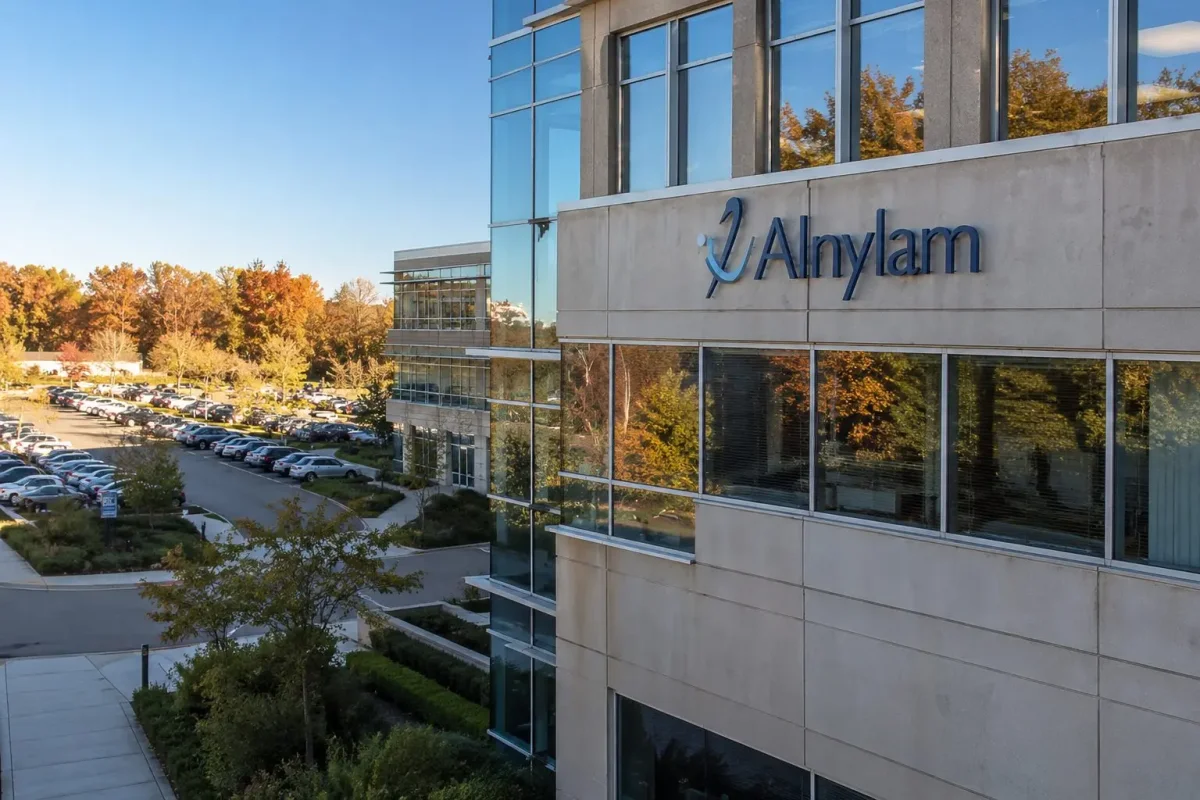
Alnylam Pharmaceuticals (NASDAQ:ALNY) experienced a sharp decline on Thursday, with shares plummeting 28.4% to $205.25 after the company revised its sales forecast for its flagship drug, Amvuttra. The stock touched an intraday low of $200.44, marking one of its worst trading sessions in recent history. The downward revision in guidance erased approximately $10.9 billion in market capitalization, based on the share count reported to the SEC on July 24.
Revenue Guidance Cut
The biotech firm lowered its 2026 transthyretin (TTR) product revenue forecast to a range of $4.2 billion to $4.5 billion, down from the previous outlook of $4.4 billion to $4.7 billion. The midpoint reduction of $200 million reflects management's reassessment of demand dynamics for Amvuttra, a gene-silencing therapy administered quarterly for transthyretin amyloidosis. The updated guidance implies average quarterly TTR sales of approximately $1.205 billion in the second half of the year, a 16.9% increase over the second quarter's performance.
Quarterly Performance and Market Reaction
Despite the positive quarterly results, where total revenue surged 67% to $1.291 billion and product sales jumped 74% to $1.172 billion, the market focused on the future outlook. Amvuttra achieved a milestone by generating over $1 billion in quarterly revenue for the first time, yet the guidance cut overshadowed the achievement. Adjusted earnings per share came in at $1.84, beating analyst estimates, but revenue fell short of the $1.32 billion consensus by nearly $31 million. The stock's decline was isolated to Alnylam, as other ATTR-related shares and the biotech sector index showed minimal movement.
Strategic Insights and Management Commentary
Chief Financial Officer Jeff Poulton acknowledged the misstep, stating, "We didn't get it right with our original guidance. We own that." He attributed the initial overestimation to an early surge in second-line demand from patients transitioning therapies. The company now expects first-line patient starts to drive approximately 80% of category growth, as newly diagnosed patients offset declining switch demand. Management emphasized that about 80% of ATTR cardiomyopathy patients remain untreated, presenting a significant opportunity for diagnosis initiatives and prescriber outreach.
Financial Metrics and Cost Pressures
Sequential analysis reveals a mixed picture. While product sales increased 13.1% from the first quarter, adjusted operating income declined 6.1%, and product costs rose to 25.4% of sales from 20.0%, driven largely by higher royalty rates for Amvuttra. The company maintained its non-GAAP R&D and SG&A spending guidance at $2.7 billion to $2.8 billion, indicating no cuts to research or commercial investments despite the revenue headwind.
Second-Half Hurdles
To meet the updated TTR revenue midpoint of $4.35 billion, Alnylam requires $2.409 billion in the second half, with average quarterly sales of $1.205 billion. Even at the lower end of the range ($4.2 billion), the company needs $2.259 billion, representing a 9.7% sequential increase from the second quarter. Achieving this will depend on the pace of first-line adoption, reimbursement dynamics, and clinical trial outcomes. Any shortfall in third-quarter TTR revenue below approximately $1.13 billion would increase the pressure on the fourth quarter.
Market Context
The broader market reaction was muted, with the SPDR S&P Biotech ETF (XBI) actually edging up 0.9% on the day. Peer companies such as BridgeBio Pharma (BBIO) fell 2.0%, Pfizer (PFE) declined 1.5%, and Ionis Pharmaceuticals (IONS) slipped 1.8%. This suggests that the negative sentiment was company-specific, driven by concerns over the sustainability of Amvuttra's growth trajectory rather than sector-wide issues.
Outlook and Risks
Investors will closely monitor third-quarter TTR revenue as an early indicator of whether the revised guidance is achievable. Key risks include slower-than-expected first-line adoption, adverse changes in reimbursement, or negative clinical trial developments, any of which could trigger further guidance adjustments. Alnylam's ability to expand the treated patient pool through increased diagnosis and prescriber education will be critical in the coming quarters.