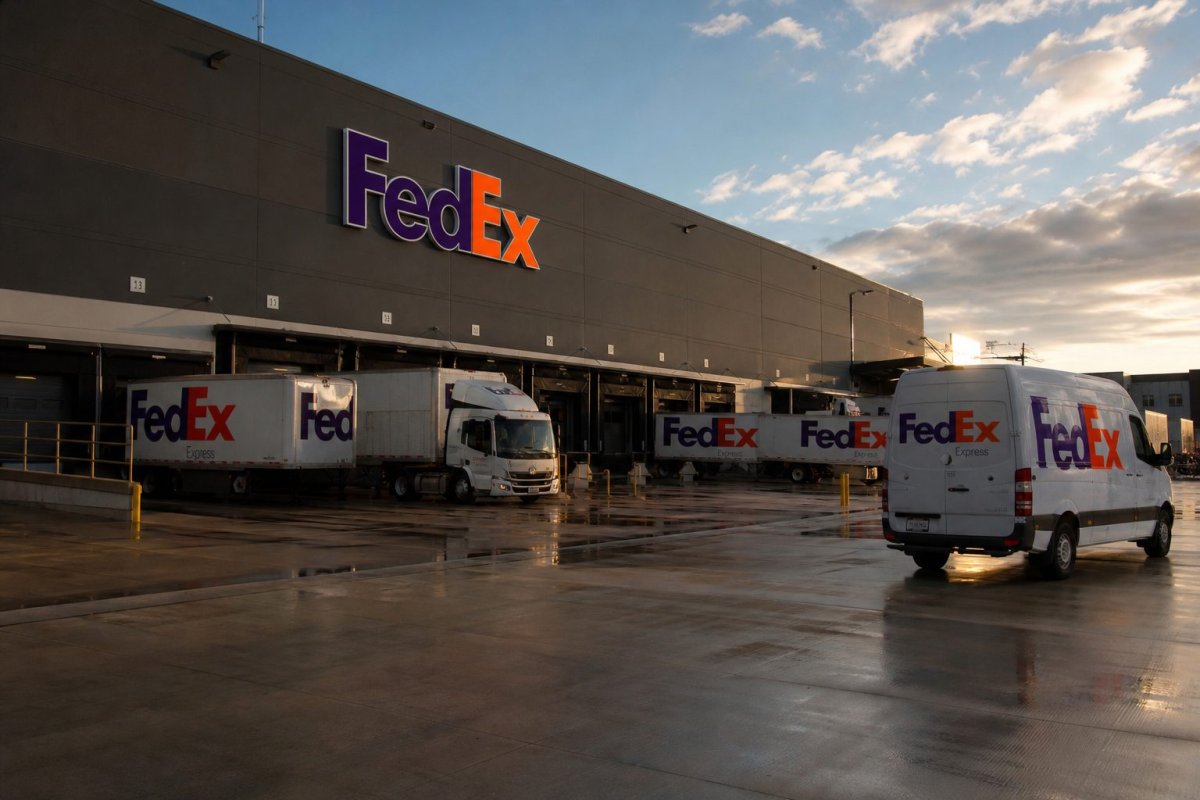
FedEx Corp. shares managed to stabilize during Tuesday morning trading, following the announcement that Amazon.com had launched a comprehensive supply chain service for third-party businesses. The new offering, dubbed Amazon Supply Chain Services (ASCS), directly competes with both FedEx and United Parcel Service across freight, fulfillment, and parcel shipping segments.
Amazon’s move represents a significant escalation in the ongoing logistics rivalry. The e-commerce giant is transforming its internally developed logistics network—originally built to support its own retail operations—into a service available to retailers, manufacturers, and healthcare companies. This gives shippers an alternative channel for moving goods from raw materials all the way to end customers.
FedEx was trading at $360.60 early Tuesday, up 0.8% from Monday’s close, while UPS climbed roughly 1.2% and Amazon added around 1.7%. The relatively muted reaction came after Monday’s sharp decline, which had trimmed FedEx’s year-to-date gains from 36% to about 24%, according to Bloomberg data.
The timing of Amazon’s announcement is notable, coming just weeks before FedEx’s planned spinoff of its FedEx Freight unit, scheduled for June 1. The spinoff had been anticipated by the market as a catalyst for unlocking value in the less-than-truckload (LTL) segment, where FedEx Freight is the largest operator in the U.S.
Amazon’s Expanding Logistics Ambitions
Amazon Supply Chain Services brings together freight, distribution, fulfillment, and parcel shipping into a single offering for companies outside Amazon’s marketplace. Early clients include Procter & Gamble, 3M, Lands’ End, and American Eagle Outfitters, the company confirmed. Peter Larsen, vice president of ASCS, described the goal as extending the “cost efficiency, reliability, and speed” that Amazon has long promised its own shoppers.
Amazon’s logistics network now includes a cargo fleet of over 100 aircraft, making it the third-largest air cargo operator behind only FedEx and UPS, according to Reuters. The company also operates extensive warehousing and sorting hubs. Its logistics service promises delivery in two to five days and includes inventory forecasting capabilities, which can help e-commerce customers reduce costs.
Analyst Reactions and Market Implications
Wall Street analysts quickly weighed in on the competitive threat. Evercore ISI described the move as “a direct competitive blow” to parcel carriers like UPS and FedEx. Parth Talsania, head of Equisights Research, framed Amazon’s effort as an attempt to “convert logistics from a cost burden into an infrastructure product.”
Morgan Stanley’s Ravi Shanker called it “a watershed moment” for North American freight, warning that air freight and parcel businesses may bear the brunt of the impact. Nate Skiver at LPF Spend Management sees Amazon’s all-in-one service as a major disruptor, saying it “stands to disrupt the US logistics market.”
FedEx’s Position and Future Outlook
Despite the competitive pressure, FedEx’s recent financial performance remains solid. In March, the company reported fiscal third-quarter revenue of $24.0 billion and adjusted diluted earnings of $5.25 per share. Management raised its fiscal 2026 adjusted earnings guidance to a range of $19.30–$20.10 per share.
The FedEx Freight spinoff remains on track for June 1. The unit, which is the top LTL operator in the U.S., is projecting medium-term revenue growth of 4% to 6% and adjusted operating profit growth of 10% to 12%. Rivals in the LTL space include XPO and Old Dominion Freight Line.
For investors, the key risks revolve around how quickly Amazon can attract third-party shippers and whether it will aggressively fill capacity and undercut prices on high-volume e-commerce routes. Mark Hackett, chief strategist at Nationwide, described the direct effect as “immeasurable” and suggested the market’s initial reaction was “likely exaggerated.”
As the logistics landscape evolves, both FedEx and UPS will need to demonstrate resilience in the face of Amazon’s growing infrastructure. The June 1 Freight spinoff could provide FedEx with a sharper focus, but the shadow of Amazon’s expanding logistics empire will remain a key theme for the transport sector.