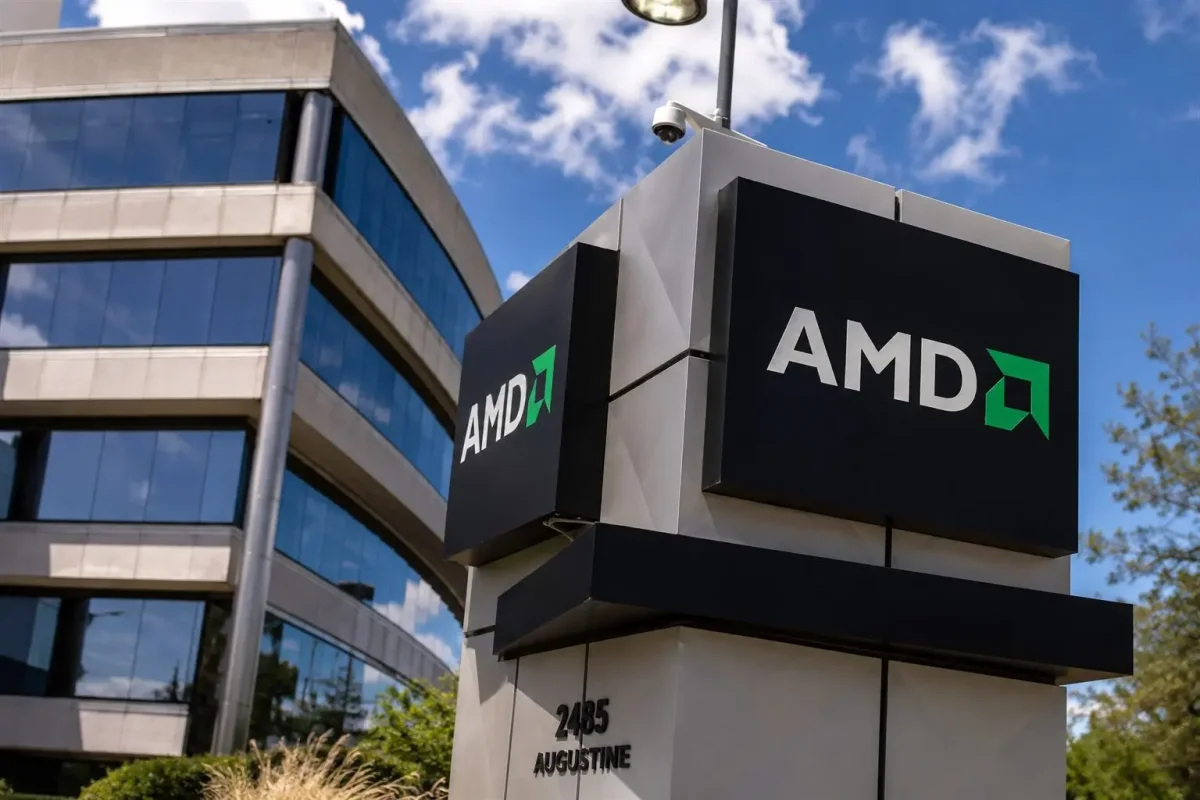
Advanced Micro Devices (NASDAQ:AMD) shares climbed 1.28% to $553.71 in late trading on Friday, outpacing the PHLX Semiconductor Index's modest 0.13% gain but still trailing Nvidia Corp (NASDAQ:NVDA), which surged 3.49% to $209.85. The stock recovered 3.1% from its session low after a volatile $23.29 intraday swing, pushing AMD's market capitalization to roughly $914 billion.
The central question for AMD investors is no longer whether the company will benefit from surging AI spending, but rather how much additional upside remains in the stock. Stifel analyst Ruben Roy raised his price target sharply to $635 from $450, arguing that AMD's AI narrative has evolved from a “show-me” story to a credible “number-two” position behind Nvidia. However, the average analyst target on TipRanks stands at just $520.23, trailing AMD's current price after a 159% year-to-date rally.
This divergence creates a $189 billion gap between Stifel's bullish case, which implies a $1.05 trillion market cap, and the consensus view, which suggests a $858.6 billion valuation. The disagreement isn't about near-term quarterly results but rather over time horizons—how long AMD can continue gaining server processor market share, how quickly its AI accelerators will ramp, and whether customers will keep buying third-party chips while also developing their own.
Roy emphasized that AMD's EPYC server CPUs remain the primary growth driver. He expects the company to beat Q2 estimates and raise guidance when it reports on August 4. However, he noted that shares already trade at roughly 40 times projected earnings. The next phase of growth hinges on successful commercialization of AMD's MI450 GPUs, which are purpose-built for AI workloads.
William Blair analyst Sebastien Naji initiated coverage on AMD with a Market Perform rating, projecting revenue growth from $52 billion in 2026 to over $104 billion by 2028, with adjusted earnings per share approaching $20. Yet Naji cautioned that AMD's “era of easy CPU share gains is ending” as custom chips, Arm-based processors, and a resurgent Intel (NASDAQ:INTC) intensify competition in the server market. Intel shares fell 2.06% to $110.22 on Friday.
Investor behavior suggests they are increasingly separating AI accelerator plays from the broader semiconductor sector. Benchmark Research's Cody Acree noted that Nvidia may lose some customer share but still grow revenue as hyperscaler spending is expected to double. AMD would benefit from the same trend, but its smaller scale leaves less room for error if products are delayed or fail to meet expectations.
Meta Platforms (NASDAQ:META), a key AMD customer, announced plans to begin production of its own Iris AI chip in September and aims to double its computing capacity to 14 gigawatts by 2027. The chip is not intended to fully replace AMD and Nvidia processors Meta already purchases. “You can't become an AI titan if you are dependent on another company for chips,” said Forrester analyst Mike Gualtieri.
AMD's next major catalyst is its Q2 earnings report on August 4, after the market close, followed by a conference call at 5 p.m. EDT. Investors will focus on MI450 shipment timelines, server CPU growth, and whether product mix can sustain margins as lower-margin AI system sales increase. Risks include a slowdown in AI spending, supply chain disruptions, or faster-than-expected customer migration to in-house chips, any of which could compress AMD's valuation before earnings materialize. William Blair flagged the stock's high multiple—roughly 33 times expected 2027 earnings—leaving little buffer if AMD misses or Intel stages a comeback.
Friday's gain didn't resolve the debate, but it brought the opposing views closer together. AMD trades as if the market has already crowned it an AI winner, yet the gap between its current price and both the analyst average and Stifel's $1 trillion case underscores how the conversation has shifted from demand forecasts to what AMD can actually deliver.