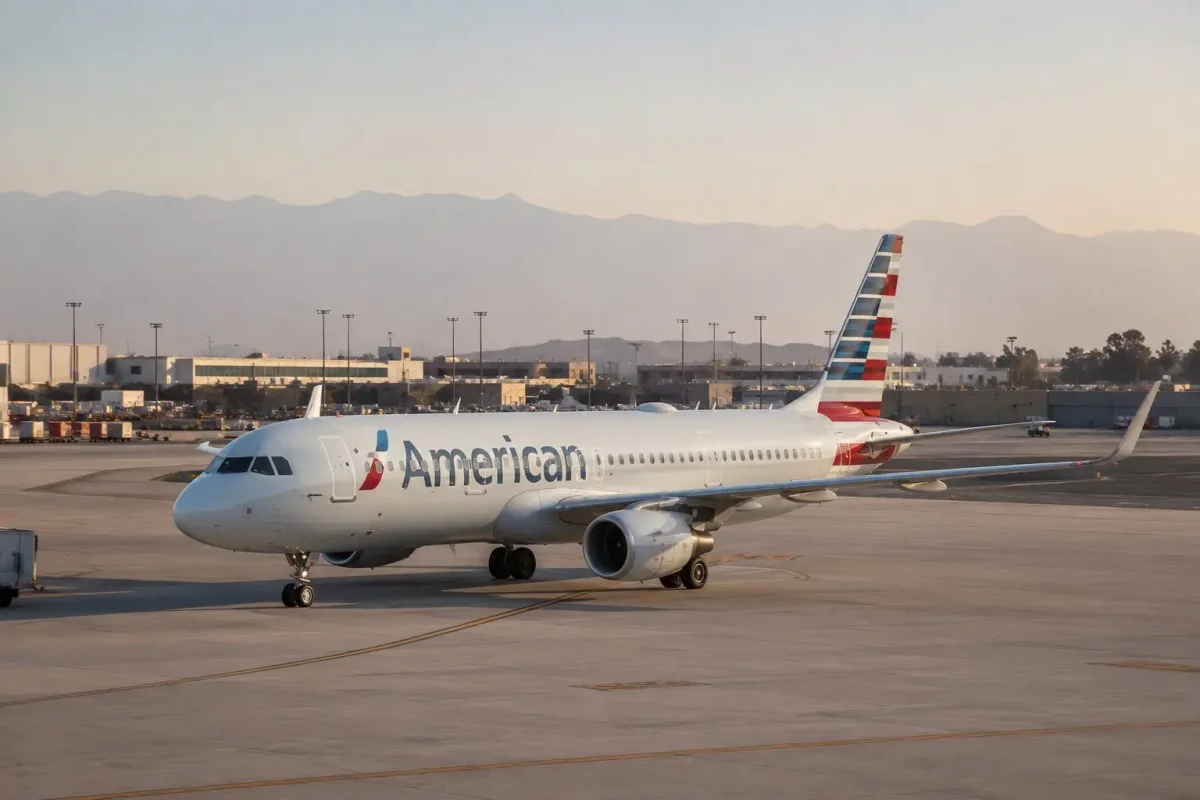
American Airlines Group Inc. (NASDAQ:AAL) faces a critical test as it prepares to release second-quarter earnings on July 23 before U.S. markets open. The carrier's stock closed at $15.60 on Thursday, down 8.0% from its July 10 level, reflecting investor caution over the company's profit outlook and elevated valuation.
Based on American's current 2026 adjusted earnings per share (EPS) guidance range of a 40-cent loss to a $1.10 profit, the stock trades at 44.6 times the midpoint of 35 cents. Even at the upper end of the guidance, the price-to-earnings multiple is 14.2 times, still above the multiples of major rivals. In contrast, United Airlines Holdings Inc. (NASDAQ:UAL) trades at 11.9 times its midpoint guidance of $10.00, and Delta Air Lines Inc. (NYSE:DAL) trades at 12.4 times its midpoint of $7.00, based on Thursday's closing prices.
The valuation gap underscores market stress rather than a standard valuation comparison, as American's guidance range dips below zero. Investors may instead focus on projected normalized 2027 earnings to assess the stock's fair value. The company's highest multiple is more than triple that of each peer at the midpoint, indicating heightened uncertainty about near-term profitability.
Rising oil prices add to the pressure. Brent crude stood at $84.75 per barrel and U.S. crude at $79.80, with both benchmarks on track to finish the week more than 11% higher. This challenges American's fuel cost recovery plans. The airline aimed to offset nearly half of its fuel cost increase in the second quarter, with targets of 75%-85% recovery in the third quarter and over 90% in the fourth quarter. A sustained oil price surge could jeopardize those goals and further compress margins.
American's second-quarter outlook, issued in April, projected adjusted EPS ranging from a loss of 20 cents to a profit of 20 cents, alongside revenue growth of 13.5% to 16.5%. The wide range highlights the dilemma: sales may increase rapidly while adjusted profit remains near zero. In late May, CEO Robert Isom stated that the company would "not make any changes" to its annual forecast, which remains between a 40-cent loss and $1.10 per share, according to Reuters.
In contrast, United reported second-quarter adjusted EPS of $1.99 this week and raised its 2026 guidance to $9-$11 per share. United recovered about half of its fuel cost increase for the quarter and expects to recover 80%-90% in the third quarter, achieving full recovery by the fourth quarter. CEO Scott Kirby noted that yields are expected to approach "reasonable pre-pandemic levels," with higher fares having minimal impact on demand, per Reuters.
Delta delivered a similar message last week. Revenue rose nearly 14% while capacity increased by about 1%, and the airline offset roughly 60% of its fuel cost rise for the quarter. Both United and Delta have demonstrated stronger profit conversion, which has helped their stocks maintain lower valuation multiples.
American ended March with $34.7 billion in debt and $10.8 billion in liquidity. The company's earnings call on July 23 at 7:30 a.m. CDT will be closely watched for updates on the fuel curve, third-quarter unit revenue, and full-year EPS guidance. If the guidance range remains unchanged, management will need to provide evidence that the upper end of the range is achievable.
Risks are present in both directions. A further surge in oil prices or excess capacity later in the year could reduce earnings. Conversely, lower fuel costs and sustained ticket prices could boost profits. For now, American Airlines trades at a significant valuation premium that demands a strong profit result to justify.