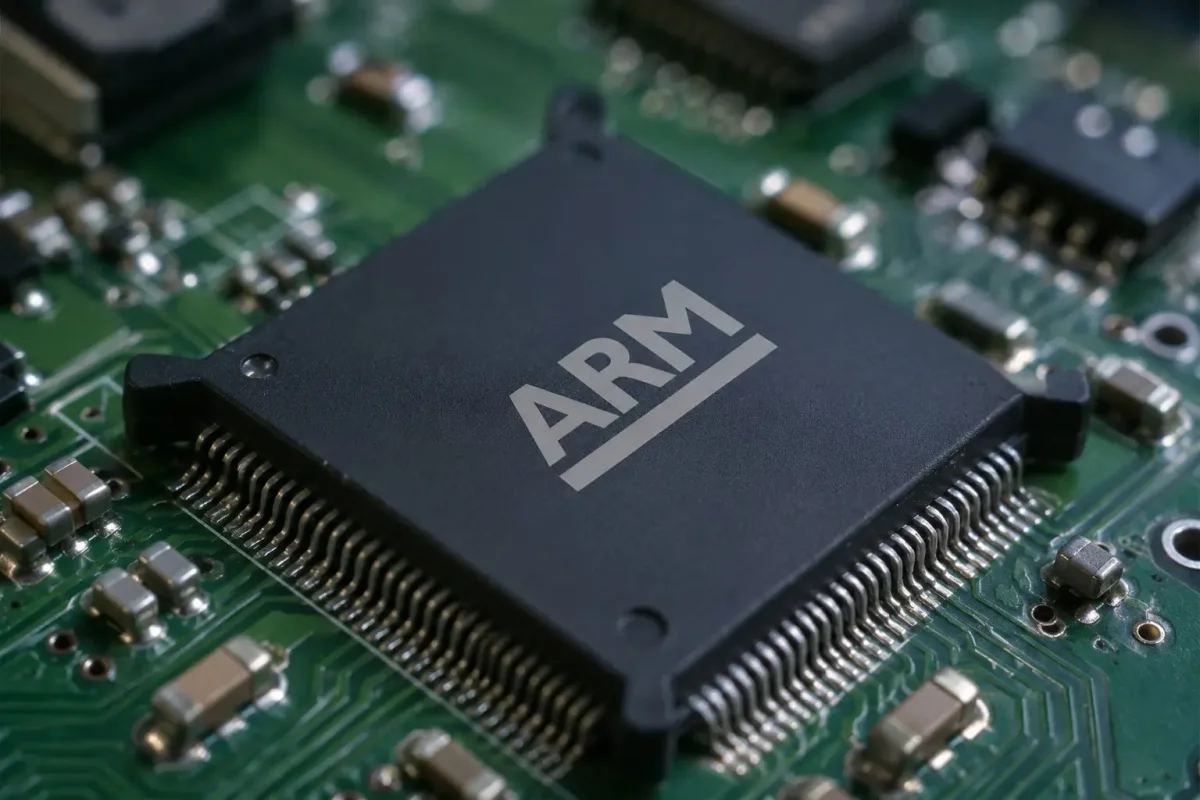
Arm Holdings (ARM) shares rocketed 10.76% on Thursday, closing at $335.27 after hitting a fresh 52-week high of $349.42 during the session. The rally came as Mizuho Securities analyst Vijay Rakesh raised his price target on the chip designer to $360 from $290, the most bullish forecast among Wall Street analysts tracked by Reuters.
The new target implies roughly 7.4% upside from Thursday’s close and reflects a shift in how investors value Arm. Once viewed primarily as a smartphone-chip royalty collector, the company is now being re-rated as a key player in central processing units (CPUs) for AI infrastructure. “The market is starting to price in Arm’s position in general-purpose computing, especially as AI moves beyond chatbots into agentic tools,” Rakesh wrote in a note to clients.
Arm licenses its chip designs to partners such as Nvidia and Apple, earning royalties on every device that uses its architecture. Its energy-efficient designs have become increasingly critical as data centers struggle with soaring power consumption and heat loads from large AI models. CEO Rene Haas earlier this month told Reuters the company is “very bullish about this data center demand,” pointing to a growing royalty stream from that segment.
However, not all analysts are convinced. Seaport Research Partners’ Jay Goldberg cautioned that expectations were “just so high,” warning the stock could be vulnerable to a pullback. Arm has flagged that it has supply lined up only for the first $1 billion in demand for its new AI chip, leaving potential growth capped in the near term. Additionally, ongoing weakness in smartphone royalties—a key revenue source—continues to weigh on the business.
The broader chip sector also provided tailwinds. Global stocks hit a fresh record on Friday, fueled by AI optimism after Dell’s improved outlook. “Multiple confirmation points are giving the AI rally new legs,” said Jason da Silva at Arbuthnot Latham. The competitive landscape is shifting rapidly: Reuters reported that ByteDance is developing its own CPUs for AI, joining Google, Amazon, and Microsoft in the race to design in-house chips. While Intel and AMD still supply the majority of CPUs, Nvidia is also pushing deeper into the CPU space to protect its AI-chip dominance.
Arm sits at the center of this rivalry but doesn’t compete directly with Nvidia, AMD, or Intel. Instead, its designs are embedded inside the chips of those hyperscalers, allowing Arm to capture a slice of growing CPU demand even as more companies build custom silicon. “Arm’s model means it benefits from the expansion of AI computing without having to win every design win itself,” one analyst noted.
Despite Thursday’s breakout, valuation risk remains elevated. The stock now trades largely on promises of future AI revenue, with much of that revenue yet to materialize. If supply constraints persist, AI server spending slows, or capital flows rotate out of high-multiple chip names, the recent rally could face a sharp reversal.