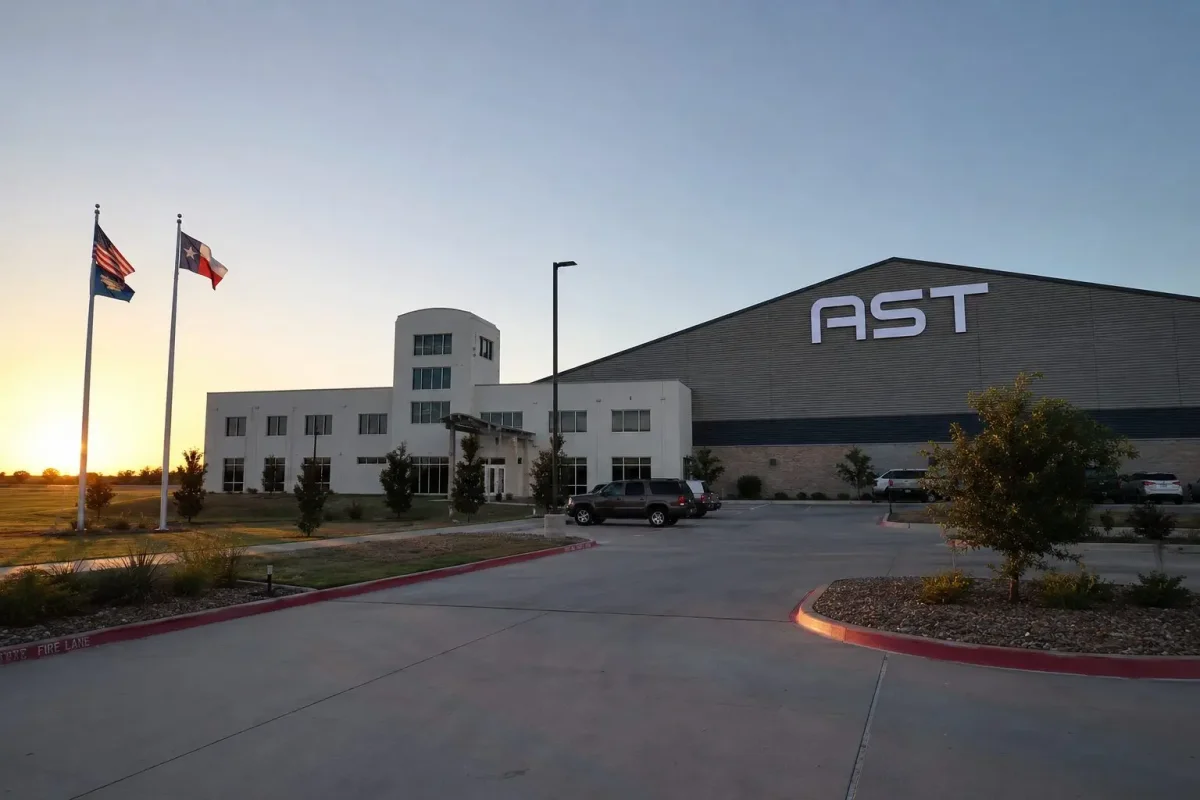
AST SpaceMobile (ASTS) shares continued their upward trajectory in premarket trading Tuesday, reaching $112.72 as of 4:49 a.m. EDT, marking a 6.48% increase from Friday's close of $105.86. The move follows a 10.01% gain last Friday, capping a week of consecutive daily advances for the satellite-to-phone broadband company.
The rally comes as U.S. cash equities prepare to resume trading after the Memorial Day holiday, with Nasdaq closed Monday. AST SpaceMobile has emerged as one of the few publicly traded pure plays on direct-to-device satellite technology, which enables standard smartphones to connect directly to satellites without specialized hardware.
Space-Themed ETF Inflows Surge
Investor enthusiasm extends beyond AST, with space-themed exchange-traded funds attracting $1.3 billion in net inflows over the past month, pushing total assets under management for these funds to $3.3 billion, according to Reuters. The influx is partly driven by speculation surrounding a potential SpaceX initial public offering. Morningstar's Bryan Armour described the trend as investors gravitating toward something "new and shiny," while Strategas ETF strategist Todd Sohn noted the limited number of publicly traded space companies could lead to significant overlap among these funds.
Reflecting heightened trading interest, Defiance launched ASTY, a 2X daily long ETF tracking AST SpaceMobile. The product aims to amplify AST's daily price movement, before fees, and is marketed specifically for experienced traders, though it does not represent a direct stake in AST.
Industry Momentum Builds
The broader wireless industry is increasingly embracing satellite connectivity. Earlier this month, AT&T, T-Mobile, and Verizon announced a joint venture to advance direct-to-device satellite technology, aiming to address coverage gaps and establish industry standards. AST SpaceMobile CEO Abel Avellan welcomed the initiative, stating the company intends to be a "key enabler" as it expands its low Earth orbit satellite network, which offers lower latency compared to higher-altitude satellites.
AT&T CEO John Stankey highlighted AST at a J.P. Morgan investor conference, describing a "great relationship" with the company and calling its technology "unique for direct-to-device." Stankey indicated AT&T will continue advancing the product as the new joint venture progresses through regulatory approvals.
Financial and Operational Update
AST SpaceMobile's first-quarter results showed revenue of $14.7 million, a sharp increase from $718,000 a year earlier, though the net loss attributable to common stockholders widened to $191.0 million, or 66 cents per share. The company noted that SpaceMobile service has not yet launched and currently generates no revenue.
On the operational front, AST reported that its Block 2 BB7 satellite, launched in April, ended up in a lower orbit than planned and subsequently de-orbited. The carrying value of the satellite is estimated between $155 million and $160 million, with insurance claims still under review. The company aims to have approximately 45 BlueBird satellites in orbit by the end of 2026, though this timeline depends on satellite testing, launch vehicle readiness, logistics, approvals, available launch windows, and capital.
Competitive Landscape
SpaceX's Starlink remains the benchmark for investors, while Rocket Lab represents another publicly traded space company. For AST, the focus is squarely on the wireless sector. Both AT&T and Verizon have invested in AST for direct-to-device capabilities, while T-Mobile operates its own service based on Starlink.
Traders will be watching regular-session volume closely to determine whether the premarket momentum holds after the long weekend. AST's stock behavior increasingly resembles that of a call option on the potential for satellite broadband to transition from pilot programs and carrier agreements to full-scale commercial deployment.