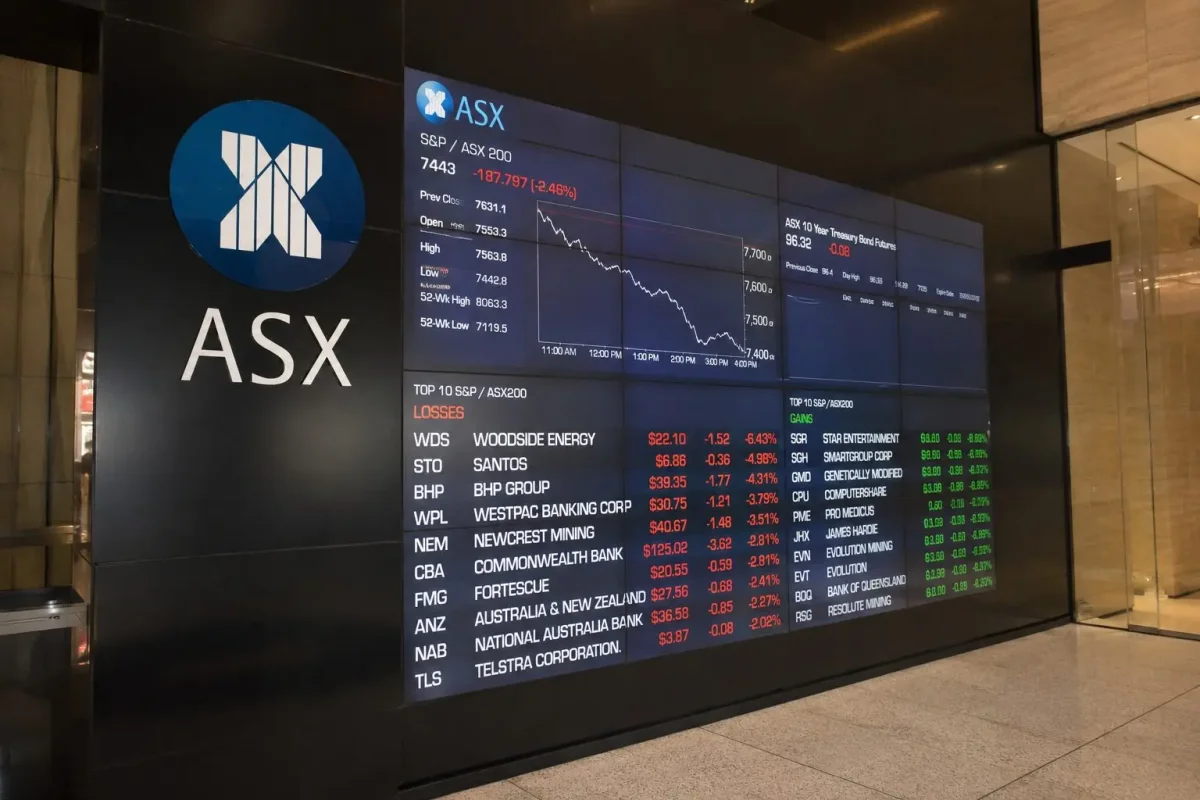
The Australian stock market took a heavy hit on Thursday, with the S&P/ASX 200 index dropping 1.4% to close at 8,592.90 as escalating geopolitical tensions in the Middle East pushed oil prices sharply higher. The renewed conflict near the Strait of Hormuz, a crucial maritime chokepoint for global oil shipments, sparked a broad risk-off move across Asian markets, dragging down banks, miners, and technology stocks.
According to Market Index, the banking, mining, and technology sectors each suffered losses exceeding 2% during the session. The S&P/ASX All Ordinaries Gold index was hit particularly hard, plunging as much as 7.1% as bullion prices slipped. Major lenders including Commonwealth Bank, National Australia Bank, and Westpac all traded lower, mirroring the same concerns over interest rates and economic growth that have weighed on global financial shares.
ASX Ltd remained under pressure, extending its losing streak after a tough week. The Inside Adviser reported that the stock has now lost 9.7% following analyst downgrades. Other notable movers included Endeavour Group, Web Travel, Southern Cross Media, and Nufarm, all of which saw significant declines amid the broad sell-off.
Oil spike reignites inflation fears
The rebound in oil prices ended a short-lived bounce in Australian markets that had been triggered by softer-than-expected inflation data earlier in the week. The April consumer price index (CPI) eased to 4.2%, down from 4.6% in March, according to the Australian Bureau of Statistics. However, the trimmed mean measure of core inflation, which strips out the most volatile price movements, ticked up to 3.4%—still above the Reserve Bank of Australia's (RBA) target range of 2% to 3%.
With oil prices now climbing again, investors are once again grappling with the same dilemma that has plagued markets in recent weeks: energy-driven price shocks that could keep inflation elevated and force central banks to maintain higher interest rates for longer. This scenario poses particular risks for sectors sensitive to borrowing costs, such as banks, property, and technology.
Regional markets in retreat
The risk-off sentiment rippled across Asia after the U.S. launched new strikes on Iranian targets and reports emerged of attacks in Kuwait. Brent crude futures bounced, Treasury yields climbed, and stock markets fell across the region. Japan's Nikkei 225 dropped 1.4%, South Korea's KOSPI lost 3.2%, and MSCI's broadest index of Asia-Pacific shares slid 2.1%.
Madison Cartwright, senior geo-economics analyst at CBA, told Reuters that markets are now waiting for a clear outcome, adding that there is a 70% chance of a new ceasefire deal, but the situation around the Strait of Hormuz remains highly uncertain. "It's either a deal for a new ceasefire, or the current ceasefire will have collapsed," he said.
Domestic data adds to uncertainty
On the home front, the data did little to clarify the outlook for investors. Harry McAuley, an economist with Oxford Economics Australia, said he expects headline inflation to peak at 4.9% in the second quarter before falling below the RBA's upper target band by mid-2027. "The rate hike cycle is on hold," he commented, adding that the labor market is beginning to lose some steam.
Meanwhile, Australian household spending dropped 1.1% in April to A$79.42 billion, a steeper decline than analysts had forecast. The data showed that air transport took the biggest hit as travel demand softened and airlines scaled back routes.
The market is now pricing in a high probability of a ceasefire, but analysts warn that if oil prices remain elevated or shipping through the Strait of Hormuz continues to be disrupted, inflation could prove stickier than expected. That would leave the RBA with less room to pause and add further strain on rate-sensitive sectors.
Looking ahead
Investors will be closely watching the release of U.S. PCE inflation data, the Federal Reserve's preferred price gauge, due late Thursday AEST. Durable goods orders, jobless claims, and revised GDP figures are also scheduled for release. In addition, China's official manufacturing PMI data is due on Sunday, which could pose another risk for resource-related stocks.