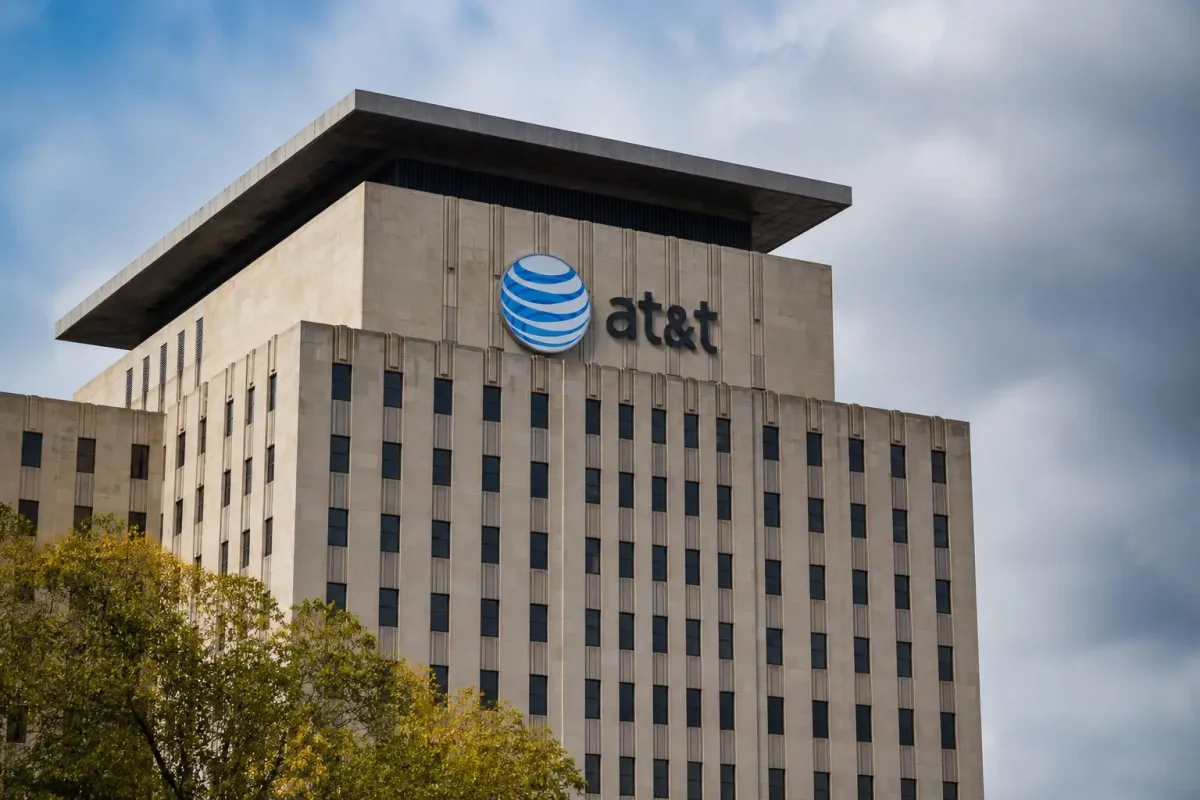
AT&T Inc. (NYSE:T) closed at $21.30 on Tuesday, July 14, 2026, marking a modest 0.8% gain over two sessions. This uptick came despite a 17% reduction in Bernstein's price target, which cited risks from SpaceX's Starlink satellite broadband service. The telecom giant now carries a market capitalization near $150 billion, with its latest full-year outlook targeting at least $18 billion in free cash flow for 2026. That projection translates to a 12% free-cash-flow yield and covers the current dividend approximately 2.3 times, though much of that yield stems from the stock's discounted valuation.
AT&T's recent performance showed a sharp contrast with the broader market. On Monday, the stock jumped 2.0% while the S&P 500 dropped 0.8%. However, on Tuesday, shares dipped 1.2% as the benchmark index gained 0.4%. Over the same period from Friday's close through Tuesday, Verizon Communications Inc. (NYSE:VZ) added 0.5%, T-Mobile US Inc. (NASDAQ:TMUS) fell 0.2%, and the S&P 500 declined 0.4%. The relative strength in telecom was uneven, highlighting sector-specific dynamics.
Bernstein analyst Laurent Yoon maintained his Outperform rating on AT&T but lowered the price target to $25 from $30, a level still 17% above Tuesday's closing price. In a note dated Monday, Yoon argued that SpaceX's Starlink (NASDAQ:SPCX) is entering an already crowded broadband market, but AT&T appears the least exposed among major carriers due to its heavier reliance on fiber for internet services. The market appears to be differentiating between current cash flow generation and future competitive threats, a distinction that is clearly reflected in valuation.
AT&T trades at roughly 7.1 times trailing earnings, a 31% discount to Verizon's 10.4x and a 64% discount to T-Mobile's 19.9x. Its dividend yield of 5.2% sits in the middle of the pack, below Verizon's 6.7% but above T-Mobile's 2.2%. This valuation gap suggests investors are pricing in more risk for AT&T, likely tied to its debt load and the uncertain impact of Starlink on its broadband business.
On the pricing front, AT&T is raising rates on some retired unlimited plans, adding $10 per month for single-line users and $20 per account for customers with multiple lines. Some subscribers saw the increase in April, while others will face it in August. A market note on Monday described the move as a follow-up to similar price hikes at Verizon and T-Mobile, calling it "a further signal that wireless competition could be moderating." The real test will be whether higher prices offset any subscriber churn.
AT&T's first-quarter results suggest the company has room to test pricing. It added 294,000 postpaid phone customers and 584,000 new high-speed internet connections. Revenue rose 2.9% to $31.5 billion, while adjusted EPS improved to $0.57 from $0.51. CEO John Stankey called it "our best first quarter ever" for new internet customers. However, free cash flow fell to $2.5 billion from $3.1 billion a year earlier, as capital investment climbed. With 6.95 billion shares outstanding, the $1.11 annual dividend requires about $7.7 billion in payouts. The full-year target of $18 billion in free cash flow would leave $10.3 billion before planned buybacks and other uses, but the trajectory is not guaranteed.
Satellite risk is not universally viewed as imminent. Morgan Stanley's Sean Diffley wrote last week that the market may be overestimating Starlink's short-term threat to U.S. wireless over the next year or two, even as he lowered AT&T's target price to $25 from $30. The risk appears more embedded in valuations than in current financials. Still, the narrative can shift quickly. Higher bills may push customers to switch, and another major fiber build could slow the cash flow recovery. AT&T ended March with $126.4 billion in debt net of cash. Starlink does not need to capture urban wireless markets to squeeze rural broadband or drive up acquisition costs. Perhaps AT&T's discount is warranted.
With second-quarter earnings scheduled for July 22, investors will focus on two key questions: whether higher pricing boosts service revenue without hurting customer additions, and whether free cash flow begins to align with the company's latest investment cycle. At $21.30, the stock offers a 5.2% dividend yield, but the 12% cash yield suggests the market remains uncertain about the path ahead. The Street wants evidence that the cash flow story is on track.