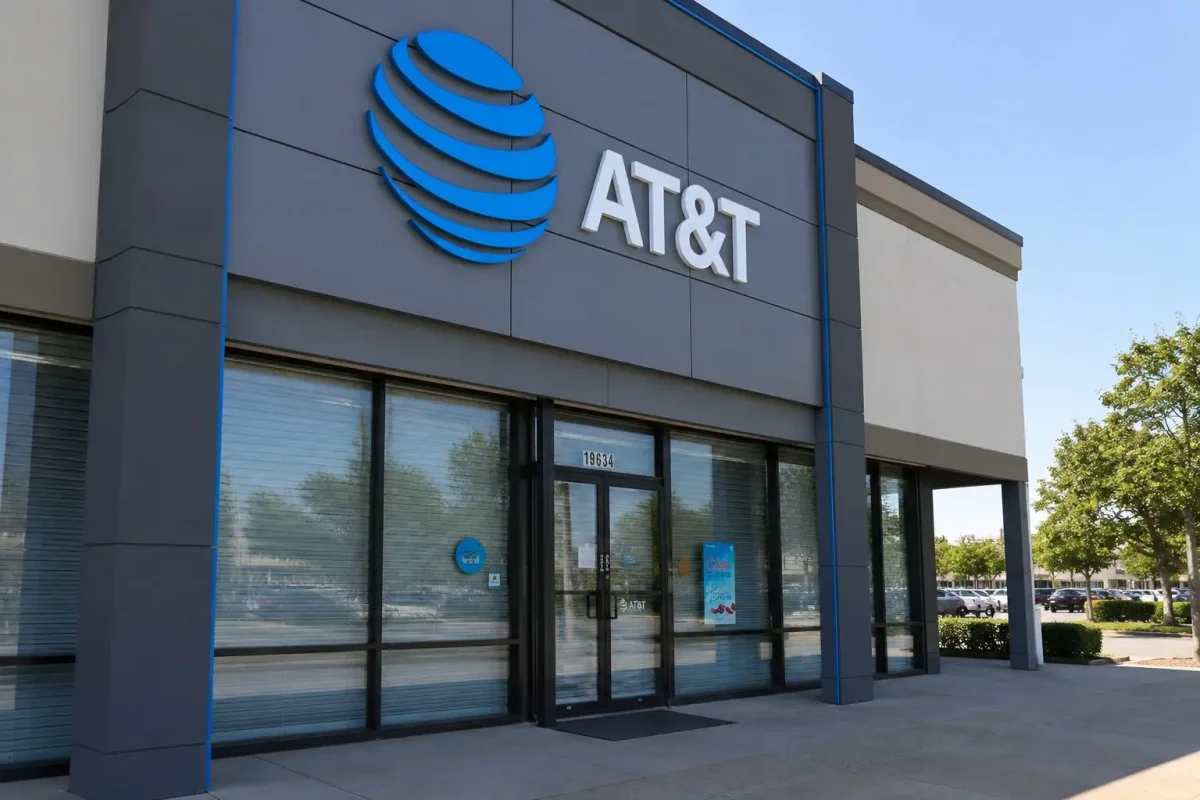
AT&T Inc. (NYSE: T) saw its shares drop 8.3% over the past week, closing at $22.75 on Friday as investors weighed the potential impact of SpaceX's Starlink satellite internet service on the traditional broadband market. The decline came amid a broader market selloff and ahead of SpaceX's highly anticipated Nasdaq debut.
The telecom giant's stock took its hardest hits midweek, falling 4.42% on Wednesday and another 3.31% on Thursday. The selloff was triggered by an Oppenheimer analyst note warning that Starlink could disrupt the $1.6 trillion U.S. communications sector, putting legacy broadband players like AT&T at risk.
Oppenheimer analyst Timothy Horan downgraded AT&T from “Outperform” to “Perform,” arguing that the market may be “underestimating” the threat from low-Earth-orbit satellite services. These satellites, which operate closer to Earth than traditional ones, can significantly reduce internet latency. Horan noted that Starlink's pricing now matches older broadband services, making it a more direct competitor.
SpaceX is expected to begin trading on Nasdaq on June 12, with a reported valuation of $1.75 trillion. The IPO marks the company's first public stock sale and has drawn significant investor attention, potentially amplifying concerns about its impact on established telecoms.
In response to these pressures, AT&T is rolling out a new, simplified fiber internet plan on Sunday. The company will offer four speed tiers: 300 Mbps, 500 Mbps, 1 GIG, and 5 GIG. Customers who bundle AT&T wireless and home internet could save up to $420 annually. Jenifer Robertson, executive vice president and general manager of AT&T Consumer, emphasized the company's focus on “value, savings, and a network that performs.”
AT&T's strategy hinges on “convergence”—convincing customers to sign up for both mobile and home broadband services. In the first quarter, the company reported 584,000 net additions in advanced-connectivity internet, including fiber and fixed wireless, along with 294,000 net new postpaid phone lines. CEO John Stankey highlighted the company's ability to offer “fiber and 5G all from one provider.”
The broader market also faced headwinds on Friday. The S&P 500 fell 2.64%, and the Nasdaq Composite dropped 4.18%, after a strong May jobs report dampened expectations for a near-term Federal Reserve rate cut. Most of the pressure was concentrated in technology and semiconductor stocks, while AT&T traded largely on its own sector and company-specific news.
Regulatory challenges also emerged. The U.S. Supreme Court ruled against AT&T and Verizon in a dispute over the FCC's ability to issue fines related to the handling of customer location data. The FCC had previously fined AT&T $57 million, Verizon $47 million, T-Mobile $80 million, and Sprint $12 million.
Looking ahead, the selloff could present two scenarios. If Starlink remains a niche player focused on rural areas, AT&T's cheaper shares and dividend yield may attract value investors. However, a strong SpaceX IPO could keep satellite competition in the spotlight, forcing legacy carriers into deeper discounts and raising questions about the returns on AT&T's fiber investments.
AT&T CFO Pascal Desroches is scheduled to speak at the Mizuho Technology Conference on Tuesday. The company's next earnings call is not until July 22, leaving investors to assess whether last week's drop was a temporary blip or a sign of more significant challenges ahead.