Aurora Innovation Inc. (AUR) saw its stock price retreat 2.6% on Friday, closing at $4.12 per share. This movement places the autonomous trucking technology company's market capitalization at approximately $9.95 billion, a significant figure that stands in stark contrast to its current financial performance. For the full year 2025, Aurora reported revenue of just $3 million, underscoring the speculative premium investors are assigning to its future potential in the nascent self-driving freight sector.
The company's most recent quarterly results highlight the substantial gap between its ambitious vision and present financial reality. Aurora posted $1 million in revenue for the fourth quarter, alongside a steep operating loss of $238 million. Management has projected operating cash usage for 2025 to reach $581 million, though liquidity remained robust at about $1.5 billion as of year-end. Chief Financial Officer David Maday has indicated that revenue for the critical 2026 fiscal year will be "back-end loaded," with the majority of income expected to materialize in the latter part of the year as the company accelerates the deployment of its driverless fleet.
Strategic Milestones and Fleet Expansion
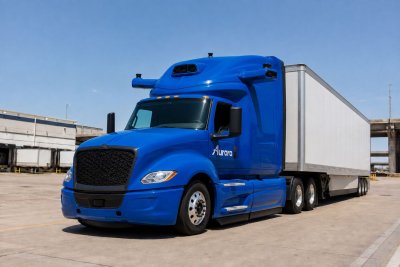
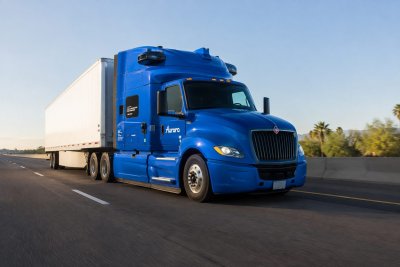
Central to Aurora's strategy is the aggressive scaling of its commercial operations. The company has publicly committed to operating more than 200 driverless trucks on public roads before the conclusion of 2026. This expansion is intended to move the company beyond initial pilot programs and freight runs, with a focus on broadening its network across the Sun Belt region of the United States. Aurora has stated that its commercial truck capacity is already fully booked through the third quarter of 2026, suggesting strong initial demand from shipping partners.
On the operational safety front, Aurora reports a milestone of 250,000 cumulative driverless miles traveled by its fleet as of January, with no collisions attributed to its proprietary Aurora Driver system. The company also claims it initiated the first commercial driverless trucking operations on U.S. public roads during 2025. A recent software update is pivotal to its growth plans, having validated a roughly 1,000-mile autonomous corridor stretching from Fort Worth, Texas, to Phoenix, Arizona. This development eliminates traditional Hours of Service constraints that govern human drivers. Furthermore, the company says it has authorized driverless operations in adverse weather conditions—including rain, fog, and high winds—which previously sidelined its Texas-based fleet for about 40% of the prior year.
Market Context and Competitive Landscape
Aurora is not operating in a vacuum. The competitive field for autonomous freight technology is intensifying rapidly. In January, competitor Gatik announced it had secured $600 million in contracted revenue and confirmed its driverless trucks were already engaged in commercial operations. Another key player, Kodiak AI, disclosed a partnership with automotive supplier Bosch this year, aimed at developing scalable hardware systems for self-driving trucks. This evolving competitive dynamic pressures all participants to accelerate technological development and commercial partnerships.
Beyond direct rivals, Aurora is actively working to shape the broader economic narrative around autonomous trucking. In mid-March, the company published a study conducted by the Steer Group, which it commissioned. The report argues that the widespread adoption of autonomous trucking could contribute up to $70 billion to U.S. GDP by 2035. It also projects annual savings of $5.7 billion in shipping fuel costs and an additional $9 billion in disposable income for American consumers each year. Aurora CEO Chris Urmson has championed the technology as a "massive engine for the American economy." Tara Andringa of Partners for Automated Vehicle Education echoed this sentiment, noting the industry is already "supporting jobs and economic activity across the country."
Regulatory Hurdles and Investor Scrutiny
The regulatory environment remains a critical variable for Aurora's timeline. The policy landscape is described as being "in flux." Following a Department of Transportation autonomous vehicle safety forum on March 11, which included executives from Aurora, Waymo, and Zoox, regulators issued new technical guidance and regulatory measures. In its annual report, Aurora explicitly flagged that upcoming safety validation tests, regulatory approval processes, and a complex patchwork of differing state laws could potentially delay commercialization efforts or push revenue recognition further into the future.
For investors, the primary focus is on tangible evidence that Aurora's operational goals can be converted into sustainable profitability. The company projects that its expanding fleet will enable it to achieve an annualized revenue run rate of approximately $80 million by the end of 2026. However, as reflected in Friday's stock price decline, the market is adopting a wait-and-see approach, demanding concrete proof that Aurora can hit these ambitious technical and financial milestones on schedule. The disconnect between the company's nearly $10 billion valuation and its current $3 million annual revenue stream encapsulates the high-risk, high-reward bet that shareholders are currently making on the future of autonomous freight.