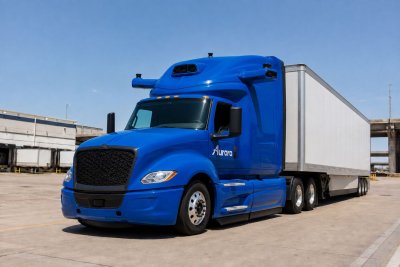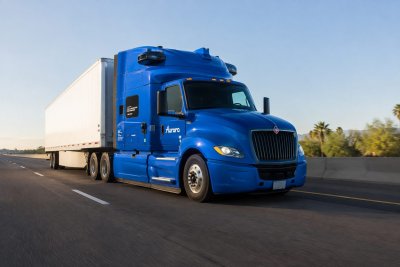
Volvo Autonomous Solutions and global logistics provider DSV have officially commenced commercial autonomous freight operations in Texas, deploying a Volvo VNL truck integrated with Aurora Innovation Inc.'s self-driving system on the high-volume Dallas-Houston corridor. The service, which began with a safety driver onboard, represents a significant step in Aurora's quest to prove that autonomous trucking can move beyond pilot programs into routine, revenue-generating operations.
Operational Details and Strategic Significance
The autonomous service will operate between Aurora's hubs in Dallas and Houston, seamlessly integrating into DSV's existing logistics network. DSV Road CEO Helmut Schweighofer described the initiative as a "production, depot-to-depot setup," emphasizing that autonomous driving is increasingly becoming part of daily business operations. Sasko Cuklev, head of on-road solutions at Volvo Autonomous Solutions, framed the Dallas-Houston rollout as a "scalable foundation" for future expansion into additional lanes.
This launch is part of a broader competitive landscape where truck manufacturers and logistics companies are hedging their bets by partnering with multiple autonomy developers. Volvo's Autona/freight platform, which pairs the VNL Autonomous truck with self-driving technology from both Aurora and Waabi, along with backend systems for large-scale autonomous freight management, illustrates the multi-partner strategy many industry players are adopting.
Financial Performance and Outlook
Aurora's latest milestone comes just over a week after the company disclosed its first-quarter 2026 results. The company reported a modest $1 million in revenue against a net loss of $223 million. Despite the heavy losses, Aurora's 10-Q filing noted that meaningful sales are not expected until commercial operations scale significantly. The company burned through $159 million in operating cash during the quarter but ended March with $273 million in cash and an additional $1.00 billion in short- and long-term investments.
CEO Chris Urmson reiterated that the company remains "on track to put hundreds of driverless trucks on the road this year," with a target of over 200 autonomous trucks in operation by the end of 2026. Aurora's shareholder letter projected full-year 2026 revenue in the range of $14 million to $16 million, a figure that underscores the early stage of its commercial rollout.
Business Model Evolution
Aurora's approach is evolving from initially owning or leasing and operating a portion of its own trucks to a longer-term vision of "Driver as a Service" (DaaS). Under the DaaS model, clients would own or operate their own fleets and pay Aurora on a per-mile basis, creating a software-like recurring revenue stream tied directly to trucks in operation. This transition is critical for Aurora to achieve the high-margin, scalable business model that investors are banking on.
Market Position and Investor Sentiment
Investors are closely watching Aurora's ability to expand routes, lift safety-driver restrictions where permitted, and secure long-term freight contracts. A recent Schedule 13G filing revealed that Capital Research Global Investors held 82.7 million shares of Aurora, representing 5.0% of the class as of March 31, indicating institutional interest in the company's long-term potential.
Aurora's stock was trading at $7.85 late Friday morning, giving the company a market capitalization of approximately $15.3 billion. The valuation reflects investor focus on execution capability rather than current revenue, as the company works to demonstrate that autonomous trucking can scale quickly enough to outpace hardware costs, customer hesitancy, and the substantial capital required to build a coast-to-coast freight network.
While the Texas deployment marks a tangible step toward integrating Aurora's technology into real-world logistics, the company still faces significant hurdles. The path to profitability requires not only technological reliability but also regulatory approvals, customer adoption, and the ability to manage cash burn until revenue from scaled operations materializes. The next few quarters will be crucial for Aurora to show it can convert its autonomous driving promise into sustainable commercial success.