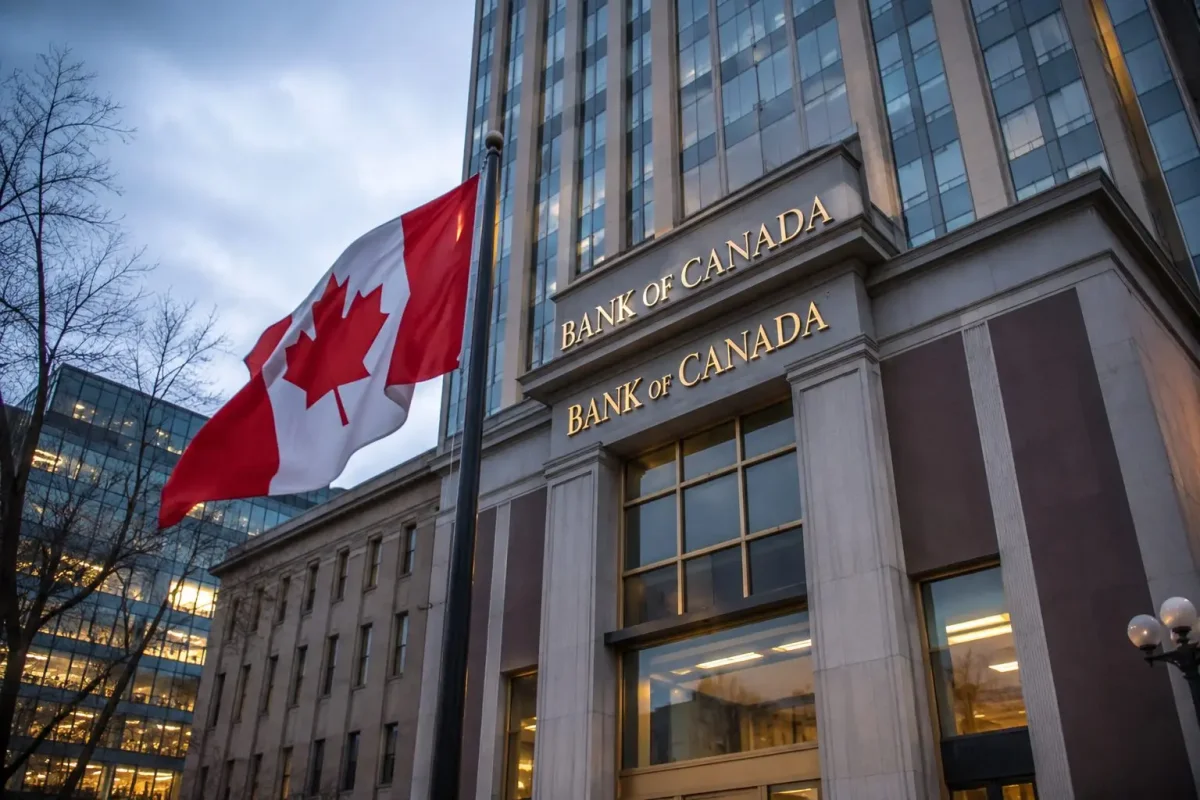
The Bank of Canada (BoC) left its benchmark overnight rate unchanged at 2.25% on Wednesday, marking the fifth consecutive pause since its last rate cut in October 2025. The decision, widely anticipated by markets, comes as the central bank navigates a challenging economic environment characterized by sluggish domestic growth and persistent inflationary pressures, largely fueled by elevated energy costs and ongoing geopolitical tensions.
In his opening statement, Governor Tiff Macklem characterized the current situation as a monetary policy "dilemma." He noted that raising rates could further dampen an already weak economy, while cutting rates risks entrenching inflation. "For now, holding the policy rate unchanged balances those risks," Macklem said, as reported by the central bank. The Bank Rate remains at 2.50% and the deposit rate at 2.20%.
Economic Weakness and Inflationary Headwinds
The BoC's decision reflects a delicate balancing act. On one hand, Canada's economic growth has faltered. First-quarter GDP slipped 0.1%, weighed down by a decline in housing activity, soft business investment, and sluggish imports. Consumer spending managed a modest 1.4% gain, but overall domestic demand remained subdued. The economy has now recorded two consecutive quarters of annualized contraction, though Macklem stopped short of declaring a recession, stating, "the economy is weak, but not clearly in recession."
On the other hand, inflation remains stubbornly above the central bank's 2% target. The Consumer Price Index (CPI) came in at 2.8% in April, and the BoC projects inflation will hover near 3% in the near term before gradually easing. Core inflation measures have dropped to around 2%, but the Bank has yet to see convincing evidence that high energy costs are feeding into broader consumer prices. The conflict in the Middle East, now in its fourth month, continues to disrupt supply chains and keep energy prices elevated, while U.S. tariff risks remain a persistent threat.
Labor Market Strength Provides Support
Offsetting some of the economic weakness, Canada's labor market showed renewed vigor in May. Statistics Canada reported an 88,000 gain in employment, the first solid increase since November 2025. The unemployment rate fell to 6.6% from 6.9%, with full-time jobs surging by 154,000, reversing earlier losses. This strength gave the central bank additional reason to hold steady, as a robust jobs market can help underpin consumer spending and economic activity.
Market Reaction and Currency Impact
The Canadian dollar weakened following the announcement, hitting a seven-month low of 1.4023 per U.S. dollar before recovering slightly to 1.3980. The loonie's decline was driven by widening Canada-U.S. yield spreads, with the two-year yield gap reaching its widest in a year. Oil prices remained volatile, adding to currency uncertainty. The muted initial market response gave way to further pressure on the loonie in subsequent trading.
Outlook and Policy Path
All 34 economists surveyed by Reuters had predicted no move on June 10, with over 80% expecting the overnight rate to hold through the year. A Wall Street Journal survey of 14 economists similarly called for rates to remain at 2.25%. Analysts at Morningstar Canada interpreted the decision as a signal that the BoC intends to maintain a steady course without rushing toward a hike or a cut. Andrew Grantham of CIBC Capital Markets described the central bank as "very patient," noting it still has time to monitor how risks evolve.
Looking ahead, the BoC's next rate decision is scheduled for July 15, when it will also release a fresh Monetary Policy Report. Governor Macklem emphasized the need for policy to remain "nimble," suggesting that new U.S. trade restrictions could prompt a rate cut, but if higher energy prices keep inflation elevated, the Bank might consider back-to-back hikes. The path forward remains highly data-dependent, with the central bank carefully weighing the risks to growth and price stability.