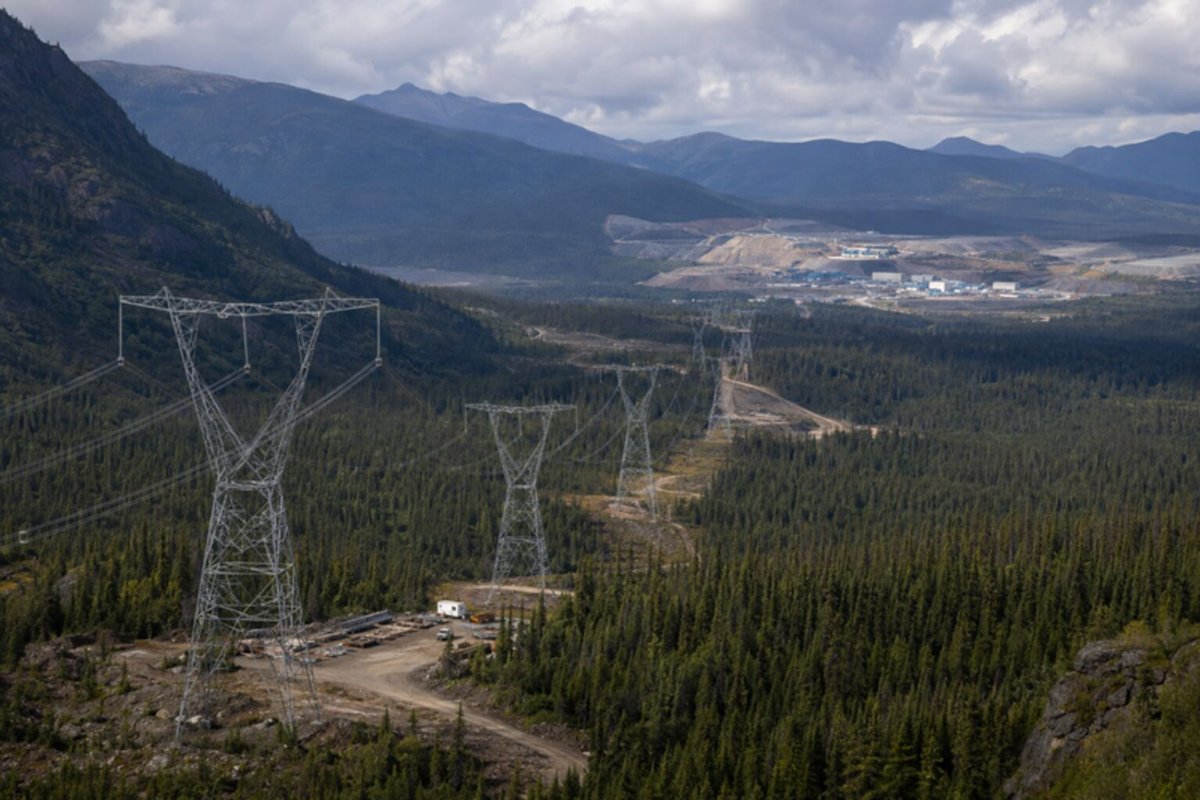
PRINCE GEORGE, British Columbia – Canada has officially launched construction on a major new power transmission line into northern British Columbia, a project that promises to reshape the region's mining and industrial landscape. However, the mining companies that stand to benefit most are still looking at a multi-year wait before the first electrons flow.
BC Hydro broke ground on the North Coast Transmission Line on Thursday, with the first two phases now estimated to cost C$6 billion, according to the utility's latest service plan. The project is designed to more than double the available power capacity between Prince George and Terrace, a 440-kilometre corridor that is critical for the region's growing mining and liquefied natural gas (LNG) sectors.
Despite the milestone, the market response was muted. An equal-weighted index of four Golden Triangle mining stocks fell 1.22% on Friday, with only Skeena Resources Limited (TSE:SKE) managing a gain of 0.13%. The basket, which includes Seabridge Gold Inc. (TSE:SEA; NYSE:SA), Imperial Metals Corporation (TSE:III), and Newmont Corporation (NYSE:NEM), has dropped 3.49% over the past ten sessions.
That tepid reaction is understandable. Phase 1 of the transmission line is not scheduled to enter service until around fall 2030, with Phase 2 following in mid-2032. The groundbreaking removes one infrastructure uncertainty, but it does not finance a mine, settle permits, or guarantee a grid connection. Metal prices are likely to drive these stocks far more than the construction schedule.
Funding and Timeline
The federal and provincial governments have committed C$3.9 billion toward the first two phases, covering 65% of BC Hydro's preliminary C$6 billion estimate. The remaining C$2.1 billion is not a definitive funding gap; it could be covered by customer contributions, financing arrangements, and updates to the capital plan. Phase 3, which is not included in the C$6 billion figure, remains under development.
A C$139.5 million loan from the Canada Infrastructure Bank has funded early engineering, route clearing, and consultation work. Clearing began in July, and major line contracts are expected to be awarded during 2027, according to BC Hydro's procurement update.
The construction milestone is real, but so is the risk of delays and cost overruns over a project that spans six construction seasons. The route is 440 kilometres, with Phase 1 covering 165 km from Prince George to Glenannan and Phase 2 adding 275 km from Glenannan to Terrace.
Mining Exposure
The federal government has explicitly tied the line to Golden Triangle critical-minerals development. However, each mine still needs its own interconnection and investment decision.
- Skeena Resources (TSE:SKE) owns the Eskay Creek project, which is already under construction and targets initial production in 2027. It will connect to the existing 287-kV Northwest Transmission Line.
- Seabridge Gold (TSE:SEA; NYSE:SA) holds the KSM project and is working on a switching station for a BC Hydro hookup as part of its 2026 goals.
- Newmont (NYSE:NEM) operates Red Chris with a 70% stake, while Imperial Metals (TSE:III) owns the remaining 30%. Newmont expects a final investment decision on the underground expansion later this year.
Regional capacity is only one gate. Permits, local connection work, mine finance, construction, and commodity prices remain company-specific risks.
Broader Impact
Power demand from mines, LNG facilities, and ports currently exceeds the capacity of the existing 500-kV line. The new route is expected to unlock C$10 billion in new activity and nearly 10,000 jobs, according to government projections, though those figures depend on separate industrial projects proceeding.
Energy Minister Tim Hodgson said the line would “deliver the clean electricity needed to unlock B.C.’s world-class deposits,” linking it to new processing capacity. First Nations may co-own up to 50% of the new line, with negotiations ongoing and agreements expected later this year. However, some conditions remain unresolved. Chief Robert Michell of Stellat’en First Nation said, “All our conditions to build haven’t been addressed by the Crown.”
The grid start changes the probability tree, moving a regional expansion from policy language into physical work. But Friday's prices show that investors still separate infrastructure progress from mine economics. Skeena's nearer production date gives it the shortest operating clock, while Seabridge still needs a partner and Red Chris awaits Newmont's feasibility work. The C$6 billion estimate is preliminary, and Phase 3 has no defined timeline or cost.