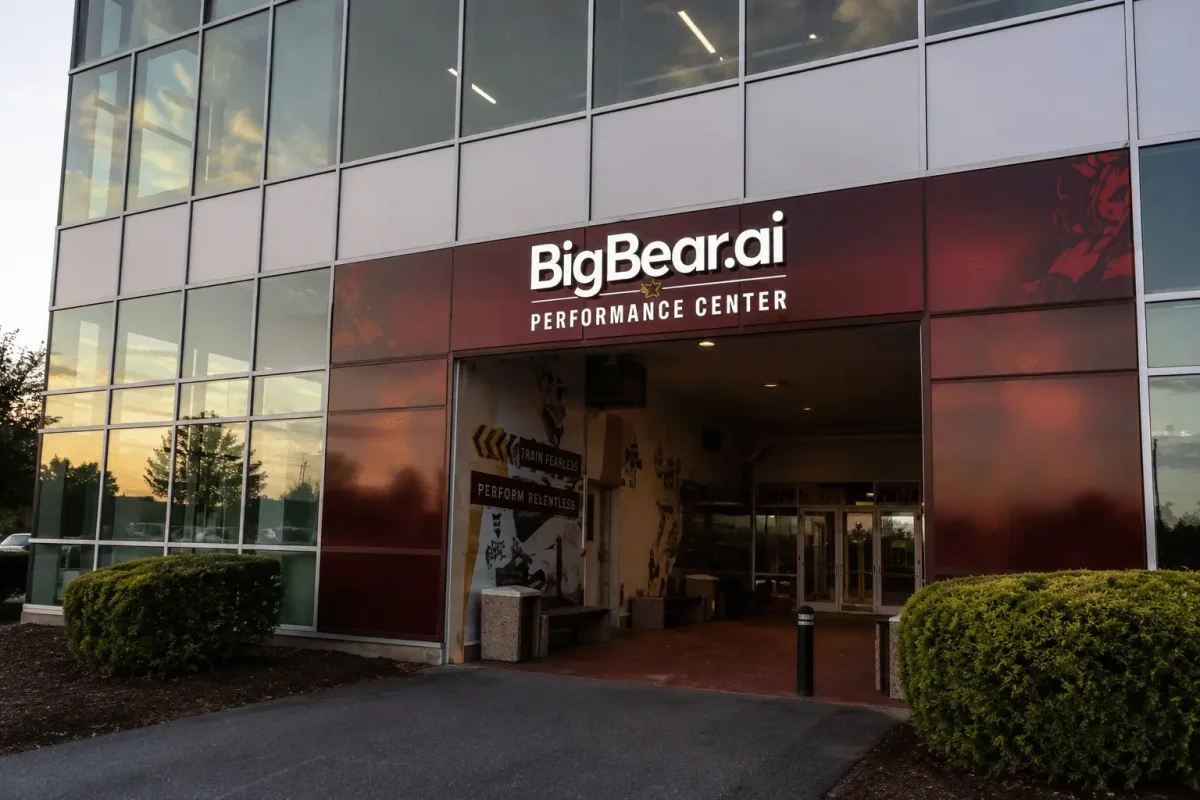
BigBear.ai Holdings, Inc. saw its shares decline on Tuesday, retreating as investors balanced recent contract wins against ongoing financial losses and potential dilution. The stock was recently down 33 cents at $3.98, after trading between $3.83 and $4.39 during the session, with volume near 39.4 million shares.
The move underscores the challenge BigBear.ai faces in convincing the market that its contract pipeline will translate into consistent revenue. The company's backlog—contracted work not yet recognized as sales—rose 14% sequentially to $281.9 million, helped by a $53 million classified award. Yet revenue conversion remains a key test, as the company continues to operate at a loss.
Broader market conditions did not provide a tailwind. The Invesco QQQ Trust, a proxy for large-cap tech, fell 1.9%, while the SPDR S&P 500 ETF slipped 0.8% and the iShares Russell 2000 ETF was little changed. Among AI peers, Palantir Technologies fell 3.4% and C3.ai rose 0.9%, offering a mixed signal for BigBear.ai.
On the operational front, BigBear.ai garnered attention with a Panama cargo-security deployment. According to a report from Biometric Update, Panama Transshipment Group (PTG), the country's largest logistics operator, has become the first deployment partner for International Shipping Compliance (ISC), an AI-powered cargo security platform developed by BigBear.ai in collaboration with Narval Holding Corp. and ISC. The system uses biometrics and real-time cargo data to track shipment handlers and detect anomalies during transit. BigBear.ai had announced on May 20 that PTG signed a commercial agreement to deploy the platform, which is already being used to enhance supply-chain transparency. Troy Miller, BigBear.ai's senior vice president of Department of Homeland Security solutions and a former acting U.S. Customs and Border Protection commissioner, emphasized that the solution aims to secure commerce without slowing it down. CEO Kevin McAleenan noted that Panama could serve as a foundation for broader regional adoption.
The company held its virtual annual meeting at 2 p.m. EDT on Tuesday, which concluded by late afternoon. Final voting results are expected to be disclosed in a Form 8-K within four business days. Capital structure remains a focal point for investors. An April 8-K revealed that shareholders approved an increase in authorized common shares from 500 million to 1 billion. While this does not immediately issue new stock, it provides the company with additional flexibility for financings, equity awards, or acquisitions, raising concerns about future dilution.
BigBear.ai's first-quarter results highlight the dichotomy investors are grappling with. Revenue fell 1% year-over-year to $34.4 million, while gross margin improved to 34.0% from 21.3% a year ago. Backlog increased 14% from the fourth quarter, and the company reaffirmed its 2026 revenue guidance of $135 million to $165 million. However, the company reported a net loss of $56.8 million for the quarter. It also noted $431.5 million in available cash and investments and said it had settled the remaining $124.6 million of its 2029 convertible notes, primarily through debt-to-equity conversion. McAleenan stated that first-quarter wins kept the company on track for its 2026 revenue target.
Despite these positives, the risk remains that pilot programs and contract awards may not convert quickly enough into revenue, leaving the stock priced on promise while losses persist. The potential for future stock issuance could also dilute existing holders, with the proxy warning that new common shares or convertible securities could reduce earnings per share, book value per share, and voting power. For now, BigBear.ai remains a show-me story, with investors weighing a Panama deployment, a larger backlog, and a cleaner balance sheet against a growing share count and a business that has yet to achieve consistent profitability.