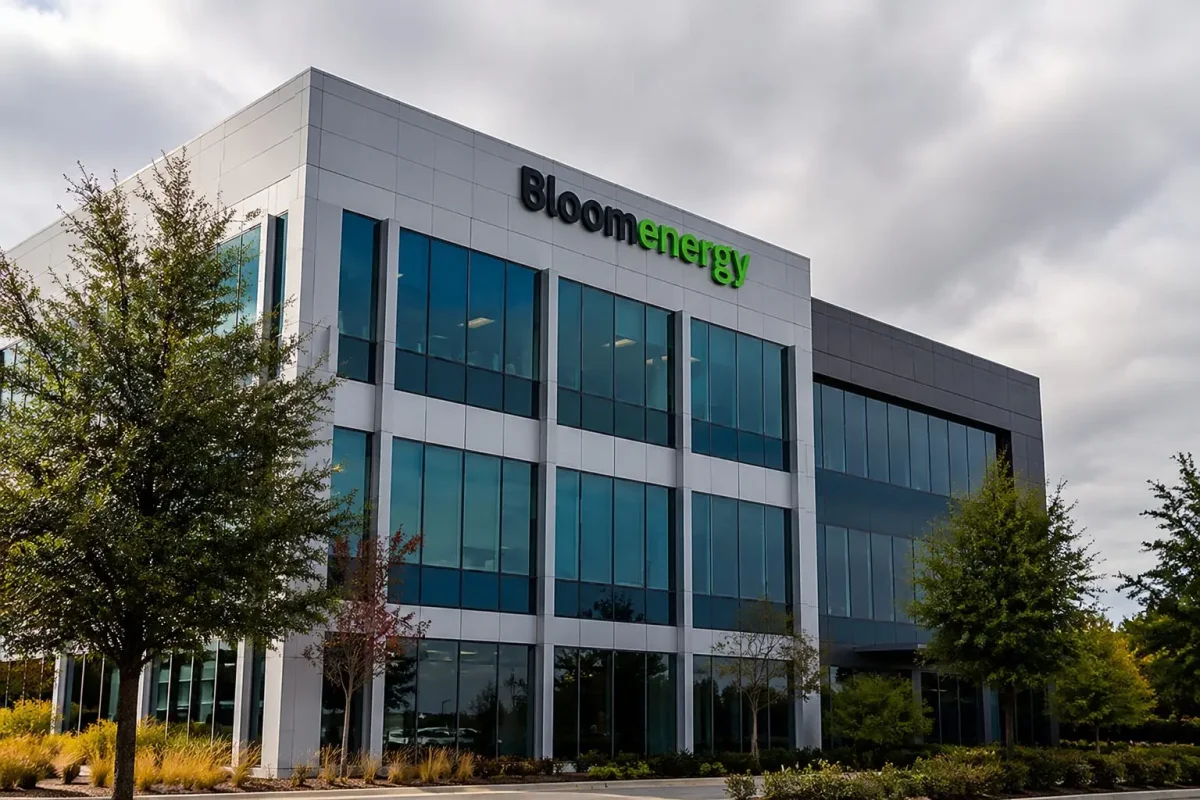
Bloom Energy Corporation (NYSE:BE) saw its shares climb approximately 10.6% in after-hours trading on Tuesday, reaching $184.44, following a regular session decline of 11.3% that closed at $166.84. The rebound nearly erased the day's losses, reflecting investor relief after the company reported second-quarter results that surpassed Wall Street expectations and raised its full-year 2026 forecast.
Strong Q2 Performance
For the quarter ended June 30, 2026, Bloom Energy reported revenue of $1.065 billion, a 165.5% surge compared to the same period last year. Product revenue alone jumped 215.4% to $935.4 million, significantly outpacing the FactSet consensus estimate of $826 million. Adjusted earnings came in at 78 cents per share, nearly double the analyst expectation of 41 cents. On a GAAP basis, net income reached $196.3 million, a sharp turnaround from a loss of $42.6 million a year earlier.
Operating cash flow also improved dramatically, rising to $226.4 million from negative $213.1 million in the prior-year period, underscoring the company's enhanced cash generation capabilities.
Guidance Signals Manageable H2 Targets
Bloom Energy raised its 2026 revenue guidance, with a midpoint of $4.05 billion. This implies second-half revenue of approximately $2.234 billion, or $1.117 billion per quarter, representing just 4.8% growth over the second quarter's actual result. Similarly, the adjusted operating income midpoint of roughly $480.6 million for the full year suggests a quarterly average of $240.3 million in the second half, only marginally above the $239.6 million achieved in Q2.
The modest sequential growth required alleviates concerns that Bloom would need a dramatic acceleration in demand to meet its targets. The key challenge now lies in the company's ability to sustain its recent operational efficiency gains as it scales production capacity.
Margin Expansion and AI Tailwinds
Margins improved alongside higher volumes. GAAP gross margin stood at 33.4%, up from 30.0% in the prior quarter and 26.7% in the same period last year. Non-GAAP gross margin reached 34.3%, and if the annual margin lands precisely at 34%, the midpoint implies approximately 34.7% in the second half. Maintaining this level will require continued efficiency improvements.
CEO KR Sridhar highlighted that Bloom's systems have received approval from all major U.S. hyperscalers, with over a dozen neoclouds, AI labs, and colocation providers also on board. "Bloom is now a standard for AI onsite power," Sridhar said, underscoring the company's positioning in the rapidly growing AI infrastructure market.
Key Customer and Financing Developments
Oracle Corporation (NYSE:ORCL) is a notable customer, having entered into a contract for an initial 1.2 gigawatts as part of a deal that could expand to 2.8 gigawatts, with projects currently rolling out across the United States. Additionally, Brookfield Asset Management Ltd. (NYSE:BAM) increased its Bloom financing structure to $25 billion in June, aimed at supporting power projects that supply AI infrastructure.
Market Context and Risks
Despite the after-hours rebound, Bloom's shares ended Tuesday's regular session down 23.6% over five days and off 42.4% for the past month, though they remain up 92% for 2026. The volatility reflects how much growth expectation was already priced into the stock.
Key risks include the company's ability to convert significant deals into reported revenue as it scales production. Potential setbacks from delayed data centers, customer concentration, interconnection issues, or supply constraints could negatively impact the run-rate. The forward guidance relies on non-GAAP figures and management assumptions.
Upcoming earnings reports from Microsoft Corporation (NASDAQ:MSFT), Meta Platforms, Inc. (NASDAQ:META), and Amazon.com, Inc. (NASDAQ:AMZN) later this week will provide further insight into AI-related capital expenditure plans, which could influence sentiment for suppliers like Bloom Energy. The Federal Reserve's policy decision on Wednesday also poses a risk, as higher rates would increase the discount rate applied to growth stocks with long-duration cash flows.