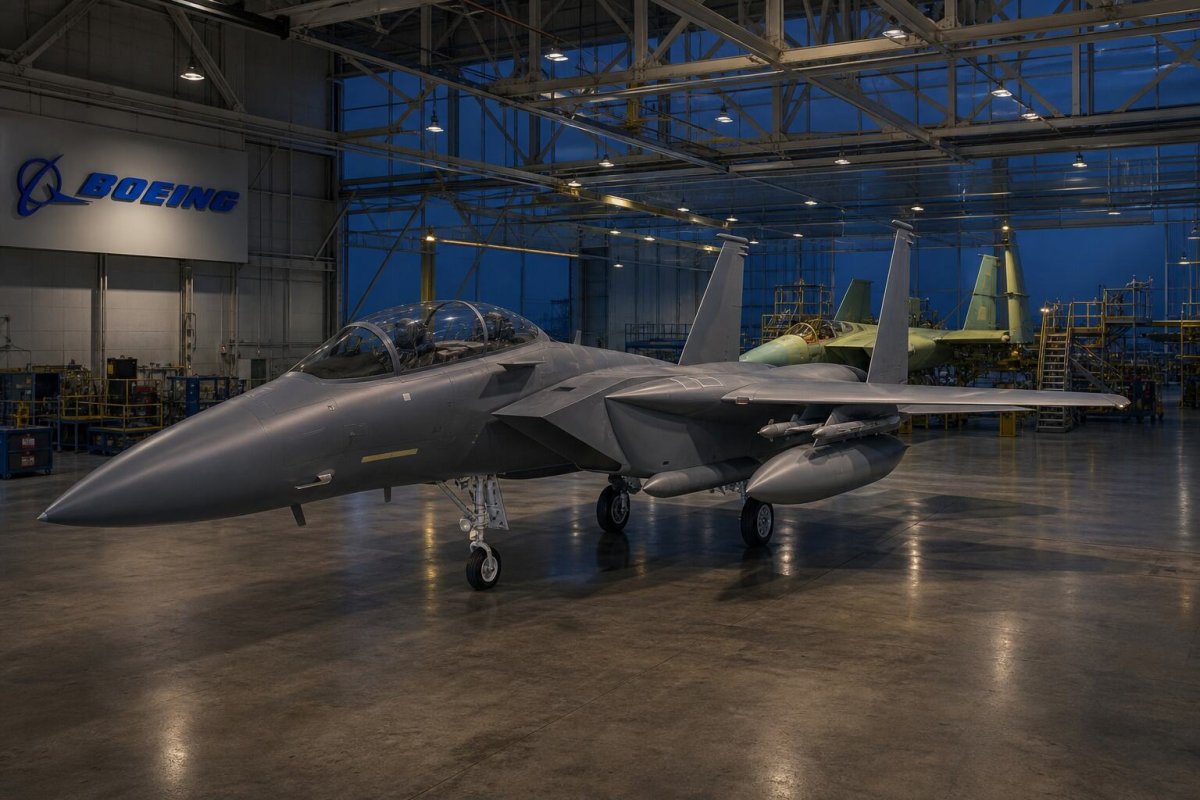
Boeing Co. (NYSE: BA) marked a significant milestone on September 5, 2026, when the first F-15EX destined for Kadena Air Base rolled out of its St. Louis facility. While the event underscores progress on the fighter program, the financial reality is more nuanced. The headline contract ceiling of $131.23 billion, announced by the Air Force, comes with initial funding of just $343,740—a figure that represents a mere 0.00026% of the ceiling. This disparity is crucial for investors to understand, as the ceiling is not a guaranteed revenue stream but rather an upper limit for potential future orders.
Boeing shares closed the week at $212.25, up 0.81% on Friday and 2.15% over the holiday-shortened week, according to Nasdaq data. The stock's movement, however, cannot be attributed solely to the F-15EX news; broader market trends and investor sentiment have played a role. The company's shares have shown resilience, rebounding from a weekly low of $205.66 on September 1 to end the week at their high.
Contract Ceiling vs. Backlog: A Critical Distinction
The Air Force awarded Boeing an indefinite-delivery, indefinite-quantity (IDIQ) contract on August 24, covering aircraft production, modernization, retrofits, sustainment, and depot capability through 2037. The ceiling of $131.23 billion is the maximum ordering capacity, not a committed order. In contrast, Boeing's total Defense, Space & Security (BDS) backlog stood at $85.32 billion as of June 30, according to the company's 10-Q filing. This backlog excludes unfunded government amounts and purchase options, making the F-15 ceiling 1.54 times the entire segment's current backlog—a figure that sounds impressive but is not directly comparable to booked business.
Initial funding of $343,740 comes from fiscal 2026 research and development money, which is earmarked for specific early-stage activities. Future task orders will determine how much work Boeing actually wins under the contract, and some spending may flow to suppliers, further diluting the direct benefit to Boeing's bottom line.
Program of Record: A More Modest Scale
The Pentagon's latest acquisition report outlines a program of record with 268 U.S. aircraft, including two development jets and 266 procurement units. The then-year acquisition estimate is $36.93 billion, about 28% of the IDIQ ceiling. This estimate covers development and procurement costs, with an average procurement unit cost of $131.57 million. The lifecycle operating and support estimate is $140.67 billion, but this is a government cost projection, not guaranteed Boeing revenue.
Boeing's BDS segment reported first-half 2026 revenue of $15.08 billion and operating earnings of $218 million, reflecting an operating margin of just 1.4%. In the second quarter alone, the segment lost $15 million on $7.48 billion in sales. This thin margin underscores the importance of execution and cost discipline, especially as Boeing aims to increase production rates.
Production Schedule Still Under Pressure
The first Kadena-bound F-15EX departed on August 28 for further work in Portland, with delivery to Japan expected during fiscal 2027. While this is a positive step, the program continues to face schedule challenges. According to the Pentagon's acquisition report, only six of 12 Lot 3 aircraft are projected to be delivered by the end of 2026, a significant shortfall from the original requirement to complete the lot in early 2026. Lot 4 deliveries, originally slated for this year, have slipped into 2028.
The program also faces future hurdles, including the need to refresh radar, mission computer, electronic warfare, and engine components as parts age out. Notably, there is no approved cost estimate for Lots 9 through 12, forcing the use of government estimates for initial budget sizing.
Wall Street's Optimism vs. Reality
Despite these challenges, analysts remain bullish on Boeing. Nasdaq's compilation shows 17 buy ratings, one hold, and zero sell ratings. The consensus price target is $274.67, implying a 29.4% upside from Friday's close of $212.25. Analyst targets range from $250 to $305, suggesting a potential upside of 17.8% to 43.7%. This optimism likely reflects broader expectations of a Boeing recovery, not just the F-15 program.
However, investors should weigh the F-15EX contract's true financial impact. The $131 billion ceiling is a long-term vehicle for potential orders, but the immediate funded amount is minimal. Boeing's ability to convert this ceiling into profitable revenue will depend on future task orders, production efficiency, and margin discipline. As the company navigates these complexities, the stock's performance will hinge on its overall defense portfolio and commercial aviation recovery.
In summary, while the F-15EX rollout is a notable operational achievement, it is not a financial windfall. The gap between the contract ceiling and funded amount is a reminder that in defense contracting, headline numbers can be misleading. Investors should focus on Boeing's execution and the gradual realization of this contract's potential.