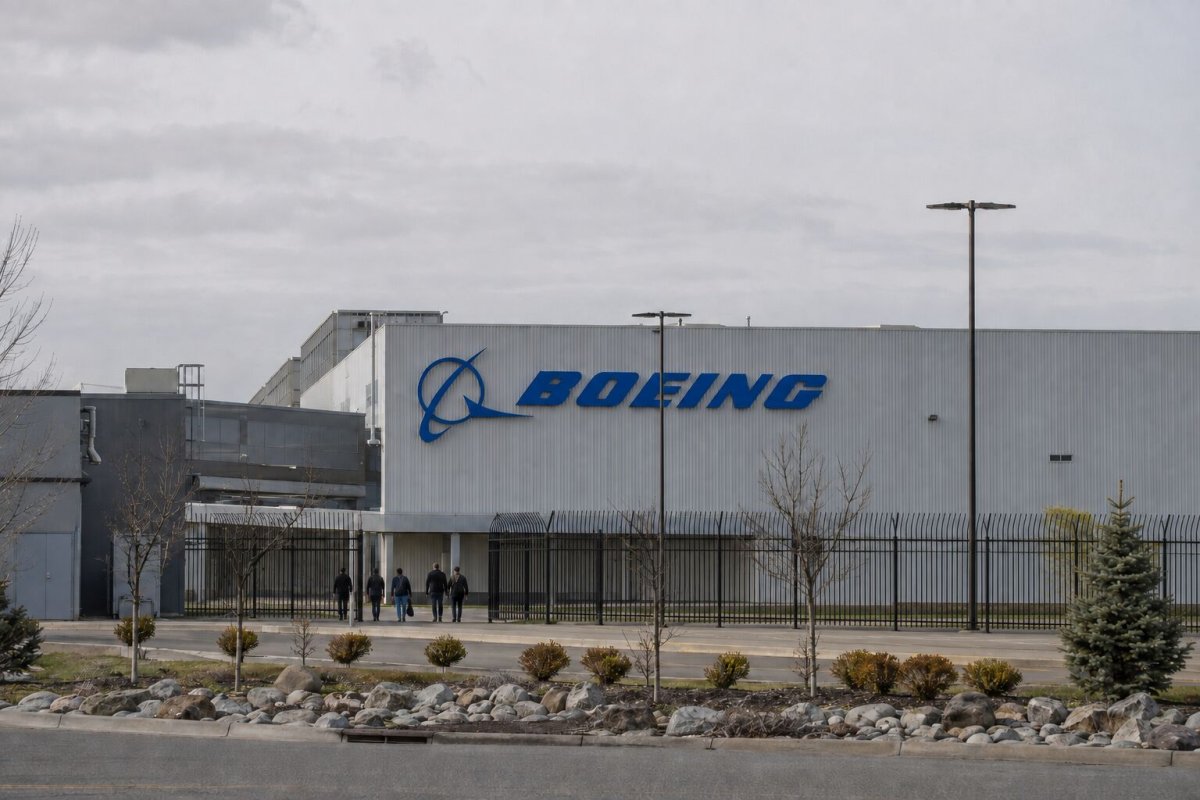
Boeing (NYSE:BA) shares edged higher in early trading Thursday as investors weighed the financial implications of its recent acquisition of Spirit AeroSystems. The company's provisional purchase accounting, disclosed in its latest regulatory filing, shows a $1.889 billion difference between the goodwill recorded and the total consideration paid, a gap that underscores the challenges of absorbing the struggling supplier.
Balance Sheet Scrutiny
The filing reveals $10.278 billion in provisional goodwill against $8.389 billion in total acquisition consideration. This $1.889 billion shortfall—equivalent to 2.99 times Boeing's second-quarter free cash flow of $631 million—highlights the scale of the integration task ahead. While the gap does not represent a new cash charge, it signals the difficult economics Boeing inherited with Spirit's operations.
At 09:30:15 EDT, Boeing shares were trading at $210.85, up 0.95% from Wednesday's close, as the market digested the news. The stock's modest gain suggests investors are cautiously optimistic about the aerospace giant's ability to manage the integration.
Provisional Accounting Details
According to the SEC filing, the $8.389 billion consideration includes $4.704 billion in exchanged shares, $2.589 billion in settled prior funding, and $948 million in repaid Spirit debt. The provisional goodwill of $10.278 billion implies net identifiable liabilities of $1.889 billion. Accrued liabilities rose by $418 million after the initial allocation, reaching $2.202 billion in June, with $1.520 billion attributed to off-market customer contracts.
These off-market contracts, which carry terms below current market economics, are expected to generate $64 million in accounting revenue in 2026 and $154 million in 2027, according to Boeing's estimates.
Commercial Airplanes Segment Shows Improvement
The Commercial Airplanes division remains a critical focus. Second-quarter revenue rose 8% to $11.751 billion, while its operating loss narrowed to $322 million from $557 million a year earlier. The segment's margin improved to negative 2.7% from negative 5.1%, helped by higher deliveries and a better product mix.
However, CFO Jay Malave has warned that Spirit will have a "$1 billion negative" cash-flow impact in 2026. He emphasized that productivity, synergies, and quality improvements should help mitigate the drag in the latter half of the year.
Production Ramp and Future Outlook
Boeing has begun increasing 737 production from 42 to 47 aircraft per month, a move that could spread fixed costs and accelerate work on inherited low-return contracts. But higher output also risks exposing additional contract losses if the off-market terms deteriorate further.
Analysts remain largely bullish, with 17 buy ratings, one hold, and no sells, and an average price target of $274.67—roughly 30% above Thursday's opening price. CEO Kelly Ortberg acknowledged there is "more work ahead in the second half," but noted progress in the July report, where quarterly free cash flow turned positive from a $200 million outflow.
Upcoming Investor Test
The next major test for Boeing's management comes on September 16, when Ortberg speaks at the Morgan Stanley Laguna Conference. Investors will be watching for updates on Spirit integration, production targets, and any further adjustments to purchase accounting, which remains provisional until December.
Risks include potential certification delays for the 737-10 and 777-9, which could slow deliveries and cash receipts. The stock's recovery hinges on Boeing's ability to turn Spirit into an operating improvement rather than a permanent financial burden. As the company navigates these challenges, its margin trajectory will be a more telling indicator than the headline goodwill figure.