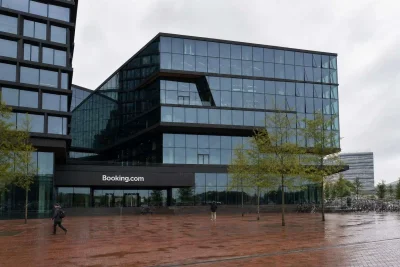
Booking Holdings (BKNG) experienced a sharp decline on Monday, with shares falling 4.9% to $157.80, extending a two-day sell-off as investors reacted to the company's revised growth outlook. The broader market showed modest gains, with the S&P 500 and Dow Jones Industrial Average each rising 0.19%, but online travel stocks faced significant pressure amid ongoing Middle East disruptions.
The company, which owns brands such as Booking.com, Priceline, Agoda, Kayak, and OpenTable, reported first-quarter gross bookings of $53.8 billion, a 15% increase from the prior year. Revenue rose 16% to $5.5 billion, and adjusted EBITDA grew 19%. Despite these solid results, management warned that the conflict in the Middle East had created a roughly 2 percentage point drag on room-night growth during the quarter.
Booking's revised forecast now projects second-quarter room-night growth of just 2% to 4%, with revenue growth expected between 4% and 6%. For the full year, the company lowered its revenue growth target to high single digits, down from the previous goal of low double digits. CEO Glenn Fogel described the quarter as a "solid start" but acknowledged the headwinds from regional instability.
Chief Financial Officer Ewout Steenbergen highlighted that the effects of the conflict extended beyond the Middle East, particularly impacting transit routes connecting Europe and Asia. He cautioned that prolonged disruptions could lead to higher jet fuel prices, reduced airline capacity, and weakened traveler sentiment. In contrast, the U.S. market showed relative strength, with room-night growth in the low teens during the first quarter.
The sell-off was not limited to Booking Holdings. Expedia (EXPE) fell 3.7%, Airbnb (ABNB) lost 3.1%, and Trip.com's U.S.-listed shares edged down 0.9%. Expedia had previously noted that the Middle East conflict and a Mexico travel advisory together reduced its quarterly bookings and room-night growth by about 200 basis points, a larger impact than anticipated.
Analysts weighed in on the developments. Baird's Michael Bellisario noted that Booking faced similar headwinds to Expedia, despite its broader regional footprint. BTIG's Jake Fuller characterized the disruptions as "temporary," but investors remained cautious about the timing of a recovery. Booking's management expects a rebound in the second half of the year, coinciding with the summer travel season, but some analysts question whether this timeline is realistic if the conflict persists.
Investors will have another opportunity to hear from management on May 20, when CEO Glenn Fogel is scheduled to speak at the J.P. Morgan Global Technology, Media and Communications Conference in Boston. The event will be webcast, with a replay available afterward.
The key question for the market is whether Monday's decline represents a temporary reaction to a forecast cut or signals deeper concerns about cross-border travel demand. With operations spanning more than 220 countries and territories, Booking Holdings remains a bellwether for the global travel industry, but the current environment highlights the vulnerability of even the largest players to geopolitical shocks.