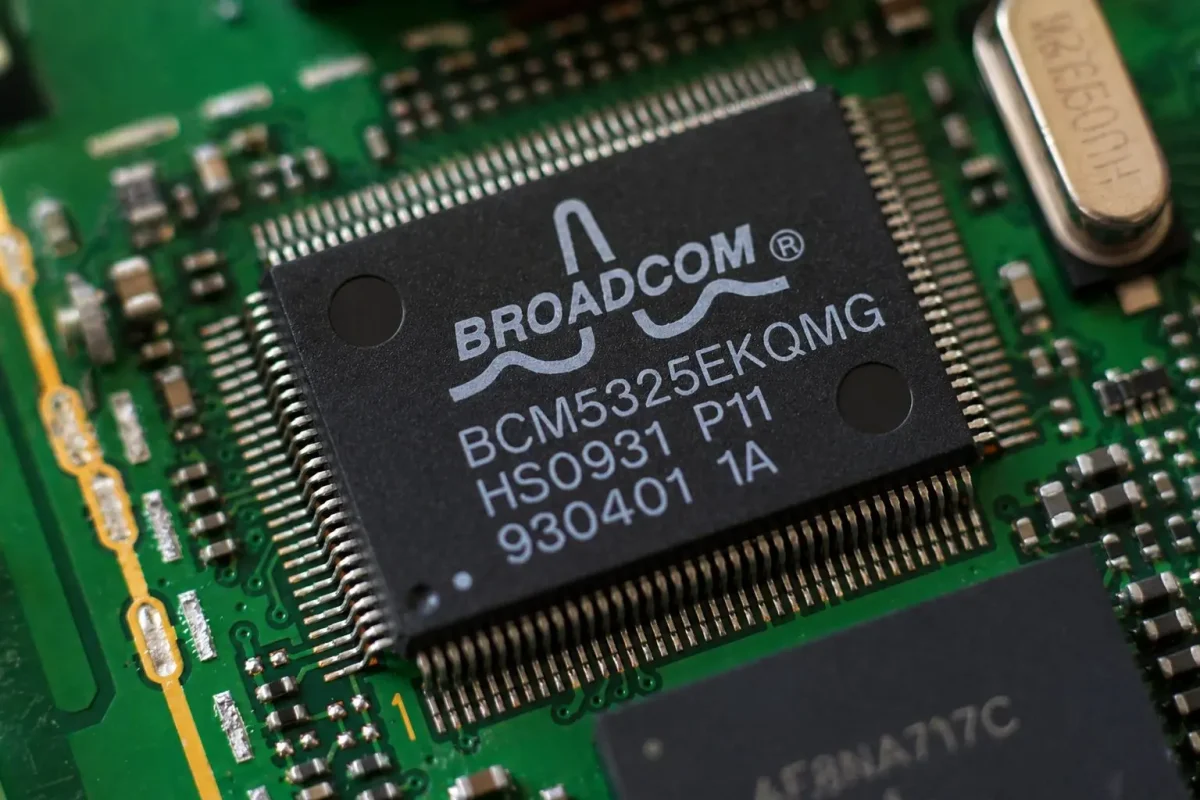
Broadcom Inc. kicked off Monday with a market capitalization of $2.05 trillion, joining an elite group of chipmakers at that valuation. The company's shares were trading at $422.76 ahead of the U.S. market open, reflecting investor enthusiasm for its expanding role in artificial intelligence infrastructure.
The semiconductor giant's fiscal first-quarter results underscored the shift. Revenue climbed 29% year-over-year to $19.31 billion, with AI semiconductor revenue more than doubling to $8.4 billion—a 106% surge. Chief Executive Hock Tan highlighted "custom AI accelerators and AI networking" as the primary growth engines, and the company projects $10.7 billion in AI chip revenue for the second quarter.
Google Partnership Deepens
A key catalyst is Broadcom's deepening relationship with Google. In an April 6 filing, the company disclosed a multi-year agreement to co-develop and supply future versions of Google's Tensor Processing Units (TPUs), custom chips designed for training and running large AI models. The deal also includes a provision for Anthropic to access approximately 3.5 gigawatts of next-generation TPU-based compute power through Broadcom and Google starting in 2027, contingent on Anthropic's continued commercial performance.
Anthropic CFO Krishna Rao described the arrangement as "the most significant compute commitment to date." The AI company, which also uses chips from AWS Trainium and Nvidia GPUs, now reports an annualized revenue run rate exceeding $30 billion.
Google recently unveiled its eighth-generation TPU lineup, splitting the family into the TPU 8t for training large models and the TPU 8i for inference. The company emphasizes improved energy efficiency and stronger performance per dollar for both chips, which are designed for its AI Hypercomputer platform.
Networking and ETF Exposure
Beyond custom chips, Broadcom is expanding its networking footprint. On April 22, the company announced that Google Cloud is integrating AppNeta by Broadcom into its Cloud Network Insights offering. The tool helps users monitor and troubleshoot network and application issues across hybrid environments. "Observability has never been more crucial," said Rob Enns, Google Cloud's vice president and general manager for cloud networking.
Retail investors are gaining easier access to Broadcom shares through recent ETF splits. According to a Motley Fool analysis, Broadcom now ranks among the top 10 holdings in four of five Vanguard ETFs that executed splits on April 21, and it is the largest position in Vanguard's High Dividend Yield ETF. While the splits do not change economic value, they lower share prices for individual buyers.
Competitive Landscape and Risks
Broadcom faces stiff competition. Nvidia remains the dominant supplier of general-purpose AI graphics chips, while Broadcom and Marvell compete in the custom silicon space, designing tailored hardware for cloud providers. Reuters reported earlier this month that Google had held discussions with Marvell about new AI chip projects, signaling the hyperscalers' desire to diversify suppliers. "Customers are eager to reduce their exposure to any single vendor," said Russ Mould, investment director at AJ Bell, noting that diversification helps hedge both technology and logistics risks.
Meta Platforms added to Broadcom's client roster in April, striking a deal covering multiple generations of custom AI chips through 2029, with an initial commitment exceeding 1 gigawatt of compute. Large tech companies continue to seek greater control over their chip supply chains and costs.
Investors should remain cautious. Broadcom's stock price already reflects expectations of sustained custom AI demand. The company's own filings acknowledge that growth tied to Anthropic depends on that company's commercial viability. Additionally, if Google and other major buyers spread orders among multiple chipmakers, Broadcom could face pricing pressure, even as the overall AI market expands.
Broadcom's shares have become a direct bet on custom AI silicon, cloud networking, and the infrastructure spending plans of hyperscalers like Google and Meta. The Vanguard ETF splits simply make it easier to hold that position—but the underlying economics remain unchanged.