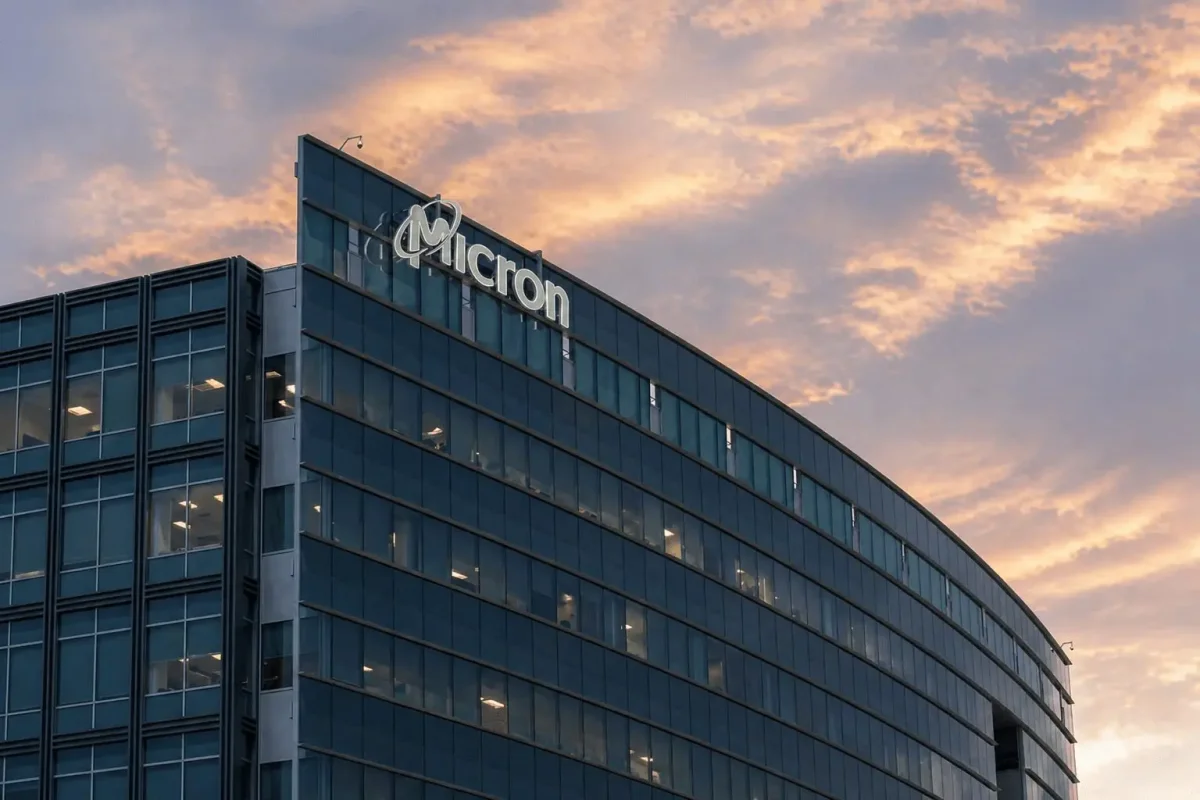
Micron Technology (NASDAQ: MU) saw its shares climb approximately 3% in premarket trading Monday, hovering near $497 and pushing the U.S. memory-chip maker's market capitalization close to $567 billion. The uptick comes as investors re-engage with the AI memory narrative following the company's robust fiscal second-quarter earnings report, which showed revenue surging to $23.86 billion—nearly triple the $8.05 billion recorded in the same period last year. Net income under GAAP reached $13.79 billion, underscoring the profitability of Micron's focus on high-bandwidth memory (HBM) for artificial intelligence applications.
The stock's movement is not merely a reaction to Monday's headlines but reflects a broader reassessment of Micron's place in the semiconductor landscape. Traditionally viewed as a cyclical memory player, Micron is now increasingly seen as a structural beneficiary of the AI revolution. The key question driving the conversation: Can HBM—stacked memory designed to sit alongside AI processors, accelerating data transfer while reducing power consumption—sustain elevated prices and margins beyond typical memory upswings?
Analyst Optimism and Valuation Targets
Pythia Research, in a note published on Seeking Alpha Monday, described a "structural, AI-driven paradigm shift" behind Micron's rally, distinguishing it from routine upturns in DRAM and NAND markets. The firm assigned a Strong Buy rating, citing supply constraints, firm pricing, and an often-overlooked memory boost tied to central processing units (CPUs). They indicated they would revisit their call if new supply began to compress margins.
Separately, writing for The Motley Fool, Marc Guberti named Micron as one of only two AI stocks he recommends buying and holding, emphasizing the company's memory storage technology as critical for AI chips handling demanding workloads. He highlighted Micron's fiscal second-quarter revenue—almost triple year-over-year—a 75% sequential increase, and a net profit margin of 57.8%.
Technology analyst Anthony Di Pizio, also from The Motley Fool, laid out a mathematical path for Micron to reach a $1 trillion valuation but flagged a risk: as Micron and its competitors introduce more HBM supply, memory prices could decline. "There is no AI without memory," he stated bluntly, reinforcing the strategic importance of Micron's products.
Product Roadmap and Competitive Landscape
Micron's product roadmap provides tangible evidence of its AI ambitions. In March, the company announced that its HBM4 36GB 12H memory was already in mass production for Nvidia's Vera Rubin platform, offering over 2.8 terabytes per second of bandwidth and at least 20% better power efficiency than HBM3E. "Compute and memory were being designed to scale together from day one," said Sumit Sadana, Micron's chief business officer.
Beyond GPUs, Micron's SOCAMM2 modules—also built for Nvidia Vera Rubin setups—can handle up to 2 terabytes of memory and push bandwidth to 1.2 terabytes per second per CPU. This expansion into CPU-adjacent memory highlights how AI workloads are increasingly affecting the entire server stack, not just graphics processors.
Competition remains intense. SK Hynix, one of Nvidia's primary memory suppliers, surged over 7% to an all-time high in Seoul Monday, outpacing Samsung Electronics' 2.5% gain, as investors piled into stocks with the most AI memory exposure. The HBM supply race currently centers on SK Hynix, Samsung, and Micron.
Risks and Outlook
The primary risk to Micron's narrative is the potential for oversupply. SK Hynix is aggressively expanding HBM output, and Samsung's influence over the memory market remains formidable. If additional chips come online before AI-related demand catches up, the tight supply that currently supports Micron's margins could unravel, impacting profits before the broader AI story is affected.
Looking ahead, Micron's fiscal third-quarter revenue guidance of $33.5 billion sets a high bar. CEO Sanjay Mehrotra declared, "Memory has become a strategic asset." The company's ability to maintain pricing power and customer commitments will be critical in justifying its valuation. For now, the market appears to be betting that AI memory has fundamentally shifted the sector's traditional boom-bust cycle, but the next earnings report will serve as a key test.