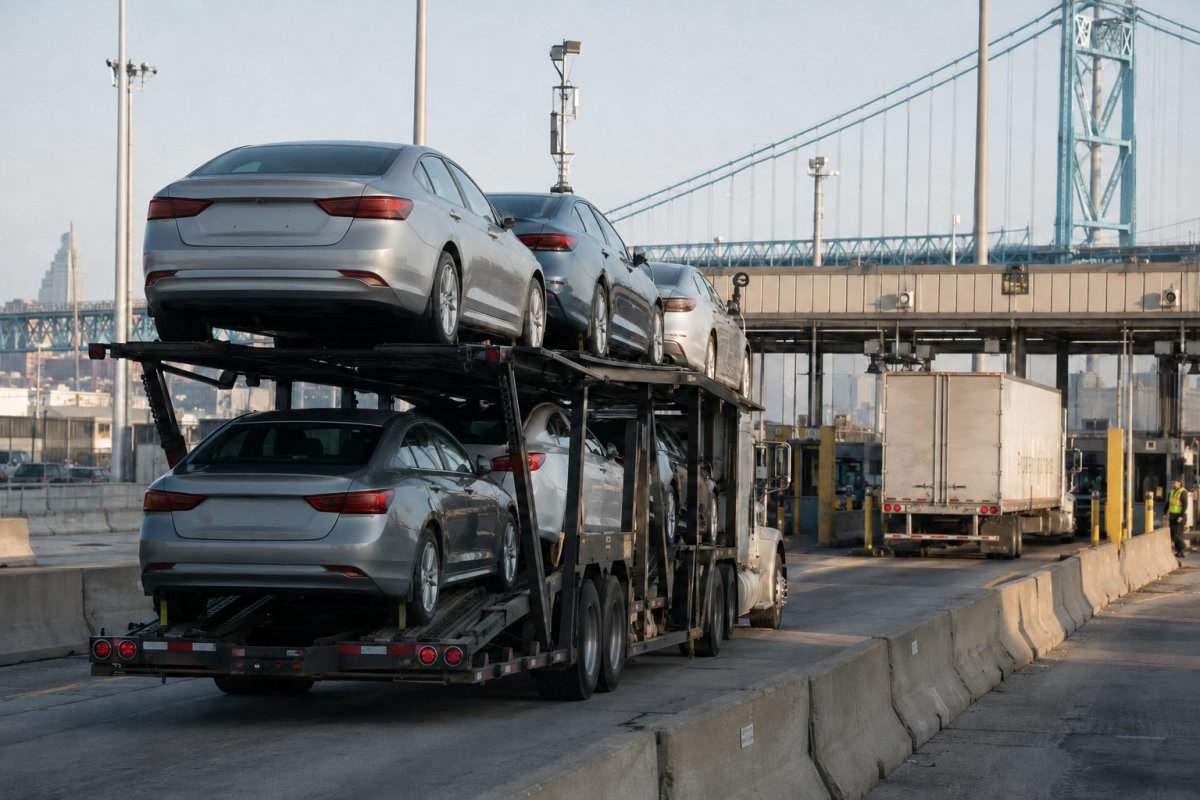
U.S. premarket trading was active on Tuesday as investors digested President Donald Trump's latest threat to impose 50% tariffs on Canadian-made vehicles and auto parts starting January 1, 2027. The announcement has put a mechanical upper bound of C$40.8 billion on the annual cost of such a levy, based on 2024 export figures.
Canada exported C$81.6 billion worth of automobiles and light trucks (C$46.4 billion) and auto parts (C$35.2 billion) to the United States in 2024. A flat 50% tariff on that full value would translate into C$40.8 billion per year, or roughly C$6.8 billion per month. However, analysts caution that the actual exposure could be significantly lower, as final rules may exempt certain content or provide relief for components that cross the border multiple times.
The threat marks a sharp escalation from the collapsed negotiated package, which would have reduced the top tariff rate on Canadian cars and light trucks to 15% from the current 25%. Instead, Trump now proposes a 50% tariff on all Canadian-made cars, trucks, and parts. This move has sent shockwaves through the integrated North American auto industry.
Market Reaction
Investors have responded by selling shares of major automakers. Ford Motor (NYSE: F) fell 3.6% on Monday, while Stellantis (NYSE: STLA) dropped 4.2%. General Motors (NYSE: GM) declined 1.6%, and Toyota Motor's U.S. shares (NYSE: TM) slipped 1.5%. Honda Motor's ADRs (NYSE: HMC) also fell 2.1%.
The market reaction underscores the broader impact beyond finished vehicles. Flavio Volpe, president of Canada's Automotive Parts Manufacturers' Association, warned that without specific parts, U.S. auto assembly would come to a halt. This highlights the deep integration of the cross-border supply chain, where components often cross the border multiple times before final assembly.
Policy Path and Countermeasures
Ottawa has announced dollar-for-dollar counter-tariffs starting September 8, 2026, along with a business-support package aimed at liquidity and workers. Finance Minister François-Philippe Champagne is expected to outline the measures at 11:00 EDT on Tuesday. The broader trade relationship is substantial, with U.S. goods and services trade with Canada totaling $872.3 billion last year.
The main market question is incidence—who ultimately pays. Automakers could absorb part of the levy, shift sourcing, reduce Canadian output, or raise sticker prices. Each option would have different implications for margins, capital spending, and North American vehicle inflation.
Risk Assessment
The C$40.8 billion estimate is a stress test, not a forecast. It assumes the 50% rate applies to the full 2024 export value. Content-based relief, exemptions, or a renewed agreement could reduce the actual cost. Conversely, a full levy with retaliation could amplify costs as parts cross the border more than once, disrupting supply chains and raising production costs across the continent.
Investors will be watching for Canada's support announcement at 11:00 EDT, the September 8 retaliation list, and any White House implementing order. The absence of detailed tariff rules remains as important as the 50% headline rate, as the ultimate impact will depend on the specifics of implementation.