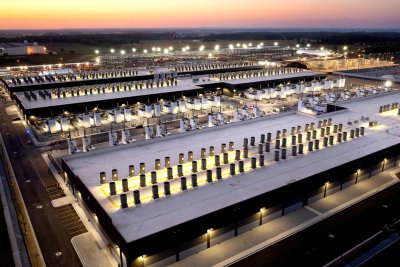
Microsoft shares traded lower on Monday following news of a 20-year natural-gas power supply agreement with Chevron for its massive data center campus in Pecos, Texas. The deal underscores a pivotal shift in the artificial intelligence investment narrative—from software demand to energy access—as investors weigh the capital intensity required to convert a $627 billion contracted demand backlog into realized cloud revenue.
The Pecos campus, which Microsoft describes as one of its largest capacity builds ever, will ultimately draw up to 2.67 gigawatts of dedicated power from Chevron's Project Kilby. GE Vernova turbines will supply the bulk of generation, with Caterpillar's Solar Turbines providing additional capacity. First power is expected in 2028, pending a final investment decision by year-end.
Microsoft's Azure cloud platform grew 40% in the latest quarter, while the company's AI business reached a $37 billion annual revenue run rate—up 123% year-over-year. Total revenue jumped 18% to $82.9 billion, and net income rose 23% to $31.8 billion. Yet the market's focus has narrowed to the cost of fulfilling that demand: capital spending on property and equipment hit $30.9 billion last quarter, depressing free cash flow to $15.8 billion.
CFO Amy Hood noted that demand continues to outstrip capacity across workloads, regions, and customer groups. Microsoft's commercial remaining performance obligation—contracted but not yet recognized revenue—stood at $627 billion, highlighting the scale of the infrastructure challenge. The company plans to invest several billion dollars in the Pecos site over five to seven years, with peak construction employing 6,000 workers.
The Chevron deal sharpens the debate over whether Microsoft's stock should be valued as a software company or an infrastructure play. Kevin Dempter of Renaissance Macro Research warned that software stocks overall could be forming a "massive topping pattern." Meanwhile, Simply Wall St's valuation analysis noted that Microsoft's trailing free cash flow of $93.7 billion supports a fair P/E ratio above the current level, suggesting the stock is undervalued—but only if capital spending translates into clear revenue gains.
Morgan Stanley estimates that leading tech companies, including Microsoft, have outlined over $700 billion in capital spending for 2026, a 69% jump from 2025. That surge has stoked investor fears of overbuilding. Risks also include a shareholder lawsuit filed in Seattle federal court alleging Microsoft misled investors about Azure growth and AI infrastructure costs; Microsoft has called the suit meritless.
The gas-fired nature of Project Kilby also raises questions about Microsoft's carbon commitments. While the company has pledged aggressive emissions reductions, the Pecos campus will generate power on site for direct use, bypassing the public grid. Chevron's Jeff Gustavson said the project can deliver power with "certainty, speed and at a competitive cost."
In the near term, Microsoft faces a clear test: Azure must sustain near-40% growth, Copilot seat counts need to rise, and cloud margins must hold steady as new capacity comes online. If capital spending continues to outpace revenue gains, the stock may continue to trade more like an infrastructure project than a software play, with margins under intense scrutiny.