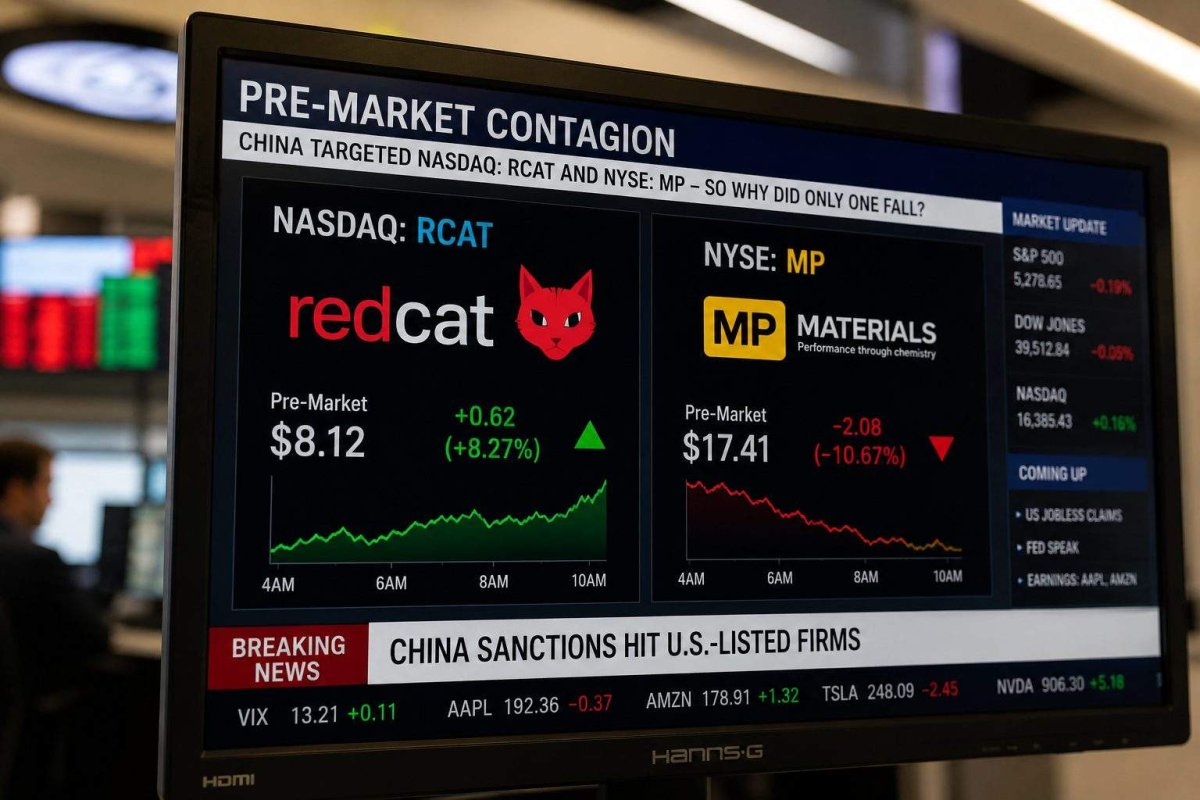
China's Commerce Ministry announced an immediate halt on dual-use exports to ten U.S. entities, including Red Cat Holdings (NASDAQ: RCAT) and its subsidiary Teal Drones, as well as MP Materials (NYSE: MP). The move, effective immediately, triggered divergent pre-market reactions as investors assessed each company's exposure to Chinese-origin components.
Pre-market trading saw RCAT shares slip 0.79% to $11.35 on thin volume of just 36,180 shares, representing only 0.16% of the 22.98 million shares traded in the last regular session. In contrast, MP Materials gained 1.02% to $61.50, reflecting the market's quick repricing based on actual supply-chain ties. The 1.81-percentage-point divergence highlights that the selloff was not uniform, as traders moved beyond the initial headline to evaluate real exposure.
MP Materials' rise is underpinned by its strategic shift away from China. The company stopped sending rare-earth concentrate to China in April 2025 and now processes nearly half its output at its California plant, with almost all sales outside China. The Pentagon, now MP's largest shareholder, supports a $110-per-kilogram NdPr price floor and a 10-year magnet supply deal. CEO James Litinsky emphasized the company's free-market approach while meeting national security needs. Monday's sanctions appear to reinforce MP's ex-China scarcity premium rather than threaten its sales.
Red Cat Holdings faces a different risk profile. Its annual filing notes that all parts come from third-party suppliers, with some parts available only from single or few sources, relying on factories in Asia and other regions. The filing does not specify whether Teal Drones uses any parts targeted by China's order, leaving a key uncertainty at the center of early price action. About 73% of Red Cat's fiscal 2025 revenue is tied to U.S. government contracts, and U.S. moves against Chinese drones have boosted demand for domestic makers, but supply-chain disruption remains a concern.
George Chen, partner for Greater China at The Asia Group, described the commercial impact as likely symbolic, noting that these companies do not do business in China. However, the risk of indirect exposure through third-country suppliers remains, as Beijing's transfer rule aims to close loopholes. The ban also includes a provision barring third parties from sending Chinese-origin controlled goods to listed entities, potentially affecting supply chains beyond direct imports.
The contagion risk extends beyond the main export list. China also blocked government purchases from 46 U.S. companies, including Lockheed Martin, Raytheon, and General Dynamics affiliates. Automated trading systems can react to both sets of moves, potentially impacting defense sector stocks and hedge models before the legal distinctions are fully sorted. The RCAT-MP spread underscores why details matter: one action blocks inputs, the other blocks sales to Chinese state buyers.
Looking ahead, the next key event for Red Cat is a sourcing disclosure clarifying whether any Chinese-controlled parts are in its supply chain. If management confirms the bill of materials is free of Chinese content, the early loss could reverse quickly. Conversely, if a critical Chinese-origin part cannot be swapped, the stock could test its recent low of $10.73, a 6.2% drop from the $11.44 close. MP Materials is set to present at the J.P. Morgan Natural Resources Conference on June 23, offering an early test of the market's bullish reaction.
China's Announcement No. 23 of 2026 added 10 U.S. entities to its export-control list, effective immediately. The thin pre-market trading volumes for both stocks—RCAT with 36,180 shares and MP with comparable count but higher dollar value—suggest that early price moves may not fully reflect the fundamentals. As investors await more details from both companies, the divergence in pre-market action serves as a reminder that supply-chain risk is not evenly distributed.