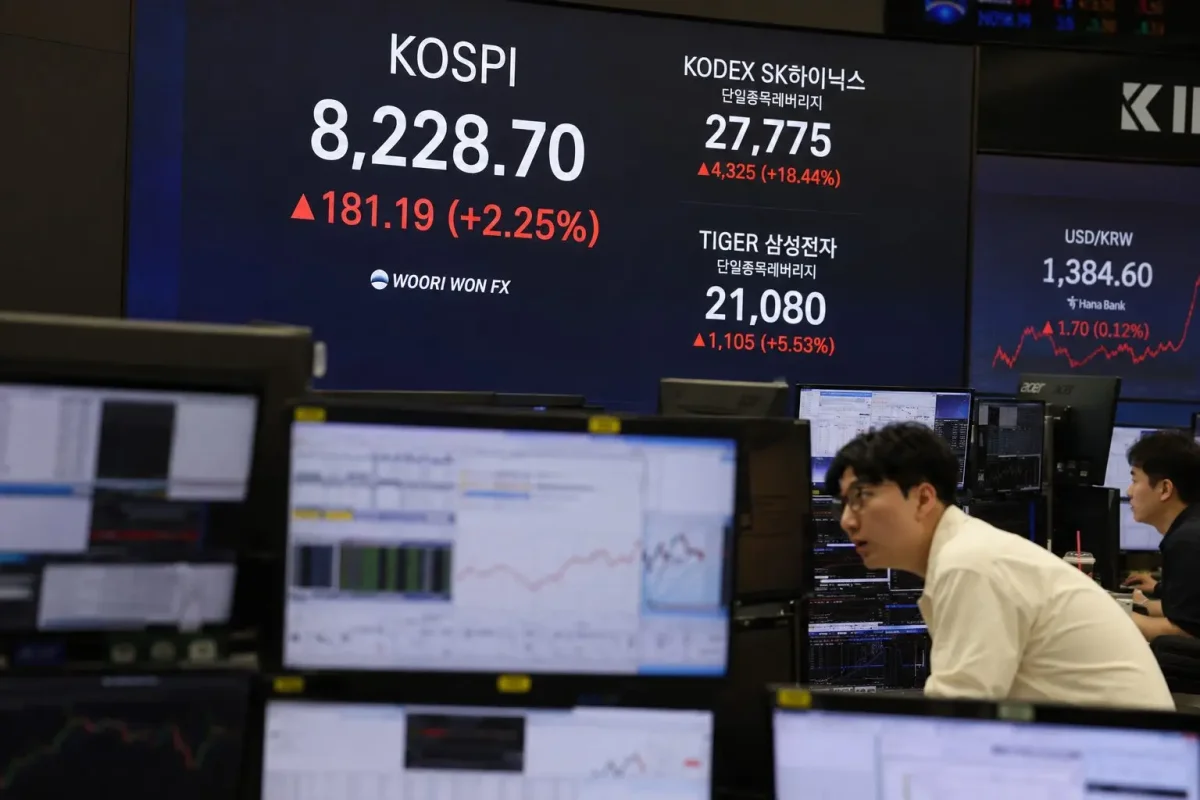
The KOSPI index closed sharply lower on Monday, July 20, 2026, falling 4.46% to 6,516.27, as a sharp sell-off in the country's two largest chipmakers significantly weighed on the benchmark. Samsung Electronics (KRX:005930) and SK Hynix (KRX:000660) together accounted for 50.33% of the index's total market value at the close, underscoring a growing concentration risk exacerbated by leveraged ETF unwinding.
Initial estimates indicate that the two stocks contributed 2.15 percentage points to the index's total decline of 304.33 points, representing 48.2% of the day's drop. Samsung Electronics fell 4.31% to 244,000 won, while SK Hynix declined 4.23% to 1,764,000 won. Both stocks have experienced significant drawdowns from their June highs, with Samsung down approximately 34% and SK Hynix off about 40%.
ETF Mechanics Amplify Pressure
The concentration of index weight in these two memory-chip stocks has altered the risk profile of passive investment vehicles. KOSPI index trackers now carry a substantial implicit exposure to the semiconductor sector, without investors having to select individual names. The daily reset mechanism of leveraged ETFs compounds this effect, as these funds are forced to buy after gains and sell after losses, with a significant portion of trading activity concentrated near the market close.
Goldman Sachs (NYSE:GS) reported that assets in leveraged ETFs linked to Samsung and SK Hynix stood at $28 billion as of Thursday, down sharply from a peak of $53 billion on June 22. Two-thirds of these holdings remain in onshore funds, leaving the market vulnerable to further forced selling if the downturn continues.
Institutional Flows Paint Complex Picture
Despite the sharp decline, foreign investors were net buyers on Monday, purchasing a total of 523.5 billion won in Korean equities, including 887 billion won in the leading chip stocks. This runs counter to narratives of a broad foreign exodus. Instead, institutional investors were the primary sellers, offloading 921.7 billion won. The divergence suggests that domestic leveraged products and institutional de-risking, rather than foreign panic, are driving the current weakness.
The previous week was particularly harsh for the KOSPI, which dropped 8.8% over four trading days. The index fell 8.95% on Monday and another 6.37% on Thursday, with only temporary mid-week recoveries. Markets were closed on Friday for Constitution Day.
Regulatory and Risk Considerations
Retail investors remain exposed, with margin loans totaling 34.37 trillion won as of July 15, down from an all-time high of 38.63 trillion won. Overall investor debt exceeded 60 trillion won at the end of May. "The risk is asymmetric," said Inki Cho, senior strategist at Exness. "Leverage accelerates losses more rapidly than gains during price fluctuations."
In response to market instability, authorities temporarily paused new listings last week. Starting August 5, the minimum required cash balance for margin trading will triple to 30 million won, and in November, the minimum trading lot will increase to 20 from the current one. President Lee Jae Myung described the market as "quite unstable" on July 15 and urged regulators and the exchange to prepare additional measures as part of his broader effort to advance market development.
Valuations and Outlook
Despite the sell-off, valuations remain attractive. Each chipmaker's shares trade at under five times estimated earnings, which may draw value-oriented investors. However, the daily rebalancing of leveraged ETFs continues to exert pressure independent of fundamentals. Upcoming earnings reports from SK Hynix on July 29 and Samsung on July 30 could provide catalysts, but the pace of the market will also depend on closing-auction volume and margin debt levels.
Risks are present on both sides. A recovery in chip stocks could force leveraged funds to buy near the close, potentially accelerating a rebound. Conversely, additional margin calls or stricter limits might intensify the sell-off. The coming days will be critical for the KOSPI as it navigates this period of elevated concentration and leverage.